

Remember when buying Bitcoin felt like a wild gamble with no safety net? Those days are officially over. By May 2026, the global landscape for Cryptocurrency is a digital asset system governed by increasingly strict national and international laws designed to protect investors and ensure financial stability has shifted dramatically. Governments aren't just watching anymore; they are actively shaping how you buy, sell, and hold digital assets. Whether you are a retail trader in London or an institutional investor in New York, understanding these rules isn't optional-it's survival.
The era of regulatory ambiguity is closing fast. With frameworks like the European Union’s MiCA fully active and new U.S. legislation taking shape, the question is no longer 'if' you need to comply, but 'how.' This guide breaks down exactly what these regulations mean for your wallet, your business, and the future of the crypto market.
Key Takeaways
- MiCA is live: The EU’s Markets in Crypto-Assets regulation is fully effective, requiring all service providers to be authorized and stablecoins to have 100% reserve backing.
- U.S. clarity emerges: The GENIUS Act (July 2025) now mandates full reserves and audits for dollar-pegged stablecoins, while the CLARITY Act distinguishes between securities and commodities.
- Institutional boom: Jurisdictions with clear rules see a 37% higher adoption rate from institutions compared to fragmented markets.
- Compliance costs rise: Expect higher barriers to entry, such as the $100 million capital requirement for U.S. stablecoin issuers, which has already forced smaller players out.
- Global alignment: 95% of jurisdictions have adopted at least some FSB recommendations, signaling a move toward standardized global oversight.
The End of the Wild West: Why Regulation Matters Now
For years, crypto operated in a gray zone. That changed rapidly after the 2017-2018 boom exposed massive risks. Today, the Financial Stability Board (FSB) is an international body that monitors the global financial system and makes recommendations about financial regulatory issues reports that 95% of jurisdictions have implemented at least some elements of their crypto-asset framework. This isn't just bureaucracy; it’s about trust.
When regulations are clear, money flows. Data shows a 37% increase in institutional crypto adoption in places with fully implemented frameworks compared to those with patchwork rules. Why? Because banks and hedge funds can’t risk operating in legal vacuums. They need to know their assets are protected and their transactions are legal. If you’re holding onto crypto hoping for total anonymity, you might want to rethink your strategy. The focus has shifted from hiding value to securing it within legal boundaries.
Europe Leads with MiCA: A Unified Approach
If you are operating in or serving customers in Europe, the Markets in Crypto-Assets (MiCA) is a comprehensive regulatory framework established by the European Union to govern crypto-assets and their service providers is your bible. Fully effective since December 2024, MiCA created a single set of rules for all 27 member states. No more navigating different laws in France, Germany, and Italy.
Here is what MiCA demands:
- Authorization: Every crypto-asset service provider must get a license from a national regulator.
- Stablecoin Reserves: Issuers must back 100% of issued stablecoins with cash or equivalent assets. You can’t just promise redemption; you must prove it.
- Capital Requirements: Stablecoin issuers need at least €2 million in initial capital.
The result? Certainty. Businesses love this because one license covers the whole EU. However, innovation takes a hit. The European Securities and Markets Authority reports an average approval time of 28 days for new stablecoins, compared to Singapore’s lightning-fast 14-day process. It’s slower, but it’s safer.
The U.S. Shifts Gears: GENIUS, CLARITY, and Project Crypto
The United States has historically been a mess of overlapping agencies-the SEC, the CFTC, and state regulators all fighting for jurisdiction. But 2025 brought significant changes. Three major developments reshaped the American landscape:
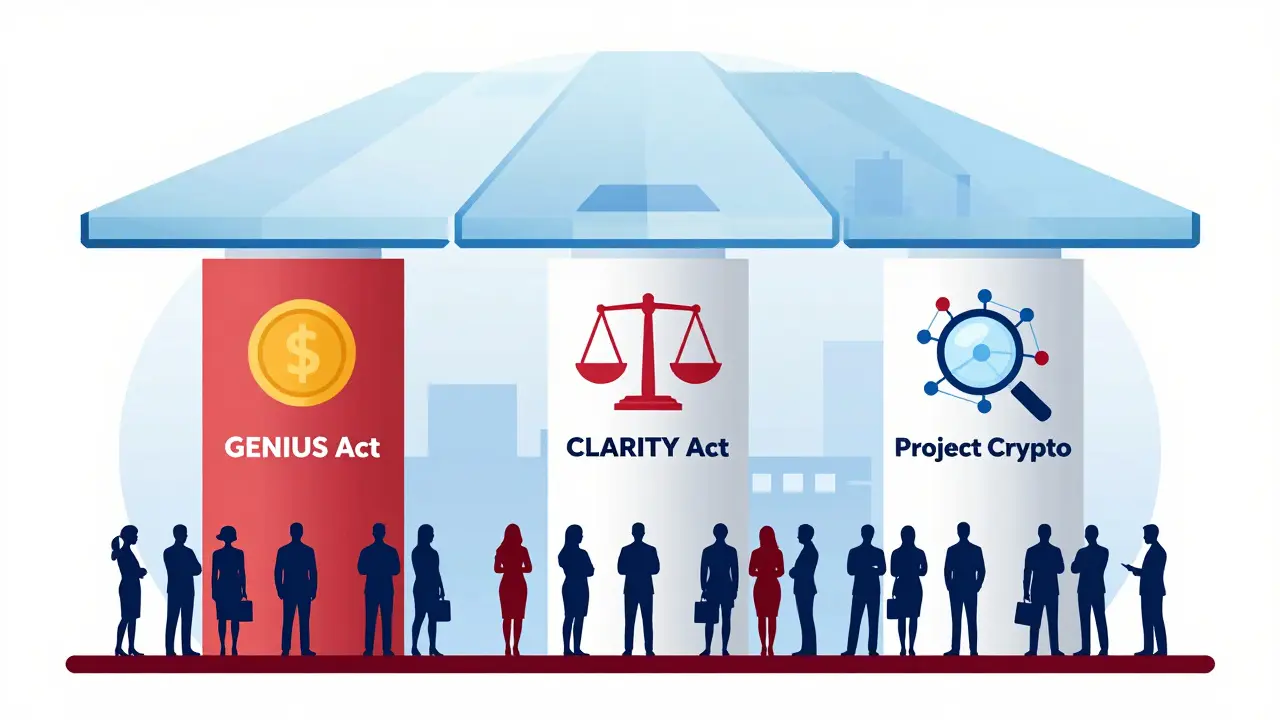
- The GENIUS Act (Signed July 15, 2025): This law focuses on payment stablecoins. It requires 100% reserve backing for USD-pegged tokens and monthly third-party audits by PCAOB-registered firms. It also sets a $100 million minimum capital requirement. Big players like Circle thrive here; smaller startups are struggling. In fact, 23 smaller stablecoin projects shut down between July and October 2025 because they couldn’t meet these hurdles.
- The CLARITY Act (Passed House June 18, 2025): Still pending Senate action, this bill aims to stop the endless debate over whether a token is a security or a commodity. It suggests that if a crypto meets five criteria-including decentralized governance and over $1 billion in daily trading volume-it qualifies as a commodity. This would move many assets out of the SEC’s harsh enforcement scope and into the CFTC’s purview.
- SEC’s Project Crypto (Launched March 3, 2025): Marking a sharp turn from previous years, SEC Chair Gary Gensler stated that 'most crypto assets are not securities.' The new guidelines use specific metrics, like having 1,000 independent validators and 10,000 unique wallets for governance tokens, to determine decentralization. This brings much-needed relief to developers who were previously targeted for minor technical choices.
Despite this progress, the U.S. remains fragmented. The Anti-CBDC Surveillance State Act (passed House July 2025) blocks the Federal Reserve from issuing a public central bank digital currency without Congress’s explicit permission, highlighting ongoing political tensions around digital money.
Comparing Global Regulatory Models
| Jurisdiction | Primary Framework | Stablecoin Reserve Req. | Approach Style | Key Challenge |
|---|---|---|---|---|
| European Union | MiCA | 100% | Unified, Comprehensive | Slower approval times (avg. 28 days) |
| United States | GENIUS / CLARITY Acts | 100% (for USD pegged) | Fragmented, Evolving | High capital barriers ($100M min.) |
| Singapore | MAS Framework | Strict Liquidity Rules | Progressive, Efficient | Small market size |
| Japan | FSA Licensing Regime | Segregated Assets | Early Adopter, Strict | High compliance costs |
| China | Ban | N/A | Prohibitive | Zero tolerance for transactions/mining |
Notice the divergence. While the EU and U.S. move toward stricter consumer protection, countries like Singapore balance efficiency with oversight. Japan, having started early in 2017, requires exchanges to hold ¥100 million ($680,000) in capital and monitor transactions with 99.5% accuracy for suspicious activity. China remains an outlier, banning all crypto activities entirely-a move that pushed 20% of global mining hash rate elsewhere.
Impact on You: Adoption, Risks, and Opportunities
How does this affect your daily life? First, safety. According to IOSCO, 42% of retail investors lost money due to fraud or platform failures in unregulated regions. With regulations like MiCA and the GENIUS Act, custodial standards are rising. Trustpilot reviews show a 0.8-point rating increase for exchanges in regulated jurisdictions.
However, convenience might decrease slightly. You will likely face stricter KYC (Know Your Customer) checks. Anonymity is dying. On-chain analysis tools are becoming standard for compliance officers, making it harder to hide illicit transactions. For legitimate users, this means faster access to traditional banking rails. Institutional custody solutions have grown to $127 billion in assets under management, proving that big money wants in-but only where it’s safe.
Market data reflects this shift. Chainalysis’ 2025 Global Crypto Adoption Index shows India and the U.S. leading growth, despite different regulatory paths. Stablecoin volumes are exploding under clear rules: EURC (Circle’s euro stablecoin) grew 76% month-over-month after MiCA implementation, showing that regulation doesn’t kill demand-it channels it.
Practical Steps for Compliance and Safety
If you run a business or manage significant assets, here is how to navigate the new world:
- Check Your Jurisdiction: Know if you fall under MiCA, U.S. federal/state laws, or other local rules. Ignorance is not a defense.
- Audit Your Reserves: If you issue or heavily rely on stablecoins, ensure they are backed 1:1 by transparent, audited reserves. Hidden liabilities are now illegal in most major markets.
- Prepare for Documentation: Expect lengthy application processes. EU providers need 17 distinct components for authorization. Start gathering legal and financial docs early.
- Hire Specialized Help: Crypto compliance officers earn 28% more than traditional finance counterparts ($142k vs $111k). They are worth every penny given the complexity of evolving laws.
- Monitor DeFi Gaps: As of mid-2025, 68% of jurisdictions lack specific DeFi regulations. This is a high-risk area. Assume future rules will target protocol operators, not just centralized exchanges.
The learning curve is steep. Deloitte reports it takes businesses an average of 8.2 months to achieve full MiCA compliance, versus 14.7 months in the fragmented U.S. system. Don’t rush. Get it right the first time.
What Comes Next?
The trend is clear: harmonization. The FSB predicts that by 2027, 80% of major economies will align their stablecoin rules with its recommendations. We are moving from a 'Wild West' model to a integrated part of the global financial system. By 2027, 92% of global crypto trading volume is expected to occur on regulated platforms.
For now, stay informed. The laws are still settling, especially in the U.S. where the CLARITY Act awaits Senate approval. But one thing is certain: the days of operating without oversight are gone. Adapt, comply, and thrive in the new era of trusted digital assets.
Is cryptocurrency legal in the United States in 2026?
Yes, cryptocurrency is legal in the U.S., but it is heavily regulated. The GENIUS Act and recent SEC guidelines provide clearer rules for stablecoins and asset classification. However, you must comply with anti-money laundering laws and tax reporting requirements. Operating without proper licenses can lead to severe penalties.
What is MiCA and how does it affect me?
MiCA (Markets in Crypto-Assets) is the EU’s unified regulatory framework. If you live in or do business with the EU, you must use licensed service providers. For consumers, it means stronger protections against fraud and insolvent exchanges. For businesses, it requires obtaining authorization and meeting strict capital and reserve requirements.
Do I need to pay taxes on my crypto holdings?
In most jurisdictions, yes. Holding crypto itself may not trigger a tax event, but selling, trading, or spending it usually does. Regulations like MiCA and U.S. laws require exchanges to report transaction data to authorities, making non-compliance much harder. Always consult a local tax professional.
Can I still use anonymous cryptocurrencies?
It is becoming increasingly difficult. Many regulated exchanges delist privacy-focused coins like Monero to comply with KYC/AML laws. While using them isn’t always illegal, accessing them through regulated platforms is rare. Unregulated peer-to-peer options carry higher risks of fraud and legal scrutiny.
What happens if a stablecoin issuer fails?
Under new regulations like the GENIUS Act and MiCA, stablecoin issuers must maintain 100% reserves and undergo regular audits. This significantly reduces the risk of collapse. However, if an issuer fails, recovery depends on the legal structure of the reserve assets. Always check if your stablecoin is regulated and backed by transparent, liquid assets.
Author
Ronan Caverly
I'm a blockchain analyst and market strategist bridging crypto and equities. I research protocols, decode tokenomics, and track exchange flows to spot risk and opportunity. I invest privately and advise fintech teams on go-to-market and compliance-aware growth. I also publish weekly insights to help retail and funds navigate digital asset cycles.