
Staking Rewards Calculator
Calculate your potential staking rewards using APY (Annual Percentage Yield) to see the true value of compounding interest. Enter your staked amount, APY percentage, compounding frequency, and duration to see how your investment grows over time.
Staking Inputs
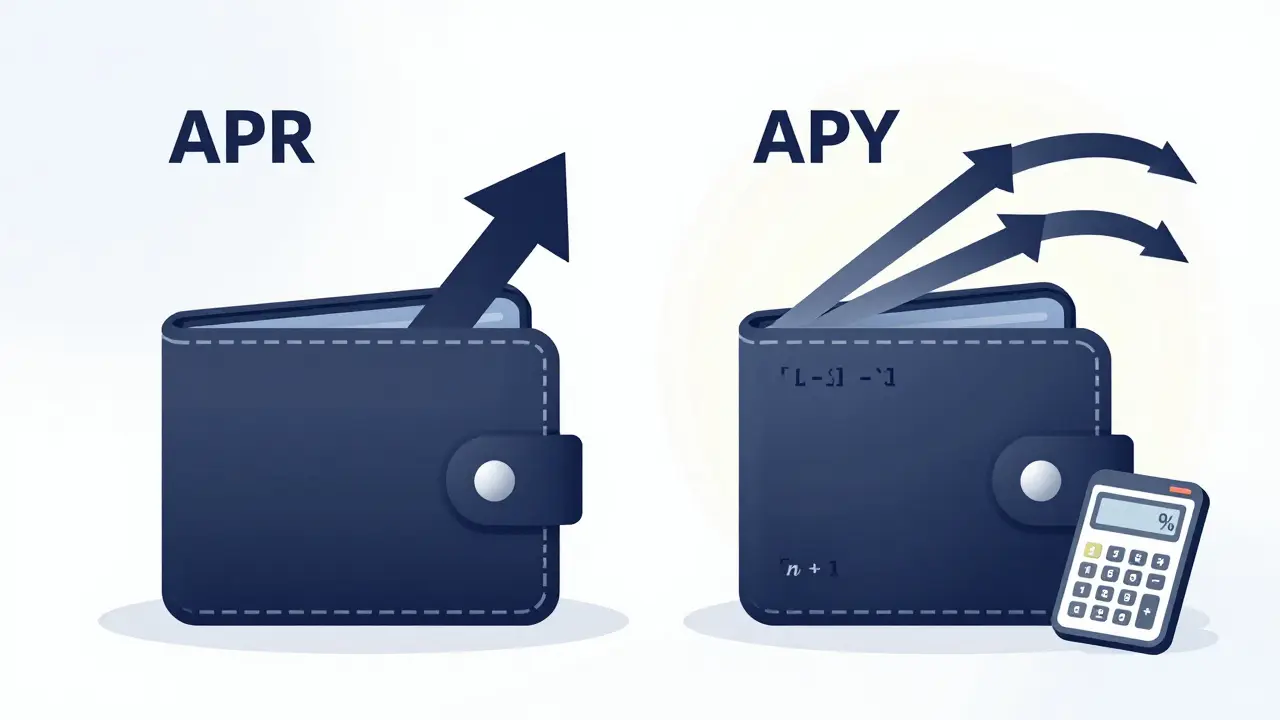
APY vs APR Explained
The same amount at 5% APR earns $500 in a year.
Your Staking Results
When you stake cryptocurrency, you’re not just holding it-you’re earning more. But how much more? That’s where APY comes in. It’s the number you see on every staking platform: 4.5%, 7.2%, 12%. It sounds simple. But if you don’t understand what it really means, you could be guessing your returns-and losing money because of it.
What APY Really Means (And Why APR Doesn’t Cut It)
APY stands for Annual Percentage Yield. It’s not just a fancy term. It’s the actual amount of crypto you’ll earn in a year, including the effect of compounding. That means your rewards get reinvested, and then those new rewards earn more too. It’s like interest on interest. APR-Annual Percentage Rate-is different. APR ignores compounding. It’s a flat rate. If a platform says 5% APR, you get 5% of your staked amount once a year, no more. But if they say 5% APY, you’re getting more than 5% because your rewards are being added back into your stake over time. Here’s the real difference:- Stake $5,000 at 5% APR for a year: You earn $250. Total: $5,250.
- Stake $5,000 at 5% APY with daily compounding: You earn $253.15. Total: $5,253.15.
How APY Is Calculated (The Math Behind the Numbers)
The formula looks scary, but it’s not. Here it is:APY = [1 + (r ÷ n)]n - 1
- r = the nominal interest rate (like 5% or 0.05)
- n = how often rewards are compounded per year (daily = 365, monthly = 12, weekly = 52)
APY = [1 + (0.048 ÷ 12)]12 - 1
APY = [1 + 0.004]12 - 1
APY = [1.04907] - 1 = 0.04907 → 4.91% APY
So even though the platform says “4.8%,” you’re actually earning 4.91% because your rewards are compounding every month. That’s why APY is always higher than the stated rate.What Affects Your Staking APY?
Your APY isn’t set in stone. It changes. Here’s what moves the needle:- Network demand: If more people start staking Ethereum, the reward per validator drops. More stakers = smaller slices of the pie.
- Protocol updates: Ethereum’s staking rewards changed after the Merge. New rules mean new APYs. Same with Solana, Cardano, Polkadot.
- Validator performance: If the node you’re staking with goes offline, you lose rewards. Some platforms guarantee uptime, others don’t.
- Platform fees: Coinbase, Kraken, or Lido take a cut. A 5% APY from a platform might be 6% from the network-after fees, you get 4.8%.
- Market volatility: APY is quoted in crypto terms, but your dollar value changes with price. If ETH drops 20%, your $100 reward is now worth $80.
Real-World Example: Staking ETH Right Now
As of December 2025, Ethereum’s network APY hovers around 3.2% after fees. Let’s say you stake 3 ETH.- ETH price: $1,811.16
- Staked amount: 3 ETH = $5,433.48
- APY: 3.2%
Annual reward in USD: $5,433.48 × 0.032 = $173.87
Monthly reward: $173.87 ÷ 12 = $14.49 Now, if you stake on a platform that auto-compounds daily, your actual return is slightly higher-maybe 3.25% APY. That’s an extra $1.60 a year. Doesn’t sound like much? Now imagine staking 100 ETH. That’s $160 extra. And if you hold for five years? That’s over $1,000 in extra earnings from compounding alone.
Auto-Compounding: Why It’s the Game Changer
Most DeFi staking platforms-like Lido, Rocket Pool, or Aave-auto-compound your rewards. That means every time you earn a reward, it’s automatically added to your stake. You don’t have to claim it. You don’t have to re-stake it. It just grows. That’s why APY matters so much here. If a platform uses APR, you’re missing out. If they use APY, you’re getting the real return. Take a DeFi protocol offering 8% APY with daily compounding. That’s 8% on your growing balance every day. Over a year, your $10,000 becomes $10,832.87. If it were APR, you’d only get $10,800. That $32.87 difference? That’s the power of automation.How to Use a Staking Calculator (And What to Watch Out For)
Staking calculators are everywhere. Coinbase, Nansen, DefiLlama-they all have them. But not all are equal. Here’s what to input:- Amount staked (in crypto or USD)
- APY (not APR)
- Compounding frequency (daily, weekly, monthly)
- Staking duration (1 month, 1 year, 5 years)
- Platforms quoting APR as APY. Double-check the fine print.
- Hidden fees. Some platforms charge 10-20% of your rewards. That cuts your APY fast.
- Lock-up periods. If you can’t withdraw for 21 days or 3 months, your liquidity is gone. Is the APY worth that?
- Price swings. A 10% APY sounds amazing-if ETH stays at $2,000. If it drops to $1,200, your returns are worth less.
APY vs. APR: When to Care and When to Ignore
You’ll see both. Here’s how to tell which one matters:- Use APY if rewards are auto-compounded (DeFi, staking pools, liquid staking).
- Use APR if you get paid once a month or quarter and you manually re-stake.
- Ignore both if the platform doesn’t say how often rewards compound. That’s a red flag.

What You Should Do Right Now
Don’t just pick the highest APY. That’s how people get burned. Here’s your checklist:- Find the APY after fees. Look for “net APY” or “estimated yield after fees.”
- Check compounding frequency. Daily is best. Monthly is okay. Quarterly? Avoid.
- Read the lock-up terms. Can you withdraw anytime? Or is it 7 days? 30 days?
- Verify the platform’s reputation. Has it been hacked? Are validators reputable?
- Use a calculator. Plug in your amount, APY, and duration. See what you’ll really earn.
What Happens If APY Drops?
Ethereum’s APY dropped from 8% in 2022 to 3.2% in 2025. Why? More people staked. More ETH in the system. Rewards got diluted. That’s normal. It’s not a failure. It’s the market adjusting. The key is to stay in. Don’t panic-sell because the APY went from 6% to 4%. Your rewards still compound. Your stake still earns. And if ETH price goes up? Your returns become even more valuable.Final Thought: APY Is a Tool, Not a Promise
APY tells you the potential. It doesn’t guarantee it. But it’s the only fair way to compare staking options. Use it. Understand it. Don’t let platforms hide behind APR. The best stakers aren’t the ones chasing the highest number. They’re the ones who know how the math works-and who stick with it through the ups and downs.What’s the difference between APY and APR in crypto staking?
APR (Annual Percentage Rate) is the simple interest rate you earn on your staked crypto, without compounding. APY (Annual Percentage Yield) includes compounding-meaning your rewards are reinvested, and those new rewards earn more too. So APY is always higher than APR when rewards compound more than once a year. For example, 5% APR equals about 5.12% APY with monthly compounding.
How do I calculate my staking rewards manually?
Use the formula: APY = [1 + (r ÷ n)]n - 1, where r is the nominal rate (e.g., 0.05 for 5%) and n is the number of compounding periods per year. For daily compounding, n = 365. Multiply your staked amount by the APY to get your annual return. For example, $1,000 at 5% APY = $1,051.27 after one year with daily compounding.
Why does my staking APY change over time?
APY changes because it’s tied to network conditions. If more people start staking, rewards get split thinner. Protocol upgrades, validator performance, and network activity all affect how much is distributed. Also, platforms may adjust fees. That’s why you’ll often see “estimated APY”-it’s not locked in.
Should I always choose the highest APY available?
No. High APY often comes with high risk. Some platforms offer 15%+ APY but have poor security, long lock-ups, or hidden fees. Always check: Is the APY after fees? Is there a withdrawal penalty? Has the platform been audited? A 6% APY from a trusted exchange is safer than 12% from an unknown DeFi protocol.
Does compounding frequency really make that much difference?
Yes. On a $10,000 stake at 5% APY, daily compounding earns you $512.67 in a year. Monthly compounding earns $511.62. Simple interest (APR) earns $500. That $12.67 difference might seem small, but over five years, it adds up to over $70 extra. And with larger stakes, it becomes thousands.
Can I lose money even if I’m staking?
Yes. If the price of your staked crypto drops, your rewards are worth less in USD-even if you earned more crypto. Also, some platforms have slashing penalties if validators misbehave. And if you lock your funds and the market crashes, you can’t sell. Staking earns rewards, but it doesn’t protect against market risk.
Is staking on an exchange safer than a DeFi protocol?
Generally, yes. Exchanges like Coinbase or Kraken are regulated, have insurance, and handle staking for you. DeFi protocols offer higher APYs but require you to manage your own keys and trust smart contracts. A hack or bug in a DeFi contract can mean lost funds. If you’re new, start with a trusted exchange. Learn first, then explore DeFi.


Author
Ronan Caverly
I'm a blockchain analyst and market strategist bridging crypto and equities. I research protocols, decode tokenomics, and track exchange flows to spot risk and opportunity. I invest privately and advise fintech teams on go-to-market and compliance-aware growth. I also publish weekly insights to help retail and funds navigate digital asset cycles.