
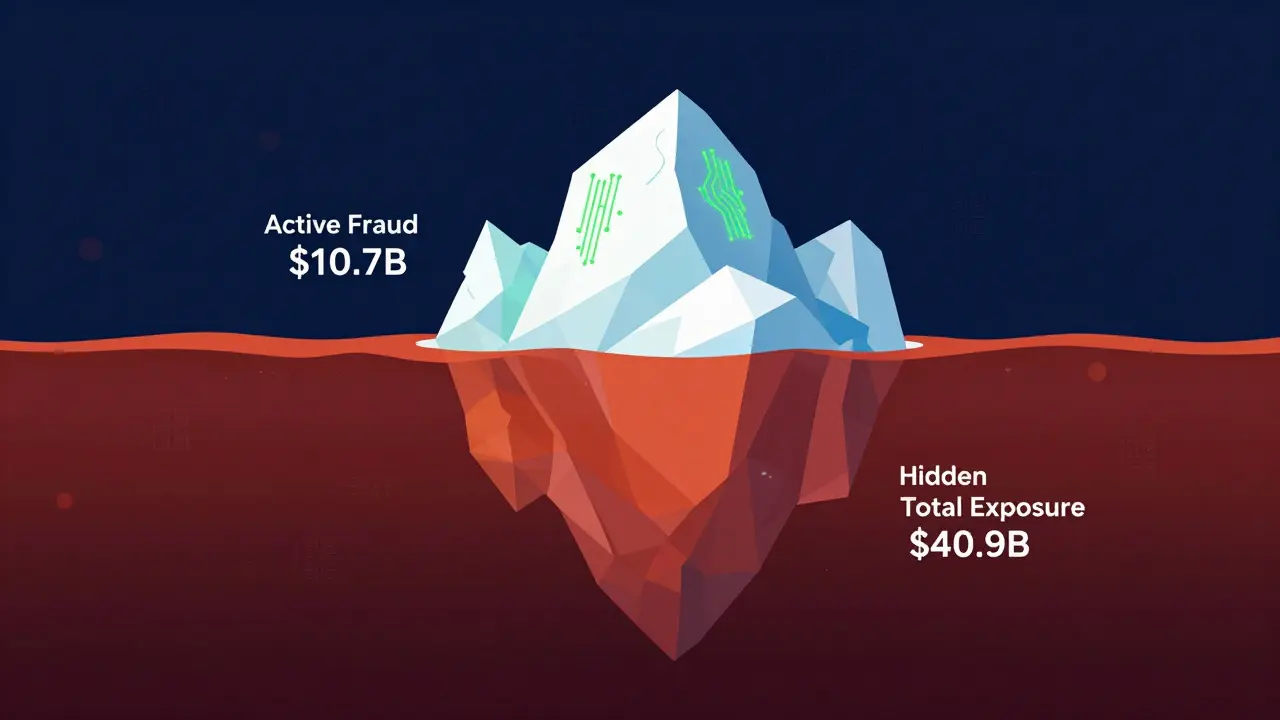
The numbers behind crypto crime are messy, but the trend is clear. In 2024, global regulators stopped just talking about rules and started enforcing them with teeth. Whether you look at the $10.7 billion in fraud funds identified by TRM Labs or the much higher $40.9 billion figure from Chainalysis, one thing stands out: the era of the wild west is over. The difference in these numbers isn’t a mistake-it’s a methodological split that tells us exactly where criminals are hiding and how hard it is to catch them.
If you’re navigating the digital asset space in 2026, understanding these enforcement stats isn’t just academic. It’s survival. Regulators aren’t targeting everyone equally. They are focusing on specific blockchains, specific crimes, and specific jurisdictions. Here is what the data from 2024 and early 2025 actually means for your business, your investments, and your compliance strategy.
The Great Discrepancy: How Much Crypto Crime Is There?
You will see two very different numbers when you search for 2024 crypto crime stats. This confuses most people, so let’s break it down simply.
TRM Labs’ Perspective: Their 2025 Crypto Crime Report, published in January 2025, states that illicit crypto activity sent to fraud amounted to $10.7 billion. This is a 40% drop from 2023. They focus specifically on funds *sent* to known fraud addresses. Because they track the destination, their numbers tend to be lower and show a declining trend as enforcement improves.
Chainalysis’ Perspective: Their 2025 Crypto Crime Report, released in February 2025, reports $40.9 billion received by illicit addresses in 2024. They count all illicit activity, including darknet markets, scams, and ransomware. Crucially, Chainalysis notes that their figures typically grow by about 25% each year after publication as they identify more hidden addresses. For example, their 2023 estimate grew from $24.2 billion to $46.1 billion within a single year.
So, which number is right? Both are. TRM shows you the tip of the iceberg (active fraud flows), while Chainalysis shows you the whole mountain (total exposure). For compliance officers, this means you should prepare for the higher number. If you build your risk models around $10 billion, you might be underprepared for the $40 billion reality.
Where Criminals Hide: The Blockchain Breakdown
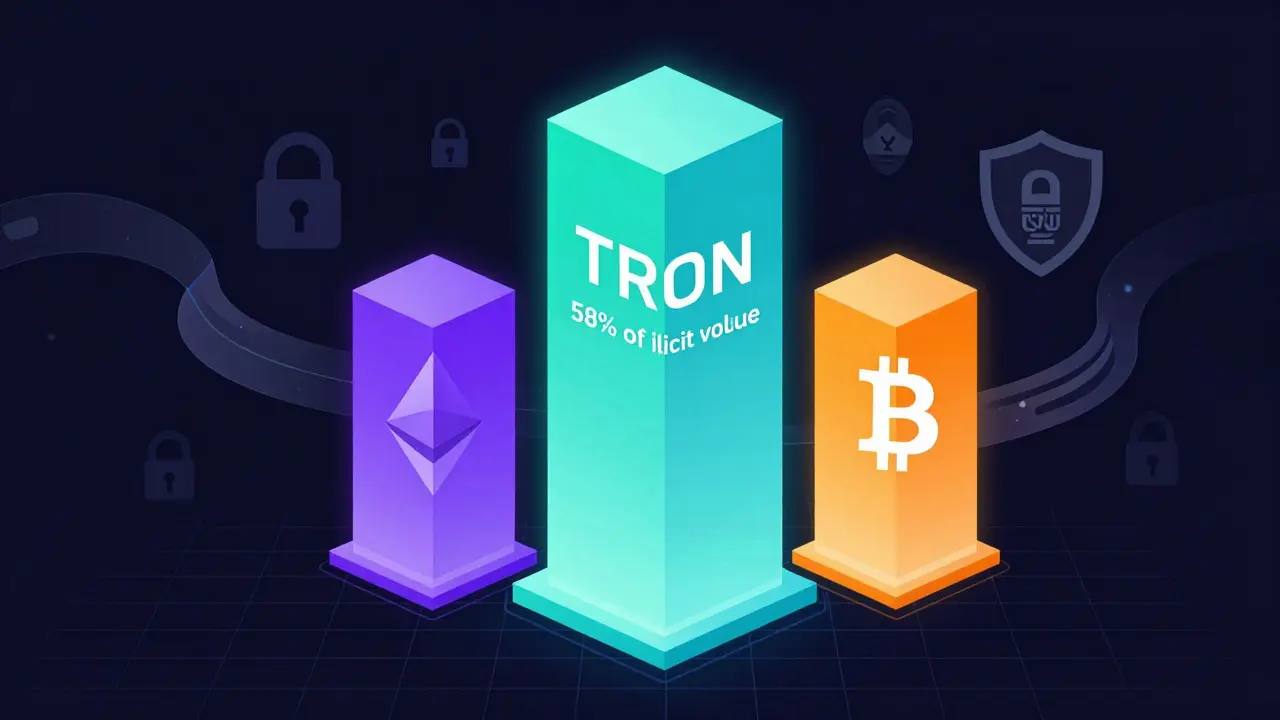
Criminals don’t pick blockchains based on ideology; they pick them based on cost and speed. The 2024 data reveals a stark hierarchy of illicit activity across networks.
| Blockchain | Share of Illicit Volume | Key Driver |
|---|---|---|
| TRON | 58% | Low fees, high USDT usage |
| Ethereum | 24% | Smart contracts, DeFi complexity |
| Bitcoin | 12% | Liquidity, legacy status |
| Binance Smart Chain | 3% | Altcoin trading |
| Polygon | 3% | Ethereum scaling |
TRON dominated the illicit landscape in 2024, hosting more than half of all bad money. Why? Because it’s cheap to move large amounts of Tether (USDT) there. But here is the good news: TRON saw the biggest drop in illicit volume, falling by $6 billion. Why? Because of the T3 Financial Crime Unit (T3 FCU).
The T3 FCU is a partnership between TRON, Tether, and TRM Labs. Since launching in August 2024, they have frozen over $130 million in illicit proceeds. About 20% of blocklisted USDT on TRON was reissued directly to victims and government accounts. This proves that public-private partnerships work. If you operate on TRON, expect stricter monitoring. If you operate elsewhere, expect similar units to form soon.
Regulatory Reality: Paper Rules vs. Actual Enforcement
In 2024, over 60% of major jurisdictions introduced new crypto policies. That sounds like progress, right? Not quite. The gap between writing a law and enforcing it is massive.
The Financial Action Task Force (FATF) assessed 58 jurisdictions in March 2024. While 91% had enacted Anti-Money Laundering (AML) registration regimes, only 84% had implemented the Travel Rule. The Travel Rule requires exchanges to share sender and receiver information for cross-border transactions. Without it, money moves in the dark.
A PwC Global Crypto Regulation Report from January 2025 revealed that 75% of surveyed jurisdictions remain only partially compliant or non-compliant with FATF requirements. Nearly 30% still fail to implement the Travel Rule entirely. This creates a "compliance arbitrage" where criminals move funds through lax jurisdictions before entering stricter ones.
For businesses, this means you cannot rely on your partner exchange being compliant. You must perform your own due diligence. If you send funds to an exchange in a jurisdiction without the Travel Rule, you are taking on significant regulatory risk, regardless of your own local laws.
Fines and Penalties: Crypto vs. Traditional Finance
There is a myth that crypto is heavily fined compared to banks. The data says otherwise. According to the Coincub Crypto Asset Risk Report 2025, the entire crypto industry faced aggregate penalties of $13.5 billion between 2020 and early 2025. This includes formal sanctions, fines, and security incidents.
Compare that to traditional finance. Just Bank of America and JPMorgan Chase have faced penalties exceeding $97 billion collectively. The broader financial services sector has incurred over $300 billion in fines.
However, the *pattern* of enforcement is different. In crypto, 72% of enforcement actions are for regulatory compliance failures, not systemic fraud. Regulators are using fines to force companies into compliance frameworks rather than punishing them for bad behavior alone. This suggests that future fines will be frequent but manageable if you stay ahead of the curve. Don’t wait for the first fine. Build the framework now.
2025 Outlook: What Comes Next?
We are already halfway through 2025, and the trends are accelerating. Kroll Cyber Threat Intelligence reported that nearly $1.93 billion was stolen in crypto-related crimes in the first half of 2025 alone. This shows that while overall fraud volumes may dip in some categories, sophisticated attacks are persisting.
Here is what you need to watch for in the second half of 2025:
- Stablecoins and DeFi: 68% of regulatory bodies plan specific guidance for stablecoins and Decentralized Finance (DeFi) protocols by Q3 2025. These were previously gray areas; they are now red zones.
- Cross-Border Cooperation: International enforcement cooperation is improving. Norton Rose Fulbright predicts significantly better cross-border asset recovery mechanisms in 2025. If you lose funds to fraud, chances of recovery are slightly better than in 2024, but still low.
- User Base Growth: The global crypto user base is projected to surpass 950 million by the end of 2025. More users mean more targets for scammers and more pressure on regulators to act.
The T3 FCU model is likely to expand. Expect other major chains to launch similar financial crime units. Platforms that proactively freeze illicit funds will gain regulatory goodwill. Those that don’t will face existential threats.
Actionable Takeaways for Your Business
Data is useless without action. Here is how to apply these 2024-2025 enforcement statistics to your operations:
- Monitor TRON and Ethereum Closely: If you handle assets on these chains, implement enhanced due diligence. They host the majority of illicit volume.
- Verify Travel Rule Compliance: Do not assume your counterparties are compliant. Check if their jurisdiction enforces the Travel Rule. If not, treat transactions with extra caution.
- Prepare for DeFi Regulations: If you use DeFi protocols, start documenting your interactions. Regulators are coming for smart contract interactions next.
- Invest in Public-Private Partnerships: Join industry groups that collaborate with law enforcement. Being part of the solution protects you from being targeted as the problem.
- Update Your Risk Models: Use the higher Chainalysis estimates ($40.9 billion+) for worst-case scenario planning. It’s better to be over-prepared than under-insured.
The crypto enforcement landscape is maturing. The days of ignoring compliance are gone. The data shows that criminals are adapting, regulators are getting smarter, and the tools to fight back are improving. Stay informed, stay compliant, and stay safe.
Why do TRM Labs and Chainalysis report such different crypto crime numbers?
TRM Labs focuses on funds specifically sent to known fraud addresses, resulting in a lower figure ($10.7 billion in 2024). Chainalysis uses a broader definition that includes all illicit activity like darknet markets and ransomware, leading to a higher figure ($40.9 billion). Additionally, Chainalysis updates its estimates annually as more illicit addresses are identified, often increasing previous years' totals by ~25%. Both numbers are valid but serve different analytical purposes.
Which blockchain has the most illicit activity in 2024?
TRON hosted the highest share of illicit crypto volume in 2024, accounting for 58% of the total. This is primarily due to its low transaction fees and heavy use of Tether (USDT) for moving value quickly. Ethereum followed with 24%, and Bitcoin with 12%.
What is the T3 Financial Crime Unit?
The T3 FCU is a collaborative initiative launched in August 2024 between TRON, Tether, and TRM Labs. Its goal is to combat financial crime on the TRON network. By working with law enforcement, the unit has successfully frozen over $130 million in illicit proceeds and returned approximately 20% of blocklisted USDT to victims and government accounts.
How does crypto enforcement compare to traditional banking fines?
Crypto enforcement fines are significantly lower than those in traditional finance. From 2020 to early 2025, the crypto industry faced $13.5 billion in penalties. In contrast, just two major banks (Bank of America and JPMorgan Chase) faced over $97 billion collectively. However, crypto fines are more frequently related to regulatory compliance failures rather than systemic fraud.
What is the FATF Travel Rule and why is it important?
The Travel Rule, issued by the Financial Action Task Force (FATF), requires virtual asset service providers to share sender and receiver information for cross-border transactions. As of 2024, only 84% of assessed jurisdictions had implemented it, and nearly 30% failed to enforce it fully. This gap allows criminals to move funds through unregulated channels, making compliance crucial for legitimate businesses.
Author
Ronan Caverly
I'm a blockchain analyst and market strategist bridging crypto and equities. I research protocols, decode tokenomics, and track exchange flows to spot risk and opportunity. I invest privately and advise fintech teams on go-to-market and compliance-aware growth. I also publish weekly insights to help retail and funds navigate digital asset cycles.