
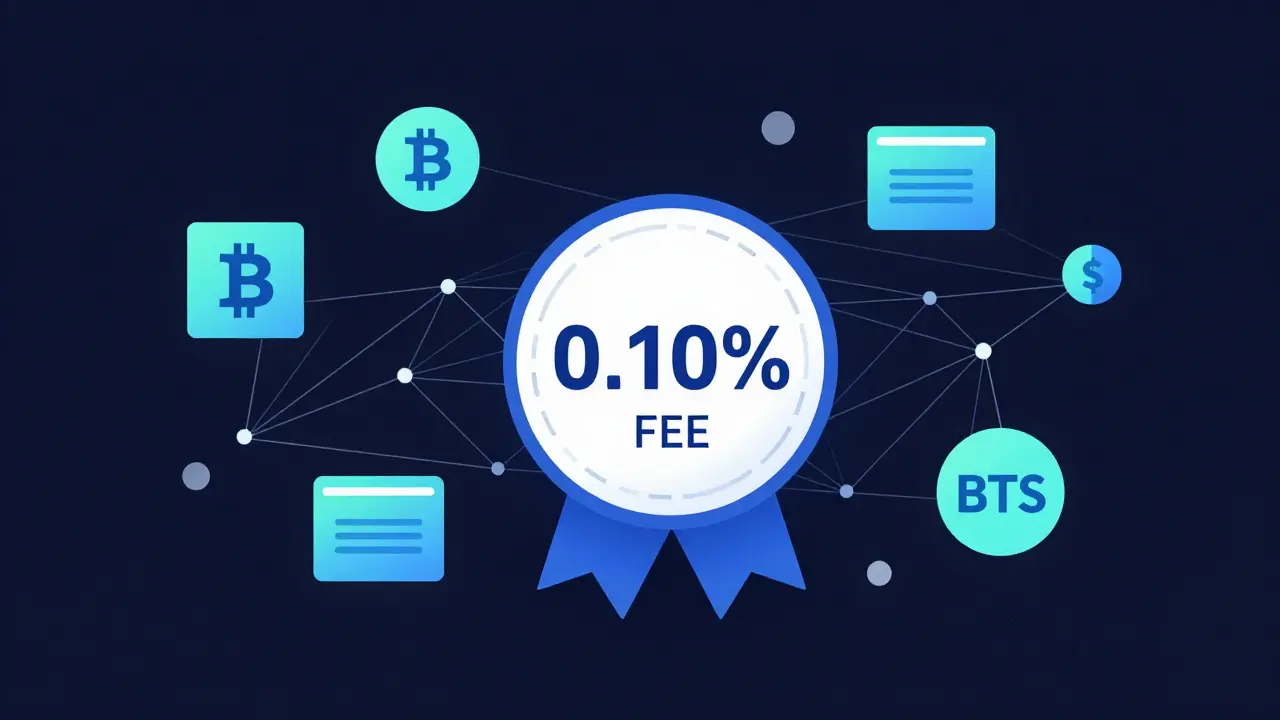
Most crypto exchanges want you to start with dollars, euros, or yen. They make it easy to buy Bitcoin with your bank account. But what if you already have crypto? What if you’re tired of paying 0.25% or more every time you trade? That’s where Escodex comes in - and why it’s not for everyone.
Zero Tiered Fees, Just One Flat Rate
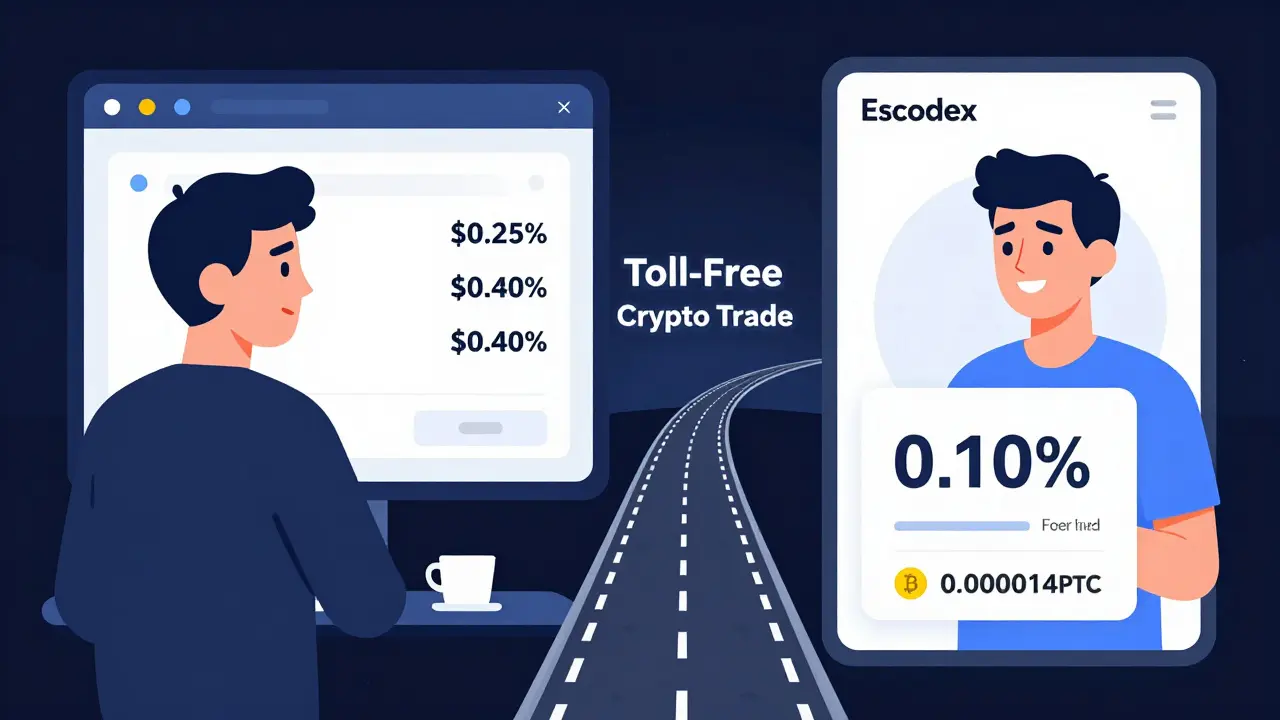
Escodex doesn’t play games with fees. Every trade, whether you’re placing a limit order or market order, costs exactly 0.10%. No discounts for high volume. No rewards for being a market maker. No hidden charges. Just 0.10% - period.That’s half the industry average. Most exchanges like Binance or Kraken charge between 0.1% and 0.4% depending on your trading volume and whether you’re adding or removing liquidity. Escodex ignores all that. It’s a flat fee model built into the BitShares blockchain it runs on. For someone making 50 trades a month on $10,000 each, that’s $500 in fees on a typical exchange. On Escodex? $100. That’s $400 saved. That’s not pocket change - it’s rent money.
No Fiat. No Bank Accounts. No Entry Point
Here’s the catch: you can’t deposit USD, EUR, AUD, or any government currency on Escodex. Not even through a card or bank transfer. If you don’t already own Bitcoin, Ethereum, or another crypto asset, you can’t use this platform. It’s not a beginner’s exchange. It’s not a gateway. It’s a trading pit for people who are already in.This isn’t a flaw - it’s a design choice. Escodex assumes you’re already trading across multiple wallets and exchanges. Maybe you bought Bitcoin on Coinbase, moved it to a hardware wallet, and now you want to swap it for Litecoin without paying a 0.3% fee on a centralized exchange. That’s where Escodex fits. It’s the back-end tool for active traders who treat crypto like a currency, not a savings account.
Withdrawal Fees? Almost Nothing
Withdrawals on Escodex cost only the network fee - no extra platform fee. For Bitcoin withdrawals, that’s about 0.000014 BTC. Compare that to the global average of 0.0008 BTC. That’s more than 50 times cheaper. Other exchanges often add $5-$15 on top of network fees just for processing. Escodex doesn’t. You pay the blockchain fee, and that’s it.This matters because frequent traders move assets between wallets, staking platforms, and other exchanges. Every withdrawal adds up. On other platforms, a $10 withdrawal fee might seem small. But if you’re moving funds weekly, that’s $520 a year. On Escodex? Less than $10. That’s the kind of savings that compounds over time.
Powered by BitShares - What That Actually Means
Escodex isn’t built on Ethereum or Solana. It runs on BitShares, a blockchain designed specifically for decentralized trading. BitShares uses Delegated Proof of Stake (DPoS), which means faster transactions and lower energy use than Bitcoin’s proof-of-work. It’s not as popular as Ethereum, but it’s stable, battle-tested, and built for one thing: trading.This gives Escodex speed and cost advantages. Trades settle in seconds. There’s no waiting for 3 confirmations like on Bitcoin. The platform handles order books directly on-chain, which means no central server to hack or freeze. But it also means the interface is less polished than what you’d find on Binance or Bybit. If you’re used to slick mobile apps with charts and one-click buys, Escodex might feel dated. It’s functional, not flashy.
Who Is This For? Who Should Avoid It?
If you’re asking yourself, “Should I use Escodex?” - here’s the quick test:- Use Escodex if: You already hold crypto, trade frequently, hate paying high fees, and don’t need to buy crypto with a credit card.
- Avoid Escodex if: You’re new to crypto, want to buy your first Bitcoin with PayPal, need customer support on WhatsApp, or expect a mobile app with push notifications.
There’s no middle ground. You’re either a crypto-native trader who’s moved past the beginner stage - or you’re not. There’s no “try it out” option. You need to already have assets to even log in.
For traders in places like New Zealand, Australia, or Canada - where fiat-to-crypto options are limited or expensive - Escodex could be a hidden gem. If you’ve already bought crypto on a local exchange and want to move it to a lower-cost trading environment, Escodex is one of the few places that offers this kind of fee advantage without requiring KYC.
What We Don’t Know - And Why It Matters
Here’s the reality: there’s very little public information about Escodex. No team names. No company registration details. No security audits published online. No Reddit threads with user stories. No Trustpilot reviews. No mobile app in the App Store or Google Play.That’s not necessarily bad - many decentralized platforms operate this way. But it does mean you’re trusting a black box. There’s no customer service number. No live chat. No email support listed. If you send funds to the wrong address, there’s no one to call. No refunds. No help.
Also missing: trading volume data, supported coins list, API access for bots, or any history of outages. You’re getting a platform that’s simple, cheap, and functional - but you’re flying blind on its reliability and longevity.
Alternatives to Consider
If Escodex feels too risky or too limited, here are two realistic alternatives:- For low fees + fiat access: Kraken or Bitstamp offer 0.16%-0.20% fees and support bank transfers. They’re regulated, have apps, and support 200+ coins.
- For pure decentralized trading: Uniswap or PancakeSwap let you trade directly from your wallet with no KYC. But they charge higher gas fees on Ethereum and are harder for beginners to use.
Escodex sits in a narrow space: it’s cheaper than centralized exchanges and more user-friendly than most DEXs. But it’s only useful if you already have crypto and want to move it fast and cheap.
Final Verdict: A Tool, Not a Platform
Escodex isn’t a crypto exchange in the way most people think of it. It’s not a place to start. It’s a place to optimize. Think of it like a toll-free highway for crypto traders who already have their vehicles. You don’t buy the car here. You just drive faster and cheaper once you’re in.If you’re serious about cutting trading costs and you already hold digital assets, Escodex is one of the few exchanges that delivers real, measurable savings. But if you’re looking for ease of use, support, or a way in - keep looking. This isn’t your entry point. It’s your upgrade.
Can I deposit USD or EUR on Escodex?
No. Escodex does not support fiat currency deposits. You cannot deposit USD, EUR, AUD, or any government-issued money. You must already own cryptocurrency to use the platform.
What are the trading fees on Escodex?
All trades on Escodex cost exactly 0.10%, whether you’re making a market order or placing a limit order. There are no tiered fees, no volume discounts, and no difference between maker and taker fees.
Is Escodex safe to use?
Escodex runs on the BitShares blockchain, which is decentralized and has no central server to hack. However, there’s no public information about security audits, insurance, or the team behind it. You’re relying on the security of the underlying blockchain, not any company guarantees. Always use strong passwords and enable two-factor authentication if available.
Does Escodex have a mobile app?
No, Escodex does not have a mobile app. The platform is accessed through a web browser only. The interface is functional but not optimized for mobile use, and there’s no official app in the Apple App Store or Google Play Store.
What cryptocurrencies can I trade on Escodex?
The exact list of supported cryptocurrencies isn’t publicly documented. Since Escodex runs on BitShares, it primarily supports assets native to the BitShares ecosystem, such as BTS, bitUSD, and bitEUR. Some other major coins may be available through bridges or tokens, but there’s no official list confirming this.
Is Escodex regulated?
There is no public information about Escodex’s legal registration, jurisdiction, or regulatory status. It operates as a decentralized platform without clear ties to any country’s financial authorities. This means there’s no legal recourse if something goes wrong.
How do withdrawal fees work on Escodex?
Withdrawal fees are only the network fees required by the blockchain. For Bitcoin withdrawals, this is approximately 0.000014 BTC - far below the industry average of 0.0008 BTC. Escodex does not add any extra platform fees on top of this.
Can I use Escodex if I’m a beginner in crypto?
No. Escodex is not designed for beginners. You must already own cryptocurrency to use it. If you’re trying to buy your first Bitcoin or Ethereum with a bank card, you’ll need to use a different exchange that accepts fiat deposits, like Coinbase or Kraken.
What’s the difference between Escodex and Uniswap?
Escodex is a centralized order-book exchange built on BitShares, while Uniswap is a decentralized automated market maker (AMM) on Ethereum. Escodex has lower fees and faster trades but requires you to deposit funds into its platform. Uniswap lets you trade directly from your wallet but often has higher gas fees and is harder to use for non-technical users.
Is Escodex still active in 2026?
As of early 2026, Escodex appears to still be operational based on user reports and blockchain activity. However, there is no official website update, social media presence, or public roadmap to confirm its long-term status. Always verify the platform’s current state before depositing funds.
If you’re already deep into crypto and want to shave every possible cent off your trading costs, Escodex is one of the few places that delivers on that promise. But if you’re still figuring out what a wallet is - start elsewhere. This isn’t a starter tool. It’s a precision instrument for experienced traders.


Author
Ronan Caverly
I'm a blockchain analyst and market strategist bridging crypto and equities. I research protocols, decode tokenomics, and track exchange flows to spot risk and opportunity. I invest privately and advise fintech teams on go-to-market and compliance-aware growth. I also publish weekly insights to help retail and funds navigate digital asset cycles.