

Imagine building a bank vault but forgetting to install the lock. That is exactly what happens when developers overlook access control vulnerabilities in smart contracts. In the world of blockchain, code is law, but if that code doesn't properly restrict who can execute critical functions, anyone with a browser and an internet connection can become the admin. This isn't just a theoretical risk; it’s the leading cause of massive financial losses in decentralized finance (DeFi). From the infamous DAO hack to recent multi-million dollar drains, weak permissions remain the Achilles' heel of smart contract development.
As we move through 2026, the stakes are higher than ever. The global blockchain security market is projected to hit $67 billion this year, driven largely by the urgent need to plug these holes. Whether you are a developer writing your first token or a project lead overseeing a DeFi protocol, understanding how access control fails-and how to fix it-is non-negotiable. Let’s break down what these vulnerabilities are, why they happen, and how to bulletproof your contracts against them.
What Are Access Control Vulnerabilities?
At its core, an access control vulnerability occurs when a smart contract fails to verify if the person calling a function has the right to do so. Think of it like a corporate office where the CEO’s desk is unlocked. Anyone walking past can sign checks, fire employees, or change the company logo. In smart contracts, "anyone" means any Ethereum address on the network.
These vulnerabilities typically manifest in three ways:
- Missing Function Guards: The most common error. A critical function, such as one that mints tokens or upgrades the contract logic, lacks a check to ensure only the owner or authorized role can call it.
- Incorrect Ownership Logic: The contract assigns ownership to the wrong address, or worse, allows ownership to be transferred without proper verification, letting attackers hijack control.
- Bypassed Modifiers: Developers use custom modifiers to restrict access but implement them incorrectly, allowing malicious actors to bypass the checks entirely.
The danger lies in the immutability of blockchain. Once a contract is deployed, you cannot simply patch it like a traditional website. If an attacker finds a backdoor in your access controls, they can drain funds or freeze assets instantly, and there is no customer support line to call for a refund.
Historical Precedents: Lessons from Major Hacks
To understand the severity, we need to look at history. The blockchain industry has paid dearly for early mistakes, creating a library of cautionary tales that every developer should study.
The DAO Hack of 2016 remains the most iconic example. While often cited for its reentrancy flaw, the root issue was also about control. Attackers exploited the contract’s logic to repeatedly withdraw funds before the balance was updated, effectively draining over $50 million. This event forced the Ethereum network to undergo a controversial hard fork, splitting the chain and highlighting how fragile permissionless systems can be when logic flaws meet unrestricted access.
Then there was the Parity Multisig Wallet Hack in 2017. This incident wasn’t about stealing money directly but locking it away forever. Parity’s wallet contract allowed users to initialize their wallets by calling a specific function. However, because this initialization function lacked proper access control, an attacker called it on the library contract itself. This set the library’s owner to the attacker’s address, allowing them to lock the contract permanently. The result? Over $280 million worth of Ether became inaccessible across thousands of wallets. It proved that even simple oversight in function visibility can have catastrophic, irreversible consequences.
More recently, in 2023 and 2024, access control issues still accounted for roughly 20% of all DeFi exploits. These weren’t always giant hacks; many were subtle manipulations where attackers exploited poorly defined roles to mint infinite tokens or pause transfers selectively, causing panic and liquidity crashes.
Why Do These Vulnerabilities Persist?
If the risks are so clear, why do developers keep making these mistakes? The answer lies in complexity and false confidence.
Many junior developers rely on copy-pasting code from tutorials without understanding the underlying security implications. They might see an `onlyOwner` modifier and assume it’s secure, not realizing that if the `owner` variable is set incorrectly during deployment, the modifier becomes useless. Additionally, the pressure to launch quickly in the fast-moving crypto space often leads to skipping rigorous testing phases.
Another factor is the misconception that "code is transparent, so it’s safe." Transparency helps auditors, but it also helps attackers. If your access control logic is public, hackers can study it for weeks looking for edge cases. Automated tools like AChecker help detect some issues using static analysis, but they struggle with complex, custom logic. Research shows that automated tools often miss nuanced vulnerabilities where developers intentionally allow certain unauthorized actions under specific constraints, blurring the line between feature and flaw.
Best Practices for Secure Implementation
Preventing access control vulnerabilities requires a disciplined approach. Here are the gold standards for securing your smart contracts in 2026.
1. Use Established Libraries
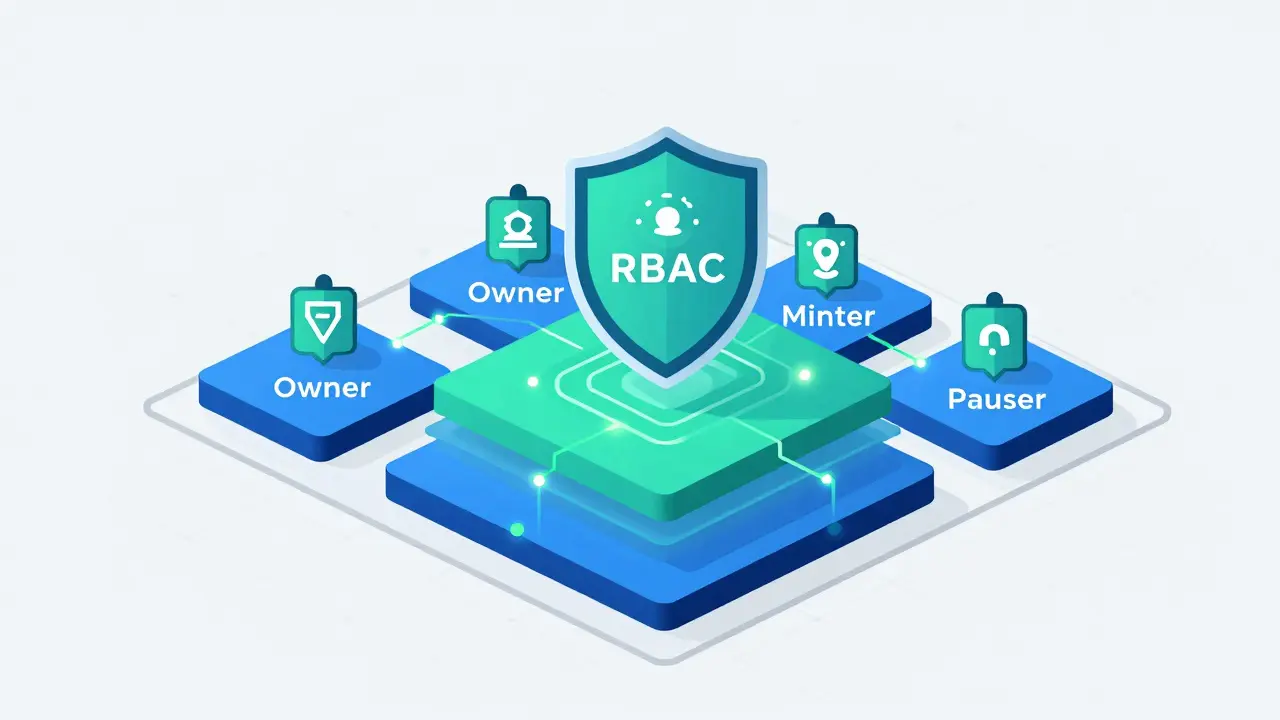
Never write your own access control logic from scratch unless you have a team of formal verification experts. Instead, use battle-tested libraries like OpenZeppelin. Their `Ownable` and `AccessControl` contracts are audited, widely used, and continuously updated. By importing these, you inherit years of security research. For example, using `AccessControl` allows you to define multiple roles (e.g., `MINTER_ROLE`, `PAUSER_ROLE`) rather than relying on a single owner, reducing the risk of a single point of failure.
| Model | Complexity | Security Level | Best For |
|---|---|---|---|
| Simple Owner | Low | Medium | Small projects, single-admin apps |
| Role-Based (RBAC) | Medium | High | DeFi protocols, DAOs, enterprise solutions |
| Multisig | High | Very High | Treasury management, high-value transactions |
2. Implement Role-Based Access Control (RBAC)
The principle of least privilege is crucial. Don’t give everyone admin rights. Define specific roles. For instance, a developer might need permission to upgrade the contract, while a moderator can pause trading during emergencies. Using RBAC ensures that if one key is compromised, the entire system isn’t doomed. It limits the blast radius of a potential breach.
3. Separate Logic from Business Rules
Keep your access control logic modular. Don’t mix permission checks with business calculations. This separation makes audits easier and reduces the chance of introducing bugs when updating features. When auditors review your code, they can focus specifically on the permission layer without getting lost in complex math.
4. Use Timelocks and Multisigs
For critical actions like upgrading a contract or withdrawing treasury funds, add friction. A Timelock forces a delay between proposing an action and executing it, giving users time to react if something looks suspicious. Combining this with a Multisignature Wallet (like Gnosis Safe) ensures that no single individual can act unilaterally. Most major DeFi protocols now require 3-of-5 multisig approvals for admin functions.

The Role of Audits and Tools
Even with best practices, human error exists. This is where professional auditing comes in. In 2026, skipping an audit is considered negligence for any project handling significant value. Leading firms like Trail of Bits, ConsenSys Diligence, and OpenZeppelin provide specialized assessments. Costs range from $5,000 for simple contracts to over $50,000 for complex DeFi protocols, with turnaround times of 2-4 weeks.
While waiting for an audit, use static analysis tools. Tools like Slither and Mythril can catch basic access control errors early in the development cycle. However, remember that these tools are aids, not replacements for human expertise. They generate false positives and miss context-specific flaws. Treat them as a first line of defense, not a final guarantee.
Future Trends in Access Control
The landscape is evolving. We’re seeing the rise of Zero-Knowledge Proofs (ZKPs) for privacy-preserving access control. Imagine verifying that a user has admin rights without revealing their identity or other sensitive data. This is particularly useful for private chains or hybrid models.
Additionally, Layer 2 scaling solutions are introducing new challenges. Cross-chain permission verification requires ensuring that access granted on one chain is respected on another. As interoperability grows, so does the attack surface. Formal verification tools like the K Framework and Dafny are becoming more accessible, allowing developers to mathematically prove that their access control logic is sound, eliminating guesswork.
Regulatory pressure is also increasing. Governments are beginning to mandate security assessments for smart contracts handling large volumes of capital. Expect stricter guidelines on access control implementation in the coming years, potentially making comprehensive auditing a legal requirement for certain applications.
What is the most common access control mistake?
The most common mistake is failing to implement any access control check on critical functions, such as those that transfer funds or update contract state. This leaves the function open to anyone who can send a transaction to the contract.
Is OpenZeppelin free to use?
Yes, OpenZeppelin’s core smart contract libraries are open-source and free to use under the MIT license. They offer paid services for audits and custom development, but the foundational code for access control is freely available.
How much does a smart contract audit cost?
Costs vary based on complexity. Simple contracts may cost around $5,000-$10,000, while complex DeFi protocols can range from $20,000 to $50,000 or more. Always get quotes from reputable firms like Trail of Bits or OpenZeppelin.
Can I fix an access control vulnerability after deployment?
Generally, no. Smart contracts are immutable. However, if you designed your contract with an upgradeable proxy pattern, you can deploy a new implementation contract that fixes the vulnerability and switch the proxy to point to it. This is why using upgradeable patterns correctly is vital.
What is the difference between Ownable and AccessControl?
Ownable grants all administrative powers to a single address, which is a single point of failure. AccessControl allows you to define multiple roles (e.g., Admin, Minter, Pauser) and assign them to different addresses, providing finer-grained security and better risk distribution.


Author
Ronan Caverly
I'm a blockchain analyst and market strategist bridging crypto and equities. I research protocols, decode tokenomics, and track exchange flows to spot risk and opportunity. I invest privately and advise fintech teams on go-to-market and compliance-aware growth. I also publish weekly insights to help retail and funds navigate digital asset cycles.