
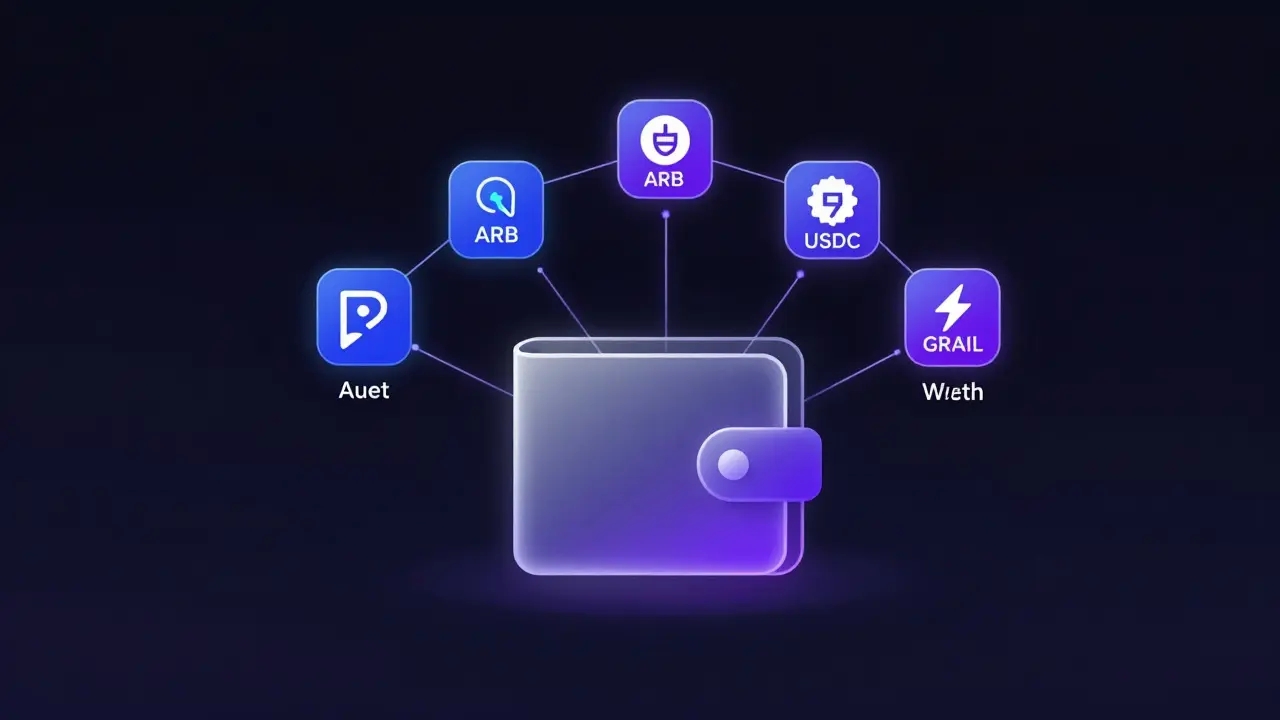
When you're trading crypto on Arbitrum, you don't need a centralized exchange like Binance. You need something built for the chain you're already on. That's where Camelot is a decentralized cryptocurrency exchange (DEX) built specifically for the Arbitrum network, launched in December 2022. Unlike platforms that just chase short-term yields, Camelot was designed to be the backbone of Arbitrum's DeFi ecosystem - offering real infrastructure, not just flashy rewards.
How Camelot Works: No Middlemen, Just Smart Contracts
Camelot runs on an automated market maker (AMM) model. That means there are no order books, no brokers, and no company holding your funds. Instead, trades happen directly between users and liquidity pools - smart contracts that hold pairs of tokens like ARB/USDC or ETH/WETH. When you swap one token for another, you're interacting with these pools, not a central server.
What sets Camelot apart is its use of Algebra’s V2 codebase. This upgrade brought concentrated liquidity to the platform - a feature once only for advanced traders. Now, anyone can provide liquidity more efficiently. Instead of spreading your funds across a wide price range, you can focus them where trading actually happens. This means less slippage, better yields, and more capital efficiency.
Camelot also supports limit orders, something most DEXs still don’t offer. You can set a price to buy or sell, and the trade executes automatically when the market hits your target. No more watching charts all day.
What Tokens Can You Trade?
Camelot supports over 137 cryptocurrencies, mostly tokens native to the Arbitrum ecosystem. You’ll find major players like ARB, USDC, WETH, and DAI, but also lesser-known projects launching on Arbitrum. If a project is built on Arbitrum, chances are it’s listed on Camelot first.
There’s no minimum deposit. You can start with as little as $1. That’s rare for a DEX with this level of functionality. Most require you to deposit at least $10 or $25 just to cover gas fees. Camelot’s integration with Arbitrum’s low fees makes small trades practical.
But here’s the catch: no leverage. No margin trading. No shorting. If you’re looking to go long on ETH with 5x leverage, you’ll need a centralized exchange. Camelot is purely for spot trading and liquidity provision.
The GRAIL Token: Governance, Not Just a Yield Farm
Camelot’s native token is GRAIL the governance token of the Camelot platform, with a maximum supply of 100,000 tokens, issued exclusively on the Arbitrum blockchain. It’s not designed to be a speculative asset - at least, not primarily. GRAIL is meant to be earned through staking and used to vote on platform changes.
You don’t hold GRAIL directly to vote. Instead, you stake it to get xGRAIL a derivative token representing staked GRAIL, used for governance voting power on the Camelot platform. The more xGRAIL you have, the more voting power you get. And here’s the smart part: voting is gasless. You don’t pay Ethereum fees to submit a proposal. The DAO handles execution on your behalf.
As of early 2026, GRAIL’s price has been volatile. Predictions from CoinLore suggest it could hit $1,616 by the end of 2025, with a long-term target of $13,673 by 2040. These are speculative, based on historical trends, not guarantees. But the fact that the token supply is capped at 100,000 means scarcity is baked in.

Fees: Zero. Really.
Camelot charges 0.00% in trading fees for both makers and takers. That’s not a typo. While centralized exchanges like Binance charge 0.1%-0.25% per trade, Camelot makes money through liquidity provider incentives, not user fees. This is why it’s become the go-to DEX for Arbitrum traders who want to minimize costs.
But there’s a trade-off. Because there are no trading fees, liquidity providers earn a larger share of the revenue. That’s good if you’re staking, but it means the platform relies entirely on user participation to stay healthy. If liquidity drops, slippage rises. So the fee-free model only works if the community keeps funding the pools.
User Experience: Fast, But Not Fancy
Camelot has no mobile app. You use it through your browser. That’s fine if you’re used to MetaMask or WalletConnect. But if you expect an app like Coinbase or Binance, you’ll be disappointed.
The interface is clean and minimal. You connect your wallet, pick a token pair, and trade. The layout doesn’t overwhelm you with charts or news feeds. It’s focused on execution. According to traffic data, users spend just over a minute on the site per visit. That’s not because it’s confusing - it’s because they get in, swap, and leave.
The bounce rate is around 49%, which is actually low for a DEX. Most DeFi sites lose half their visitors in the first 10 seconds. Camelot’s simplicity helps. If you know what you’re doing, you can complete a trade in under 30 seconds.
It doesn’t have contests, bonuses, or referral rewards beyond standard yield farming. But it does have an affiliate program. If you refer others and they trade, you earn a small cut of the protocol revenue. Not huge money, but passive income without the hype.
Security and Regulation: You’re on Your Own
Camelot is not regulated. It doesn’t need to be. It’s a decentralized protocol. No KYC, no ID checks, no government oversight. That’s freedom - and risk.
There’s no customer support team. If you send funds to the wrong address, there’s no one to call. If a smart contract glitch happens, there’s no refund policy. You’re responsible for your own actions. This is true for every DEX, but it’s worth repeating: Camelot doesn’t hold your keys. You do.
The platform has been audited, and its contracts are open-source. No major exploits have occurred since launch. But audits aren’t insurance. Always double-check contract addresses before interacting. Scammers copy the interface all the time.

Who Is Camelot For?
Camelot isn’t for everyone. If you’re new to crypto and still learning what a wallet is, start with a centralized exchange. Learn the basics first.
But if you’re already using Arbitrum - whether you’re trading ARB, staking in DeFi protocols, or holding tokens from Arbitrum-native projects - Camelot is the natural home. It’s the most optimized DEX on the chain. It’s faster, cheaper, and more tailored than trying to use Uniswap or SushiSwap on Arbitrum.
Developers love it. Projects launching on Arbitrum integrate with Camelot because it’s reliable, well-supported, and has deep liquidity. If you’re building on Arbitrum, you’re probably already using it.
What’s Missing?
- No mobile app
- No leverage or margin trading
- No fiat on-ramps (you need ETH or USDC already)
- No customer support channels
- No advanced charting tools
These aren’t bugs - they’re design choices. Camelot isn’t trying to be Coinbase. It’s trying to be the best DEX on Arbitrum. And in that narrow focus, it succeeds.
Final Verdict: A Power Tool, Not a Toy
Camelot isn’t flashy. It doesn’t have a celebrity CEO or a viral meme coin. But it’s one of the most technically advanced DEXs in DeFi. It solves real problems: high gas fees, inefficient liquidity, and lack of governance.
If you’re active on Arbitrum, Camelot should be your default swap tool. The 0% fees alone make it worth using. Combine that with limit orders, concentrated liquidity, and the GRAIL token’s governance model, and you’ve got a platform that’s built to last.
It’s not perfect. But in a space full of half-baked DEXes, Camelot stands out because it doesn’t chase trends. It builds infrastructure. And that’s what DeFi needs.
Is Camelot a centralized or decentralized exchange?
Camelot is a decentralized exchange (DEX). It runs entirely on smart contracts on the Arbitrum blockchain. There is no company, no customer service team, and no central authority controlling your funds. You interact directly with liquidity pools using your own wallet.
Do I need a wallet to use Camelot?
Yes. You need an Ethereum-compatible wallet that supports the Arbitrum network - like MetaMask, Trust Wallet, or WalletConnect. You must have ETH or ARB in your wallet to pay for gas fees on Arbitrum. Camelot doesn’t store your keys or funds.
Can I trade fiat currency on Camelot?
No. Camelot only accepts crypto. You need to buy ETH, USDC, or another supported token on a centralized exchange first, then transfer it to your wallet before using Camelot.
How do I earn GRAIL tokens?
You earn GRAIL by providing liquidity to Camelot’s pools and staking your LP tokens. The platform rewards users with GRAIL as yield, similar to how other DEXes reward liquidity providers. You can then stake GRAIL to get xGRAIL for voting power.
Is Camelot safe to use?
Camelot’s smart contracts have been audited and have operated without major exploits since launch. However, as a DEX, it carries all the risks of DeFi: smart contract bugs, impermanent loss, and scams. Always verify contract addresses, never share your seed phrase, and only use the official website (camelot.exchange).


Author
Ronan Caverly
I'm a blockchain analyst and market strategist bridging crypto and equities. I research protocols, decode tokenomics, and track exchange flows to spot risk and opportunity. I invest privately and advise fintech teams on go-to-market and compliance-aware growth. I also publish weekly insights to help retail and funds navigate digital asset cycles.