
When you hear the name DACHExchange, you might assume it’s just another crypto platform trying to jump on the decentralized exchange bandwagon. But here’s the truth: there’s almost nothing solid out there about it in early 2026. No official website. No verified team. No public audit reports. No real trading volume data. And yet, it shows up in a few comparison lists - mostly as a footnote.
If you’re thinking about using DACHExchange to trade crypto, you’re walking into a black box. That’s not a feature. That’s a red flag.
What Even Is DACHExchange?
DACHExchange claims to be a decentralized exchange (DEX), which means it should let you trade crypto directly from your wallet - no KYC, no middleman, no depositing funds into someone else’s account. That’s the promise. But unlike Uniswap, dYdX, or Jupiter - platforms that have been around for years with public code, active communities, and clear metrics - DACHExchange doesn’t show up in any major blockchain analytics tools.
DefiLlama doesn’t list it. CoinGecko doesn’t track its volume. CoinMarketCap has no entry. Even obscure DEX aggregators like 1inch or Matcha don’t pull liquidity from it. That’s not normal. It’s not a new project. It’s a ghost.
Some search results mention a token called Dach Coin (DACHX), launched in Q3 2018. But that’s not the same thing. A token isn’t an exchange. You can’t trade DACHX on DACHExchange if the exchange doesn’t exist as a live, functional platform. This confusion is likely intentional - using similar names to create false legitimacy.
How Decentralized Exchanges Should Work in 2026
To understand why DACHExchange raises alarms, look at what real DEXs look like today. Take Uniswap: it handles over $1.2 billion in daily volume across Ethereum, Arbitrum, Base, and Polygon. Its trading fees are transparent: 0.05% to 0.30%, depending on the pair. It’s been audited by Trail of Bits, OpenZeppelin, and CertiK. Its smart contracts are public. Anyone can verify them.
Or dYdX: built on Ethereum Layer 2, it offers perpetual futures with fees as low as 0.00% for makers and 0.20% for takers. It has over $800 million in total value locked (TVL), active community governance, and a clear roadmap with quarterly updates.
And Jupiter on Solana? It aggregates liquidity across 15+ DEXs, giving users the best price in under 300 milliseconds. It’s used by over 2 million unique wallets monthly.
These platforms have names, teams, GitHub repositories, Discord servers, Twitter accounts with real engagement, and public financials. DACHExchange has none of that.
Why This Matters: Security Risks
Using an unknown DEX isn’t just risky - it’s dangerous. Real decentralized exchanges don’t hold your keys. They use smart contracts that execute trades automatically. But if the contract isn’t audited, it could have a backdoor. If the code isn’t open-source, no one can check for hidden vulnerabilities. If there’s no community, no one’s watching for exploits.
There are documented cases of fake DEXs stealing millions. In 2023, a platform called “CryptoDex” mimicked Uniswap’s interface. It looked real. It had fake TVL stats. Users deposited ETH - and the liquidity pool vanished overnight. The developers vanished. No one was ever caught.
If DACHExchange is real, why isn’t it on any security radar? Why hasn’t a single researcher or auditor written about it? If it’s not real, why is it still listed in directories? Either way, you’re being asked to trust something with no proof.
What You Can Actually Verify
Here’s what you can check for any crypto exchange - and what’s missing for DACHExchange:
- Website: Does it have a clean, professional site with contact info? No.
- Smart Contract Address: Can you find the deployed contract on Etherscan, Solana Explorer, or another chain? No public address is listed anywhere.
- Team: Are there LinkedIn profiles, GitHub commits, or past projects? Zero public records.
- Community: Is there a Telegram group with 10,000+ active users? A Discord with real conversations? No.
- Trading Volume: Can you see real trades happening? No on-chain activity matches its claimed name.
- Audits: Has any security firm reviewed its code? No reports exist.
Compare that to Orca on Solana. It has a public GitHub, a 2024 audit from CertiK, 120,000 monthly users, and a transparent fee structure (0.01%-1%). You can see every trade. You can follow the team’s updates. You can join their community.
Should You Use DACHExchange?
No.
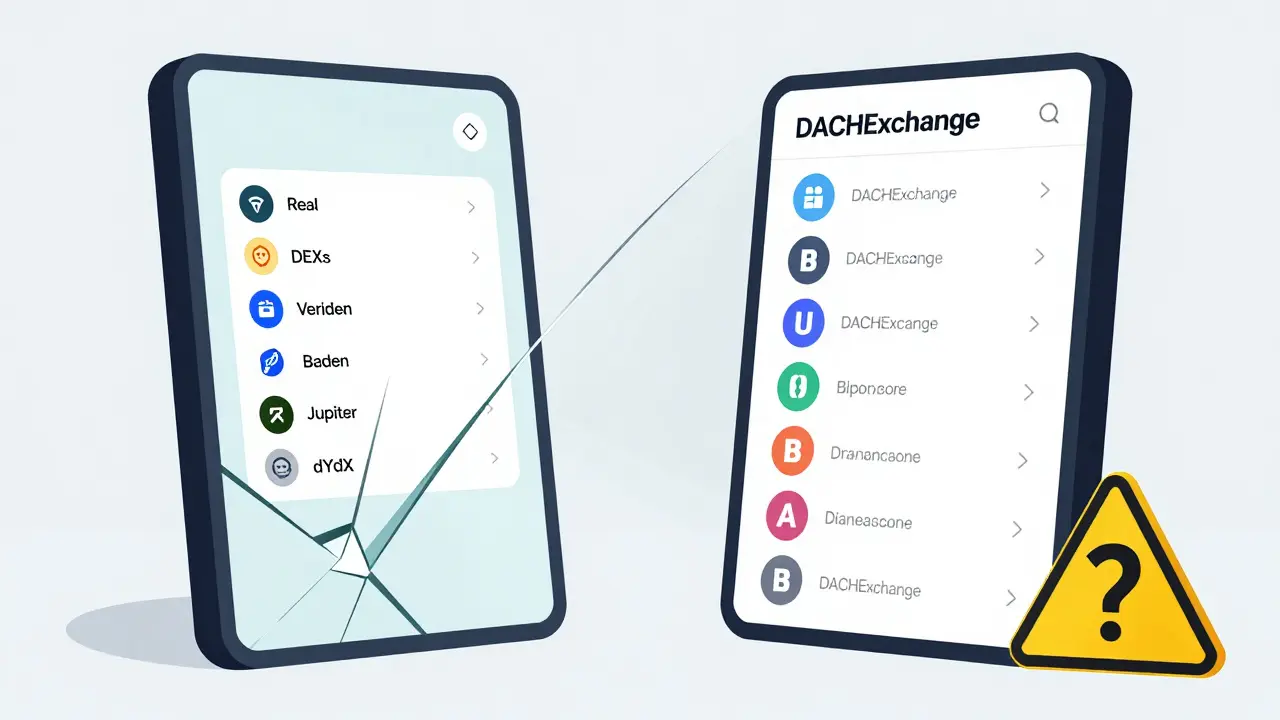
Not because it’s definitely a scam - though the evidence leans heavily that way - but because you have no way to verify it’s safe. Crypto isn’t about hope. It’s about proof. And DACHExchange has none.
If you’re looking for a decentralized exchange in 2026, go with what works:
- For Ethereum users: Uniswap or dYdX
- For Solana users: Orca or Jupiter
- For low-fee futures: Hyperliquid
- For multi-chain swaps: 1inch or Matcha
These platforms have track records. They have audits. They have users. They have transparency. You can check their numbers. You can see their code. You can trust them - because the data is there.
DACHExchange? It’s a name on a list. That’s it.
Final Warning
Don’t let a name fool you. “DACH” sounds European - maybe German, Austrian, Swiss. That might make you think it’s legit. But location doesn’t equal legitimacy. A fake exchange can call itself “SwissCryptoDEX” and still be a fraud.
Always ask: Can I verify this? If the answer is no - walk away.


Author
Ronan Caverly
I'm a blockchain analyst and market strategist bridging crypto and equities. I research protocols, decode tokenomics, and track exchange flows to spot risk and opportunity. I invest privately and advise fintech teams on go-to-market and compliance-aware growth. I also publish weekly insights to help retail and funds navigate digital asset cycles.