
If you’ve heard about an IMM airdrop and are wondering if it’s real, you’re not alone. Scrolling through Twitter, Telegram, or Discord, you might see posts claiming you can get free IMM tokens just by signing up or holding a certain coin. But here’s the truth: as of December 19, 2025, there is no verified, official IMM airdrop from a recognized project. No whitepaper, no team announcement, no contract address, no official website-nothing. That doesn’t mean it won’t happen. But right now, anyone telling you otherwise is either mistaken or trying to take your money.
Why You Haven’t Heard of IMM Before
Most legitimate crypto airdrops come from projects with clear roadmaps, active communities, and public teams. Think zkSync, LayerZero, or Monad-all had years of development, public testnets, and transparent tokenomics before their airdrops. They didn’t drop out of nowhere. They built trust slowly.IMM, as it’s being mentioned online, doesn’t fit that pattern. There’s no GitHub repository with code commits. No CoinGecko or CoinMarketCap listing. No Twitter account with more than a few hundred followers that’s been verified. Even the name “IMM” is ambiguous-it could stand for anything: Instant Money Module, Immortal Token, or just a random string of letters. That’s not how real projects name themselves.
What a Real Airdrop Looks Like in 2025
Let’s compare what’s actually happening with other crypto projects this year. Meteora, for example, ran a testnet campaign where users had to swap tokens, provide liquidity, and interact with their protocol across multiple chains. They tracked every wallet. Then, months later, they announced the airdrop with a detailed distribution map. No mystery. No guesswork.Hyperliquid did the same. They gave users points for trading volume on their perpetuals platform. You could see your score go up in real time. When the airdrop came, you got your tokens because you had proof of participation.
Compare that to the “IMM airdrop” posts you’re seeing. They often say things like:
- “Join our Telegram to claim IMM tokens”
- “Send 0.1 ETH to this address and get 10,000 IMM”
- “Only 500 spots left-act now!”
That’s not an airdrop. That’s a phishing trap.
How Scammers Use the Word “Airdrop”
Airdrops are popular. People love free crypto. Scammers know that. So they copy the branding of real projects, use fake logos, and create websites that look professional. They’ll even steal code from legitimate platforms and slap on the name “IMM” to make it seem real.Here’s how it works:
- You click a link that says “Claim Your IMM Airdrop”
- You connect your wallet-maybe MetaMask or Phantom
- You approve a transaction that looks like “Claim Tokens”
- Instead of getting tokens, you’ve given the scammer permission to drain your entire wallet
It’s not magic. It’s simple. Wallet approvals are dangerous if you don’t know what you’re signing. Even if you don’t send any ETH or SOL, just connecting your wallet to a fake site can be enough for them to track your activity and target you with follow-up scams.
How to Check if an Airdrop Is Real
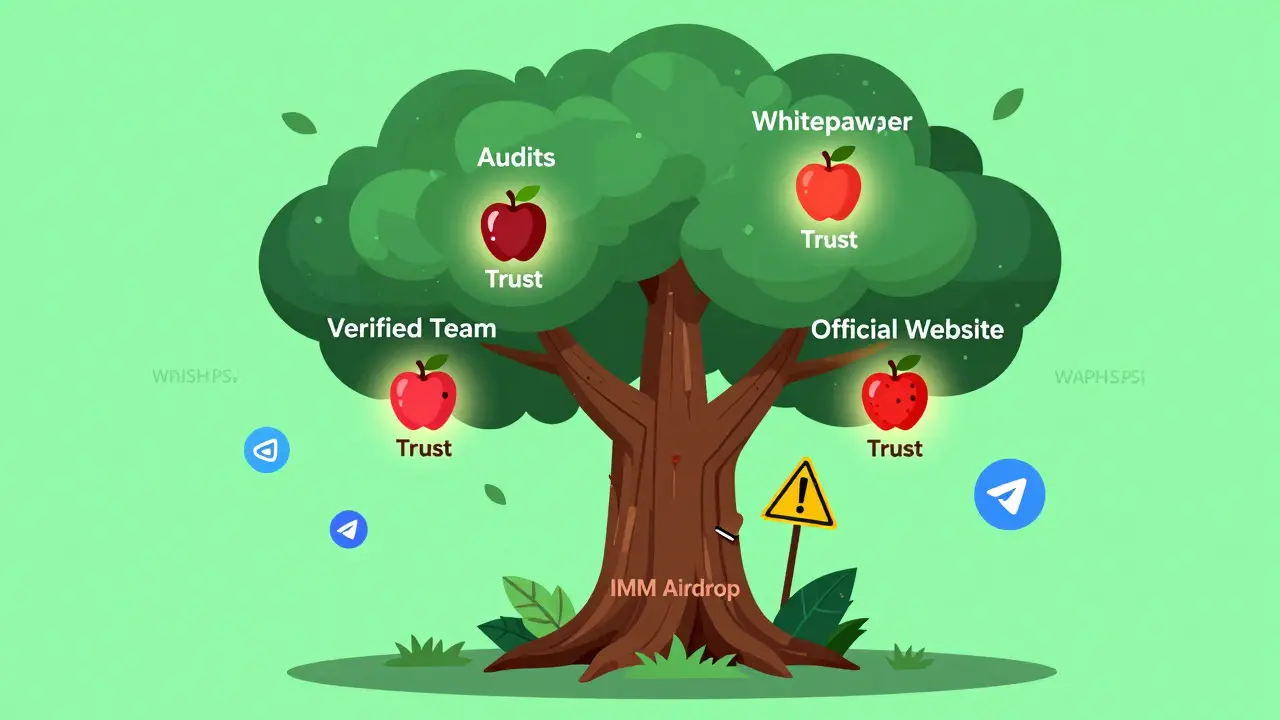
Before you even think about clicking a link, ask yourself these five questions:- Is there an official website? (Not a .xyz or .io domain with a stock image)
- Is there a published whitepaper? (PDF with technical details, not a one-page marketing blurb)
- Is the team publicly known? (LinkedIn profiles, past projects, real names)
- Are there audits from reputable firms? (Like CertiK, Hacken, or PeckShield)
- Has it been mentioned by trusted crypto news sources? (CoinDesk, The Block, Decrypt)
If even one of these is missing, treat it like a red flag. And if the site asks you to connect your wallet before explaining what IMM is-close it. Immediately.
What to Do Instead
If you’re looking for real airdrops in 2025, focus on projects that are already live and have clear participation rules:- Monad - Running testnet events with public leaderboards
- Abstract Chain - Rewarding users for using their modular smart contract system
- LayerZero - Still distributing tokens to early users of cross-chain apps
- zkSync - Has a history of rewarding users who interacted with their testnet
- MetaMask - Recently rewarded users who used their wallet for DeFi and NFTs
Follow their official blogs. Join their Discord servers. Watch for announcements from verified accounts. Don’t rely on random Telegram groups or Reddit threads.
What Happens If You Already Participated
If you’ve already connected your wallet to a site claiming to be the “IMM airdrop,” here’s what to do right now:- Go to Etherscan Allowances (or the equivalent for your chain, like Solana Explorer)
- Find any approvals linked to unknown contracts
- Revoke access to all of them
- Do not send any more funds to any address associated with IMM
- Monitor your wallet for unusual transactions
Even if your wallet looks empty now, scammers can wait weeks before draining it. Revoke permissions as soon as possible.
Will IMM Ever Have an Airdrop?
Maybe. But if it does, it won’t come from a random link or a Telegram bot. It will come from a team that’s spent years building, testing, and communicating with their community. It will be announced on their own website. It will be backed by code. It will be audited. And it will never ask you to send crypto to claim it.Until then, treat every “IMM airdrop” as a scam. Save your energy. Save your wallet. Save your money.
Where to Find Legit Airdrops in 2025
Want to find real opportunities? Here are trusted places to look:- Airdrop Alert (official site, not copycats)
- CoinGecko Airdrop Calendar (updated daily)
- TokenUnlocks (tracks upcoming token distributions)
- Official project blogs (always check the domain-no typos!)
And remember: if it sounds too good to be true, it is. Free crypto isn’t free if you lose your entire portfolio.


Author
Ronan Caverly
I'm a blockchain analyst and market strategist bridging crypto and equities. I research protocols, decode tokenomics, and track exchange flows to spot risk and opportunity. I invest privately and advise fintech teams on go-to-market and compliance-aware growth. I also publish weekly insights to help retail and funds navigate digital asset cycles.