
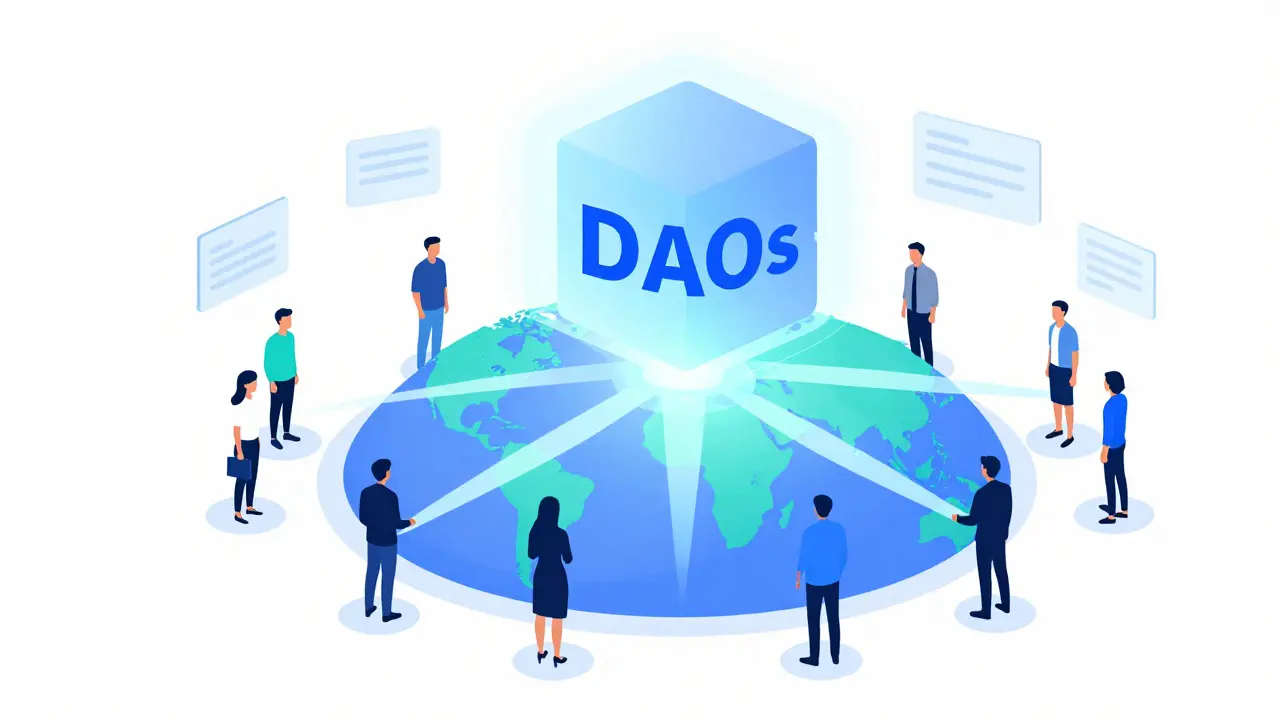
Imagine joining a company where the boss is code, the bank account is public, and you can vote on big decisions from your phone while sitting in a café in Auckland. That’s the promise of Decentralized Autonomous Organizations, or DAOs. They are blockchain-based entities governed by smart contracts and collective decision-making rather than centralized leadership.
In 2016, this idea was just a wild experiment that ended in a $60 million hack. Today, over 13,000 active DAOs manage roughly $40 billion in assets. But as the hype settles, we need to look past the marketing. Are DAOs the future of work, or are they slow, chaotic clubs for crypto whales? The truth is somewhere in the middle. Here is what you actually get when you join one, and what you might lose.
The Power of Transparency and Global Access
The biggest selling point of a DAO is radical transparency. In a traditional corporation, you trust the CFO to report numbers honestly. In a DAO, you don’t have to trust anyone. Every transaction is recorded on the blockchain ledger. If a DAO spends $10,000 on marketing, you can see exactly which wallet received it and when.
This level of openness is rare. A Harvard Business Review study from early 2025 noted that only 12-18% of financial transactions in traditional corporations are publicly verifiable. For DAOs, that number is 100%. This builds a unique kind of trust among members who may never meet face-to-face.
Then there is the borderless nature of participation. Traditional companies hire based on location and visa laws. DAOs hire based on skill and contribution. You could be a developer in Nigeria, a designer in Brazil, and a writer in New Zealand, all working together under the same smart contract rules. According to workforce data from 2025, DAO participants span 187 countries. This opens doors for talent that was previously locked out of global opportunities. For example, contributors like 'CryptoNinja', a young developer from Nigeria, have earned significant income through Gitcoin DAO contributions without ever needing a local employer.
| Feature | Traditional Corporation | DAO |
|---|---|---|
| Transparency | Low (Internal reports) | High (Public blockchain ledger) |
| Decision Speed | Fast (2-3 days average) | Slow (14-21 days average) |
| Geographic Reach | Limited by law/tax | Global (187+ countries) |
| Legal Status | Clear (LLC, Corp) | Fragmented (Varies by region) |
| Governance Model | Hierarchical | Token-weighted voting |
The Reality Check: Slowness and Voter Apathy
If transparency were the only factor, everyone would switch to DAOs overnight. But there is a heavy cost to decentralization: speed. In a traditional startup, if the CEO sees a problem, they fix it today. In a DAO, you have to draft a proposal, put it up for discussion, wait for a voting period, and then execute the smart contract.
Data from CoinLaw’s 2025 statistics shows that top-performing DAOs like MakerDAO can implement decisions within 72 hours. That sounds fast, but the average DAO takes 14 to 21 days to execute a single proposal. For time-sensitive issues, this delay can be fatal. We saw this with the Nouns DAO incident, where delayed responses to security threats resulted in $1.2 million being stolen before the community could react.
Then there is the issue of voter apathy. Most people do not want to spend their weekends reading complex governance proposals. As a result, participation rates in most DAOs sit below 18%. When only a small fraction of token holders vote, the "democratic" ideal starts to look hollow. You might feel like your voice matters, but if you’re not actively checking Discord and Snapshot every day, you’re likely being represented by someone else-or worse, ignored entirely.
The Whale Problem: Is It Really Democratic?
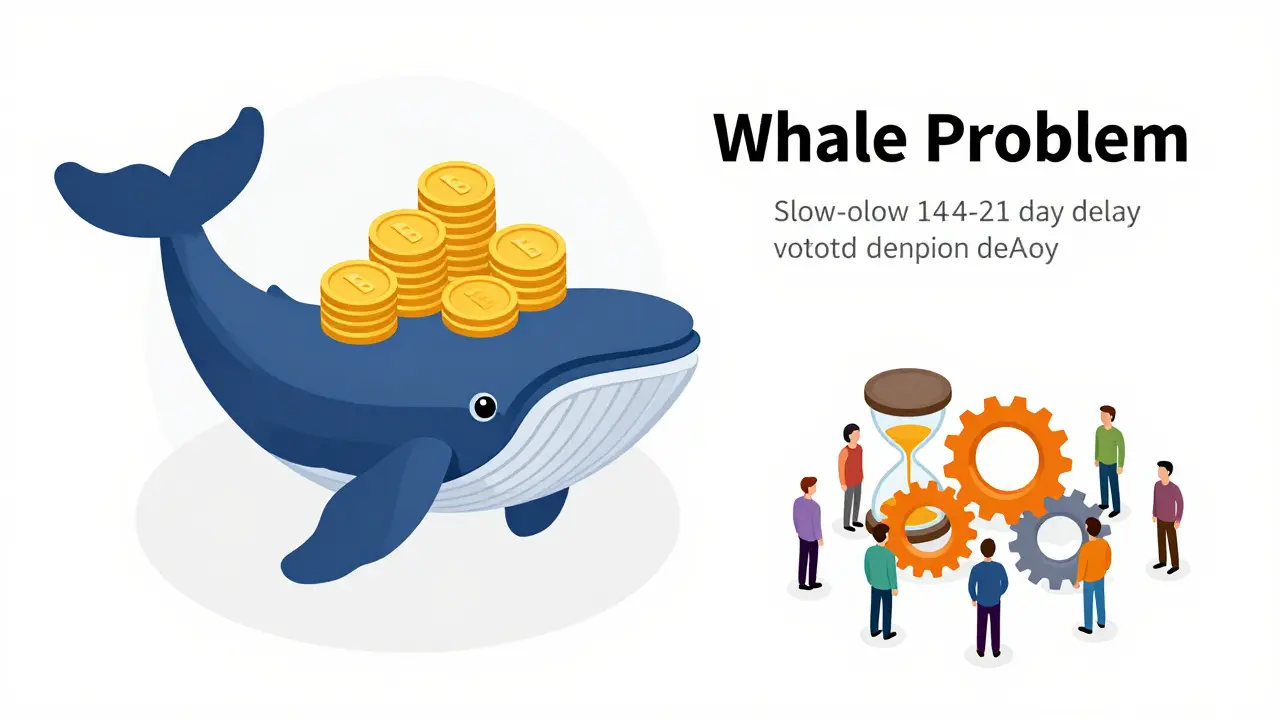
One of the most criticized aspects of DAOs is how voting power works. In most models, one token equals one vote. This creates a plutocracy, not a democracy. If you hold more tokens, you have more say. And in many major DAOs, token distribution is highly concentrated.
An analysis of Uniswap’s governance in mid-2025 revealed that 78% of governance tokens were held by the top 15-20% of holders. These "whales" can effectively steer the direction of the organization, often sidelining smaller contributors. Dr. Primavera De Filippi, a senior researcher at Harvard, pointed out in 2025 that the myth of perfect decentralization has been debunked by data showing whale dominance in 89% of major DAOs.
This concentration of power means that while anyone can join a DAO, not everyone has equal influence. If you’re a new member with a few tokens, your vote might carry less weight than a single institutional investor. This dynamic can discourage genuine community input and lead to decisions that favor large holders rather than the broader ecosystem.
Legal Gray Areas and Liability Risks
Here is the tricky part: DAOs exist in a legal gray area. While the technology is global, laws are local. As of mid-2025, only 12 US states and three countries have specific legal frameworks for DAOs. Wyoming has been a pioneer with its DAO LLC structure, allowing organizations to register formally. The UAE’s RAK DAO Association has also seen hundreds of registrations. But for the vast majority of DAOs, there is no clear legal status.
This lack of clarity poses real risks. SEC Commissioner Hester Peirce warned in late 2024 that DAO participants might face unexpected liability as regulators catch up. Without a formal legal entity, members could potentially be held personally liable for the actions of the DAO. Imagine contributing code to a DAO that accidentally violates securities laws-you could find yourself on the hook.
Furthermore, dispute resolution is messy. In a traditional company, you go to court or arbitration. In a DAO, if two members disagree on a payout, who decides? Smart contracts execute automatically, but they can’t interpret intent or fairness. This gap in accountability remains a critical weakness, as noted in the World Economic Forum’s 2025 report on DAO governance maturity.
Who Should Use a DAO? (And Who Should Avoid It)
Not every project needs a DAO. In fact, most don’t. DAOs excel in specific contexts where transparency, global coordination, and community ownership are paramount. They are ideal for:
- Protocol Development: Projects like Chainlink use DAOs to adjust network parameters and upgrade infrastructure with broad consensus.
- Treasury Management: Organizations like Arbitrum DAO manage billions in funds, ensuring transparent allocation of resources for grants and development.
- Community Funding: Platforms like Gitcoin use quadratic funding to distribute money to public goods projects based on community support.
However, DAOs fail in scenarios requiring rapid decision-making or strict legal compliance. If you are running a time-sensitive business, a traditional corporate structure is faster and safer. If you need to sign binding contracts with traditional vendors, the legal ambiguity of a DAO can be a dealbreaker.
For individuals, joining a DAO is great if you value flexibility and believe in decentralized ideals. But be prepared for a steep learning curve. You’ll need to understand tokenomics, gas fees, and governance tools like Snapshot and Discourse. It’s not just about coding; it’s about participating in a continuous, often exhausting, democratic process.
The Future: Hybrid Models and AI Integration
The industry is evolving. Recognizing the flaws of pure token-based voting, experts like Vitalik Buterin are advocating for hybrid reputation systems. Meanwhile, AI is becoming a standard tool in DAO governance. By 2025, nearly half of DAOs used AI assistants to summarize proposals and predict voting outcomes, helping to reduce the cognitive load on members.
We are also seeing the rise of "DAO 3.0" frameworks, which combine on-chain governance with off-chain legal structures like Wyoming LLCs. This hybrid approach aims to provide the best of both worlds: the efficiency and transparency of blockchain with the legal protection of traditional entities.
As we move into 2026, expect to see more institutional adoption. BlackRock’s announcement of a $500 million DAO investment fund signals that big money is taking notice. But for now, DAOs remain a high-reward, high-effort model. They are not a magic bullet for organizational problems, but they offer a compelling alternative for those willing to navigate their complexities.
What is the main benefit of joining a DAO?
The primary benefits are radical transparency and global access. All financial transactions are publicly visible on the blockchain, building trust without intermediaries. Additionally, DAOs allow anyone with an internet connection to participate and contribute, regardless of their geographic location or background.
Why are DAOs considered slow?
DAOs require collective decision-making through proposals and voting periods. Unlike traditional hierarchies where a leader can act immediately, DAOs must reach consensus. This process typically takes 14-21 days for average DAOs, making them unsuitable for time-sensitive crisis management.
Are DAOs legally recognized?
Recognition is fragmented. As of 2025, only a few jurisdictions like Wyoming (USA) and RAK (UAE) have specific legal frameworks for DAOs. Most DAOs operate in a legal gray area, which can expose members to potential liability and make dispute resolution difficult.
Do I need technical skills to join a DAO?
You don't need to be a coder, but you do need basic blockchain literacy. You should understand how to use a digital wallet like MetaMask, pay gas fees, and navigate governance platforms like Snapshot. Many DAOs also offer onboarding channels and mentorship programs to help new members.
Is it safe to invest in a DAO?
Investing in DAOs carries significant risks. Smart contract vulnerabilities can lead to hacks, and regulatory uncertainty poses legal threats. Additionally, token values can be highly volatile. Always conduct thorough due diligence and consider the security audits performed by firms like OpenZeppelin before committing funds.
Author
Ronan Caverly
I'm a blockchain analyst and market strategist bridging crypto and equities. I research protocols, decode tokenomics, and track exchange flows to spot risk and opportunity. I invest privately and advise fintech teams on go-to-market and compliance-aware growth. I also publish weekly insights to help retail and funds navigate digital asset cycles.