
Order Book Slippage Calculator
See how trade size impacts your execution price on order book DEXs. Enter your trade details to calculate real-time price impact based on market liquidity depth.
Enter trade details to see price impact analysis
When you trade crypto on a centralized exchange like Binance or Coinbase, you’re trusting someone else to match your buy and sell orders. But what if you could trade directly with other people-without giving up control of your keys or relying on a middleman? That’s where decentralized exchange order books come in. Unlike automated market makers (AMMs) like Uniswap, which use pools of liquidity to set prices, order book DEXs mirror the traditional stock market: buyers and sellers list their prices, and trades happen when those prices match. It’s not just a technical difference-it changes how you trade, how prices form, and who controls the system.
How an Order Book Actually Works
An order book is a live list of all open buy and sell orders for a specific trading pair-say, ETH/USDC. Buy orders (bids) are sorted from highest to lowest price. Sell orders (asks) go from lowest to highest. The closest bid and ask form the current market price. If someone places a buy order at $3,200 and another person has a sell order at $3,200, the trade executes automatically. No one needs to approve it. No central server pulls the trigger. The blockchain does.
There are two main types of orders: market orders and limit orders. A market order buys or sells immediately at the best available price. A limit order waits. You set a price-say, you want to buy ETH only if it drops to $3,100-and the order sits in the book until that price is hit. This gives you control. You’re not guessing what the market will do-you’re telling it what price you’re willing to accept.
What makes this powerful is transparency. Every order is recorded on-chain. You can see exactly how much liquidity exists at each price level. If you’re trading large amounts, you can see if there’s enough depth to fill your order without moving the price. On AMMs, you can’t. You just get a single price based on a formula. On an order book DEX, you see the real market.
Three Ways Order Books Are Built
Not all order book DEXs are the same. How they handle matching and settlement affects speed, cost, and decentralization.
- Fully on-chain: Every order, cancellation, and trade happens on the blockchain. This is the purest form of decentralization-but it’s slow and expensive. Ethereum can only process about 15 transactions per second. Trying to update an order book with hundreds of trades per second would be impossible.
- Off-chain matching, on-chain settlement: This is the most popular model today. Orders are matched off-chain by a server or network of nodes, but the final trade is settled on the blockchain. This is how dYdX v3 worked using StarkWare’s Layer 2 tech. It’s fast and cheap, but it introduces a central operator. Critics say that operator could censor orders or manipulate execution.
- Hybrid models: Some platforms, like Komodo’s AtomicDEX, use a decentralized network of nodes to relay orders off-chain, but still settle trades on-chain using atomic swaps. This reduces reliance on any single operator while keeping costs manageable.
Most successful order book DEXs today use the hybrid or off-chain matching approach. They trade a bit of decentralization for usability. But the goal is clear: move toward full decentralization without sacrificing performance.
Why Order Book DEXs Are Better for Professional Traders
AMMs work great for casual swaps. Buy 0.1 ETH with USDC? No problem. But if you’re trading $50,000 worth of SOL, AMMs will crush you with slippage. That’s because AMMs don’t have order depth-they have liquidity pools. The bigger your trade, the more the price moves against you.
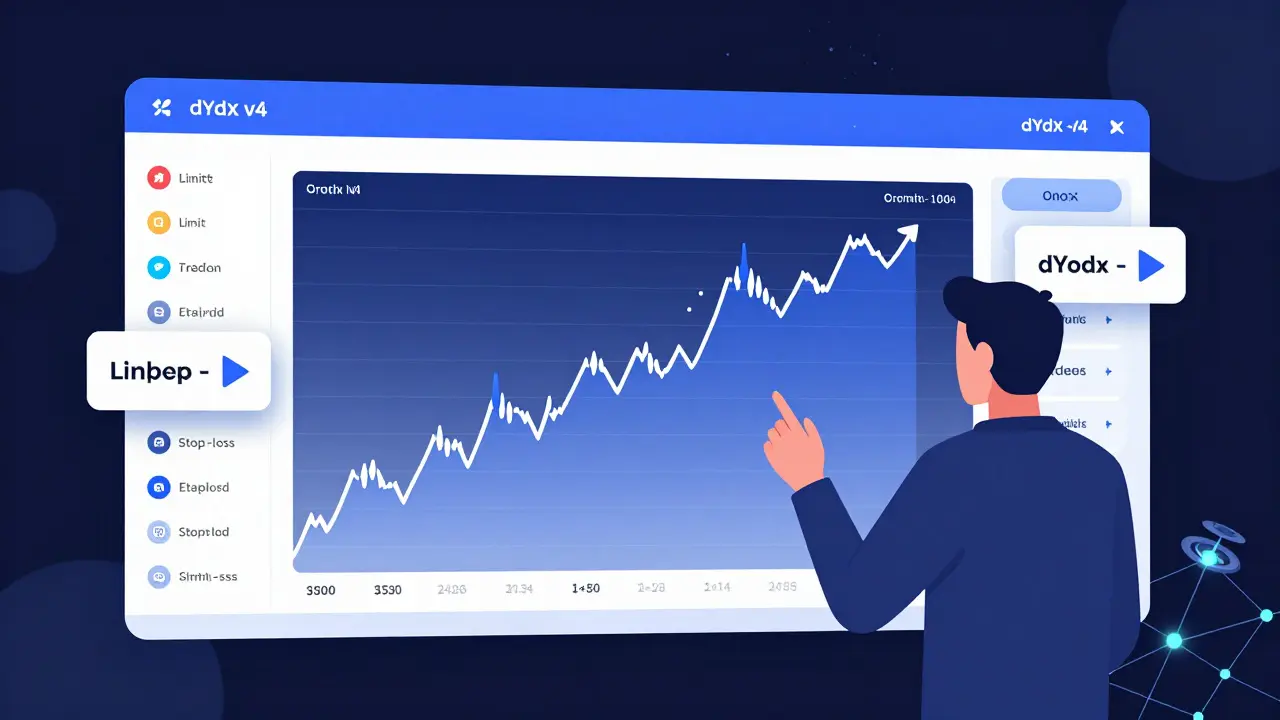
Order book DEXs solve this. You can place a large limit order and watch it fill gradually as other traders hit your price. You can see the order book depth and adjust accordingly. You can use advanced order types like stop-losses or trailing limits (available on platforms like dYdX v4). You’re not at the mercy of a mathematical formula. You’re trading in a real market.
Professional traders prefer order books because they offer price discovery-the true reflection of supply and demand. In a 2024 paper by Duke University’s Dr. Campbell Harvey, researchers found that order book DEXs provide “more accurate price signals” than AMMs because they capture the actual intentions of market participants, not just aggregated pool ratios.
On Reddit, traders consistently praise dYdX for its order book interface. One user wrote: “I can place a limit order at $2,850 and walk away. I don’t have to guess if the price will dip. I know exactly where I stand.” That kind of control is rare in DeFi.
The Big Catch: Liquidity
Order book DEXs have one fatal flaw: they need active market makers.
On Uniswap, anyone can add liquidity to a pool and earn fees. It’s simple. You deposit ETH and USDC, and the protocol does the rest. On an order book DEX, someone has to place buy orders and sell orders at different price levels. Without that, the book is empty. No one can trade.
That’s why low-volume pairs on order book DEXs often have wide spreads-the gap between the highest bid and lowest ask. If the best bid is $3,190 and the best ask is $3,220, you’re paying $30 just to enter and exit. That’s a 0.9% cost. On AMMs, it’s usually 0.3% flat.
Some DEXs solve this by paying market makers. dYdX, for example, gives fee rebates to traders who place limit orders that get filled. This incentivizes liquidity. But it’s not enough. Most order book DEXs still struggle with thin books on lesser-known tokens. If you’re trading a new memecoin, you’re better off on an AMM.
Performance vs. Decentralization: The Trade-Off
Early order book DEXs like EtherDelta and Radar Relay failed because they were too slow. Every order update cost gas. A single trade could cost $10 in fees. That made small trades pointless.
Layer 2 solutions changed everything. Loopring’s zkRollup tech handles over 2,000 transactions per second. dYdX moved from StarkEx to its own Cosmos-based chain in 2023 to reduce centralization. These moves show the industry is evolving.
But the trade-off remains. Fully on-chain = more trustless, slower, pricier. Off-chain matching = faster, cheaper, but you’re trusting someone to match orders fairly. Can that operator be trusted? What if they front-run you? What if they disappear?
The answer is in decentralization. Projects like dYdX v4 now use a decentralized validator set to verify order matching. That’s the future: off-chain speed, on-chain trust. It’s not perfect yet-but it’s getting closer.
What’s Next for Order Book DEXs?
By 2025, order book DEXs are expected to make up 25-30% of total DEX trading volume, up from 15% in late 2023, according to ConsenSys. Why? Institutional interest. Hedge funds and trading firms don’t want to use AMMs. They need precision, depth, and control.
Derivatives trading is a big driver. dYdX now leads the DeFi derivatives market because its order book supports perpetual contracts with leverage-something AMMs can’t do well. As more complex products come online, order books will be the only viable structure.
Integration with traditional finance is also happening. Platforms are starting to support fiat on-ramps, institutional custody solutions, and even compliance tools-all while staying non-custodial. That’s a big deal. It means order book DEXs could become the bridge between Wall Street and DeFi.
But they won’t replace AMMs. They’ll coexist. AMMs are perfect for simple swaps, new tokens, and small traders. Order books are for serious trading, large volumes, and price-sensitive strategies. The future isn’t one model winning-it’s both working together.
Should You Use an Order Book DEX?
Here’s when you should use one:
- You’re trading large amounts and need low slippage
- You want to place limit orders and wait for specific prices
- You’re trading derivatives, futures, or leveraged positions
- You care about seeing real market depth and not just a single price
- You’re comfortable with a steeper learning curve
Here’s when you should stick with an AMM:
- You’re swapping small amounts of common tokens
- You don’t want to manage order types or watch the book
- You’re trading a new or low-volume token
- You want the simplest possible interface
Start with dYdX or Loopring if you want to try order book trading. Use a small amount first. Watch how the book moves. Learn how limit orders fill. Then scale up.
What’s the difference between an order book DEX and an AMM?
An order book DEX matches buyers and sellers directly using a list of open orders, just like a stock exchange. Prices are set by supply and demand. An AMM uses liquidity pools and mathematical formulas to set prices automatically. With AMMs, you trade against a pool. With order book DEXs, you trade against other traders.
Are order book DEXs safer than centralized exchanges?
Yes, in one key way: you never give up control of your funds. On centralized exchanges, your crypto is held by the exchange. If they get hacked or go bankrupt, you lose everything. On order book DEXs, your crypto stays in your wallet. Trades happen through smart contracts. You’re in control.
Why do order book DEXs have wider spreads than AMMs?
Because they rely on active market makers to place both buy and sell orders. If not enough people are placing orders, the gap between the best bid and best ask grows. AMMs pool liquidity, so spreads are tighter-even if less accurate. Order books are more precise, but only if there’s enough activity.
Can I use stop-loss orders on order book DEXs?
Yes-on platforms like dYdX v4, you can set stop-loss and take-profit orders. These are advanced orders that trigger when the price hits a certain level. They’re not available on AMMs. This makes order book DEXs much more suitable for professional trading strategies.
Do order book DEXs have high gas fees?
Only if they’re fully on-chain. Most modern order book DEXs use Layer 2 solutions like zkRollups or Optimistic Rollups, which cut gas fees by 90% or more. You pay gas only when you deposit, withdraw, or settle a trade-not for every order update. That’s why platforms like Loopring and dYdX are usable for active traders.
What’s the best order book DEX to use in 2025?
For derivatives and high-volume trading, dYdX v4 is the leader. For spot trading with low fees, Loopring is strong. Both use Layer 2 tech. For a fully decentralized approach, consider Komodo’s AtomicDEX, though it’s less user-friendly. The best choice depends on what you’re trading and how much control you want.


Author
Ronan Caverly
I'm a blockchain analyst and market strategist bridging crypto and equities. I research protocols, decode tokenomics, and track exchange flows to spot risk and opportunity. I invest privately and advise fintech teams on go-to-market and compliance-aware growth. I also publish weekly insights to help retail and funds navigate digital asset cycles.