
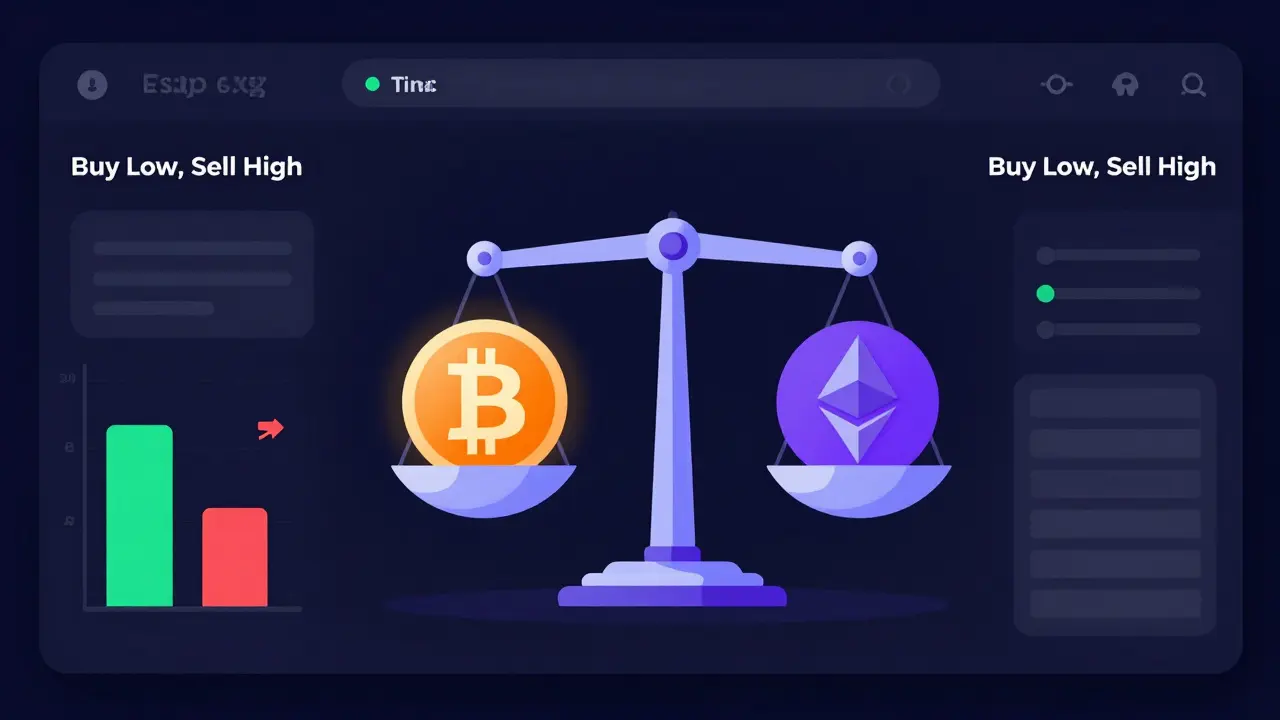
You bought Bitcoin when it was $30,000. You also grabbed some Ethereum and a few altcoins because they looked promising. Six months later, Bitcoin has doubled, but your altcoins have crashed. Suddenly, half your portfolio is in one asset, and you didn't plan for that. This is the silent killer of crypto returns: crypto portfolio rebalancing neglect.
Most investors think 'buy and hold' means buying once and never touching their assets until retirement. In traditional stocks, that might work. In crypto, where prices can swing 5-10 times more violently than equities, ignoring your allocation is like driving a car with no brakes. The market moves fast, and your risk profile changes with every tick. If you don't adjust, you're not investing-you're gambling.
The 'Rebalancing Premium': Why Adjusting Pays Off
There is a mathematical edge to rebalancing called the 'rebalancing premium.' It sounds fancy, but the concept is simple: buy low, sell high. When an asset surges, it becomes a larger part of your portfolio. Selling some of it locks in profits. When another asset crashes, its share shrinks. Buying more of it averages down your cost basis. You are systematically forcing discipline into an emotional market.
Data from Quantpedia’s 2024 analysis shows this isn't just theory. Periodically rebalanced crypto portfolios outperformed buy-and-hold strategies by 3.2% to 5.7% annually on average. This happens because crypto markets exhibit strong mean reversion-prices tend to snap back to their average over time. By rebalancing, you capture these swings. Dr. Scott Willenbrock’s research confirms that a simple buy-and-hold approach does not earn a diversification return. Only by actively maintaining your target weights do you harvest the benefits of holding uncorrelated assets.
Consider this scenario: You start with 50% Bitcoin and 50% Ethereum. Bitcoin rallies 100%, while Ethereum stays flat. Your portfolio is now roughly 67% Bitcoin and 33% Ethereum. If you rebalance back to 50/50, you sell high Bitcoin and buy cheap Ethereum. If Ethereum then catches up, you profit twice. Without rebalancing, you miss the second leg of the trade.
Two Main Ways to Rebalance: Time vs. Thresholds
There are two primary methods for deciding when to rebalance. Choosing the right one depends on how much time you want to spend managing your money and how volatile your specific assets are.
| Feature | Time-Based (Periodic) | Threshold-Based (Drift) |
|---|---|---|
| Trigger | Fixed dates (e.g., every Monday) | Asset drifts beyond set % (e.g., ±20%) |
| Frequency | Predictable, consistent | Variable, event-driven |
| Best For | Volatile, mean-reverting markets | Trending markets, tax efficiency |
| Transaction Costs | Can be higher due to unnecessary trades | Lower, only trades when necessary |
| Efficiency | Good for beginners | Higher risk-adjusted returns |
Time-Based Rebalancing is straightforward. You pick a day-say, the first of every month-and check your allocations. If they’re off, you fix them. According to Finestel’s 2025 study, 68.3% of active crypto traders use daily or weekly cycles. This works well in choppy markets where prices bounce around. However, it can lead to 'whipsaw losses,' where you trade frequently during sideways movement, racking up fees without gaining value.
Threshold-Based Rebalancing is smarter for many investors. You set a tolerance band. For example, if your target is 25% Bitcoin, you only rebalance if Bitcoin drops below 20% or rises above 30%. A Journal of Digital Finance meta-analysis found that dynamic thresholds between 10-25% generated 4.3% higher risk-adjusted returns than fixed schedules. This method reduces transaction costs and avoids trading noise. Lazy Portfolio ETF data showed that threshold-based rebalancing achieved similar returns to yearly rebalancing but with significantly fewer trades (7 vs. 17), making it more efficient.
Setting Your Allocation: Equal Weight vs. Risk Parity
Before you rebalance, you need a target. Most beginners start with equal weight-splitting their capital evenly across chosen assets. If you hold four coins, each gets 25%. It’s simple, but it ignores volatility. Bitcoin might swing 5%, while a small-cap altcoin swings 50%. Equal weighting treats them as equally risky, which they aren’t.
A more advanced approach is Risk Parity. Here, you allocate based on inverse volatility. Volatile assets get smaller dollar amounts so their potential impact on the portfolio is balanced against stable assets. XBTO’s 2025 report noted that risk-parity models reduced portfolio drawdowns by 18.3% during the 2022 crypto winter compared to equal-weight portfolios. This doesn't mean lower returns; it means smoother rides. For instance, a DeFi-tilted portfolio might hold 40% BTC/ETH, 30% DeFi tokens, and 30% stablecoins. During a bull run, this captures upside. During a crash, the stablecoins cushion the blow.
Thematic tilts are popular too. You might overweight sectors you believe in, like Layer 2 solutions or AI-integrated chains. But remember: concentration increases risk. A DeFi-heavy portfolio generated 47.2% annualized returns in 2021 but suffered 63.8% drawdowns in 2022. Know your conviction level.
The Hidden Costs: Fees, Slippage, and Taxes
Rebalancing isn't free. Every trade incurs costs. On major exchanges, fees range from 0.1% to 0.5% per transaction. If you rebalance a $10,000 portfolio monthly, those fees add up. Reddit user u/CryptoBalancer99 documented losing $142 per $10,000 invested annually just in extra transaction costs due to frequent weekly rebalancing. That’s a drag on your net return.
Then there’s slippage. In volatile markets, the price you see might change by the time your order executes. XBTO reports average slippage of 0.3-0.7% during rebalancing events. This is especially bad for illiquid altcoins. If you try to sell a large position in a low-volume token, you might crash the price yourself.
Taxes are the biggest headache. In many jurisdictions, including the US, every sale triggers a taxable event. Selling Bitcoin to buy Ethereum creates a capital gain or loss. Tracking this manually is a nightmare. TokenMetrics’ 2025 survey cited tax reporting complexity as the top complaint in 63% of negative reviews for rebalancing tools. Use software that integrates with tax platforms or consult a professional. Don't let short-term gains turn into long-term penalties.
Tools for Automation: Let Robots Do the Work
Manual rebalancing is error-prone and time-consuming. Managing a 15-asset portfolio can take 8-10 hours a month. Automation solves this. Platforms like 3Commas, Finestel Terminal, and exchange-native bots (Binance, Pionex) monitor your portfolio and execute trades automatically.
3Commas holds a 34.7% market share in rebalancing tools, praised for its smart threshold calculator. However, users note its interface can be complex for beginners. Binance’s bot offers excellent execution speed but is limited to assets listed on Binance. Finestel Terminal 3.0, launched in March 2025, uses machine learning to adjust thresholds dynamically based on volatility regimes, reducing unnecessary trades by 37%. This AI-driven approach represents the next evolution: adaptive rebalancing that reacts to market conditions rather than rigid rules.
When choosing a tool, look for:
- API integration with multiple exchanges to avoid fragmentation.
- Real-time tracking and alert systems.
- Tax reporting features to simplify end-of-year filings.
- Low latency execution to minimize slippage.
Remember, automation requires setup. You still need to define your targets and thresholds. Garbage in, garbage out. Ensure your API keys are secure and enable withdrawal restrictions to prevent hacks.
Common Pitfalls and How to Avoid Them
Even with the best tools, mistakes happen. Here are three common traps:
- Over-Rebalancing in Trends: Dr. Michael Chen warns that over-rebalancing in strongly trending markets can reduce returns by 15-20%. If Bitcoin is in a parabolic run, selling it every week to buy lagging assets caps your upside. Use wider thresholds during bull runs.
- Ignoring Correlation: During crashes, crypto assets often correlate at 80-90%. Dr. Jane Smith notes that a 5% allocation to a volatile altcoin can become 25% of your portfolio in weeks if correlations break down unexpectedly. Diversify across uncorrelated assets like stablecoins or gold-backed tokens.
- Chasing Performance: Don't rebalance into winners just because they're hot. Stick to your original thesis. If you allocated to Solana for its tech, don't sell it just because Cardano spiked. Emotional trading destroys discipline.
User u/AltcoinTrader88 reported losing 8.3% of their portfolio to fees during Ethereum's consolidation phase in Q2 2024 due to tight thresholds triggering whipsaw trades. Lesson learned: widen your bands during sideways markets.
Next Steps: Building Your Rebalancing Plan
Start small. Define your target allocation. Choose a method-threshold-based is generally more efficient. Pick a tool that fits your technical comfort level. Set realistic expectations: rebalancing won't make you rich overnight, but it will protect your downside and steady your returns.
Monitor your performance quarterly. Adjust thresholds based on volatility. As the market matures, the rebalancing premium may shift, but the core principle remains: discipline beats emotion. In crypto, survival is the first step to success. Rebalancing ensures you stay in the game.
How often should I rebalance my crypto portfolio?
There is no single answer, but threshold-based rebalancing is often more efficient than fixed schedules. Many investors use monthly checks or set drift limits of ±10-20%. Daily rebalancing is common among active traders (68.3% per Finestel 2025) but can incur high fees. Consider your transaction costs and tax implications before choosing frequency.
Does rebalancing actually increase returns?
Yes, through the 'rebalancing premium.' Quantpedia’s 2024 analysis shows rebalanced portfolios outperform buy-and-hold by 3.2-5.7% annually on average. This comes from systematically buying low and selling high, capturing mean reversion in volatile crypto markets.
What is the difference between time-based and threshold-based rebalancing?
Time-based rebalancing occurs at fixed intervals (e.g., monthly). Threshold-based rebalancing triggers when an asset's allocation drifts beyond a set percentage (e.g., ±20%). Threshold-based is generally more tax-efficient and reduces unnecessary trades, making it better for most investors.
Are there tax implications for rebalancing crypto?
Yes, in most jurisdictions, selling one crypto to buy another is a taxable event. Each rebalance can trigger capital gains or losses. Use automated tools with tax reporting features or consult a tax professional to manage compliance and avoid penalties.
Which tools are best for automated crypto rebalancing?
Popular options include 3Commas (market leader with smart calculators), Finestel Terminal (AI-driven adaptive thresholds), and exchange-native bots like Binance’s. Choose based on your need for multi-exchange support, ease of use, and tax integration capabilities.
Is risk parity better than equal weighting?
Risk parity allocates based on volatility, reducing drawdowns by up to 18.3% in bear markets (XBTO 2025). It is better for risk management but more complex to calculate. Equal weighting is simpler but treats volatile and stable assets as equally risky, which may not suit conservative investors.
Author
Ronan Caverly
I'm a blockchain analyst and market strategist bridging crypto and equities. I research protocols, decode tokenomics, and track exchange flows to spot risk and opportunity. I invest privately and advise fintech teams on go-to-market and compliance-aware growth. I also publish weekly insights to help retail and funds navigate digital asset cycles.