
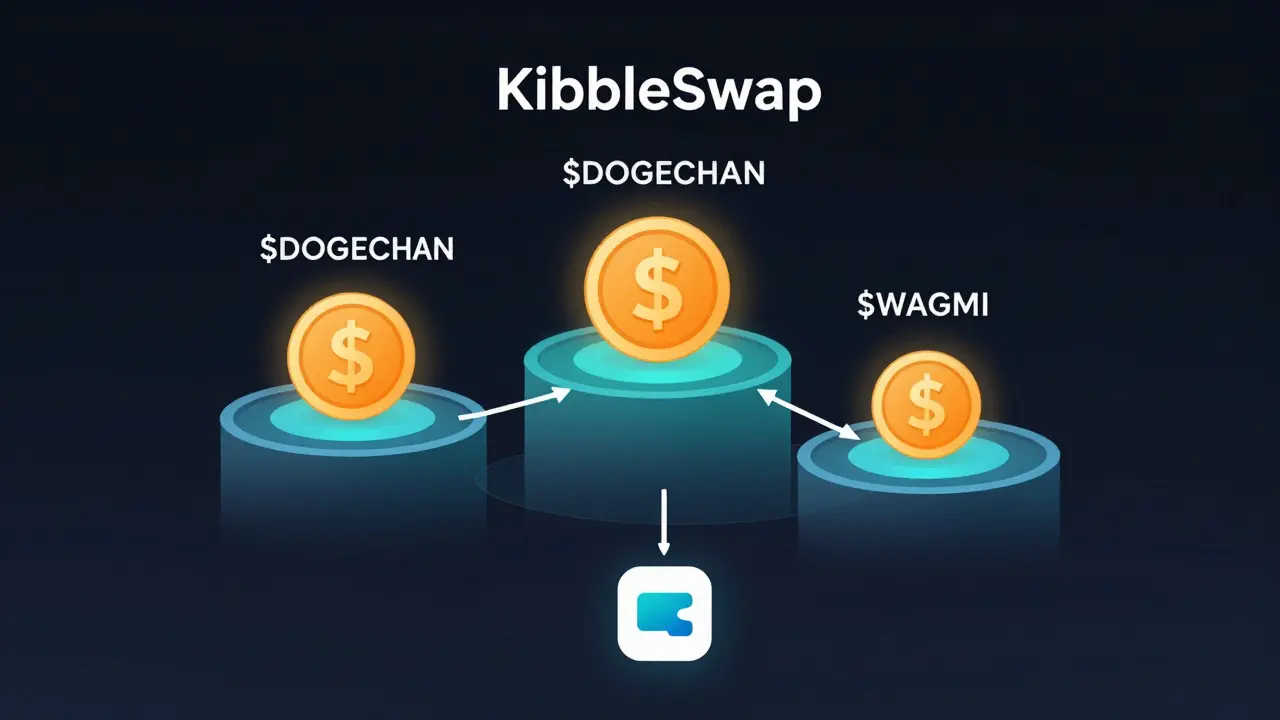
Most people looking to swap crypto use Uniswap, PancakeSwap, or SushiSwap. But what if you're only trading tokens built on DogeChain? That’s where KibbleSwap comes in. It’s not another general-purpose exchange. It’s built for one thing: trading DogeChain-native tokens. If you’re not on DogeChain, KibbleSwap won’t help you. If you are, it might be the only tool you need.
What Is KibbleSwap?
KibbleSwap is the native decentralized exchange (DEX) of the DogeChain blockchain. Unlike platforms that work across dozens of blockchains, KibbleSwap only runs on DogeChain. It doesn’t try to be everything. It’s built to be the best at one thing: letting users swap tokens like $DOGECHAIN, $BONE, $WAGMI, or any other token created on DogeChain.
It uses an automated market maker (AMM) model - the same system Uniswap uses. That means there are no order books. Instead, liquidity pools hold pairs of tokens, and prices shift based on supply and demand. When you swap $DOGECHAIN for $WAGMI, you’re trading against a pool of both tokens, not another person.
The platform’s native token is $KIB. It’s not just a currency - it’s the backbone of the whole system. Holding $KIB gives you a share of trading fees. Every time someone swaps on KibbleSwap, 0.3% of the trade goes to liquidity providers. A portion of that fee is redistributed to $KIB stakers. It’s a simple reward system, but it’s designed to keep users invested in the network.
How KibbleSwap Works
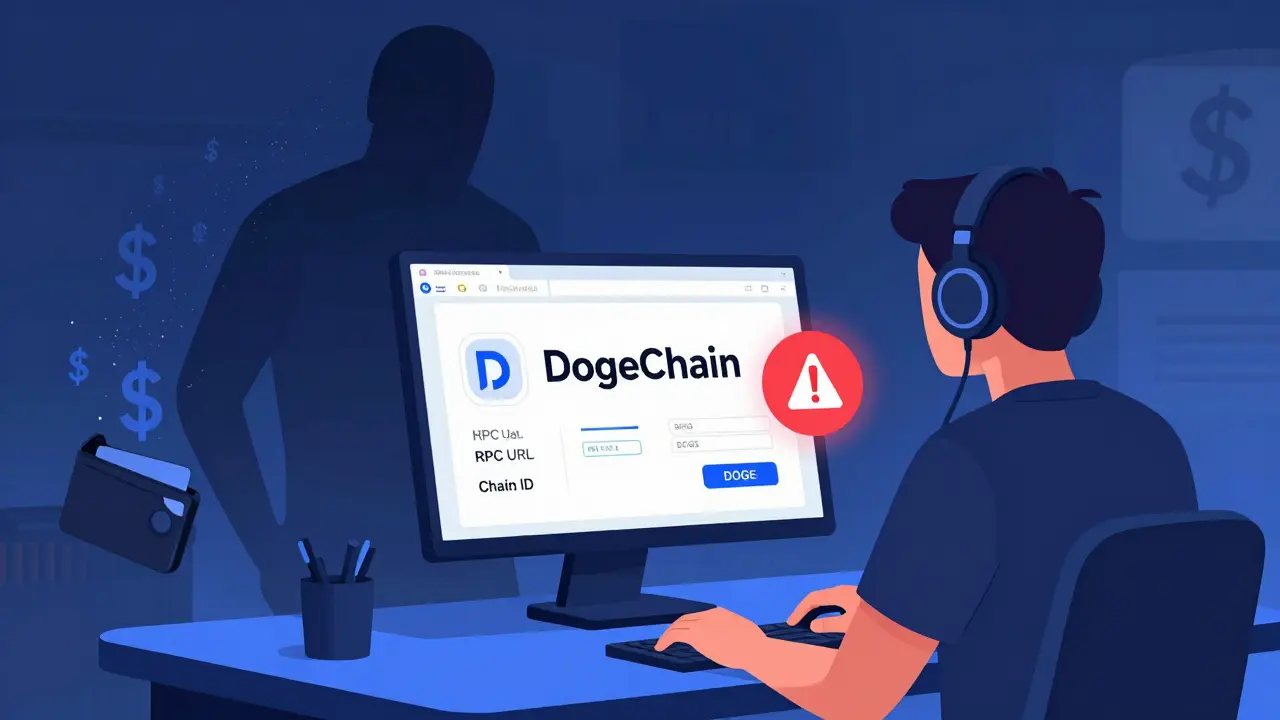
To use KibbleSwap, you need a Web3 wallet like MetaMask. But here’s the catch: you can’t just connect it like you would on Ethereum or BSC. You have to manually add DogeChain to your wallet.
DogeChain is EVM-compatible, meaning it works with Ethereum tools - but it has its own network ID, RPC endpoint, and native currency (DOGE). If you don’t configure your wallet correctly, you’ll send funds to the wrong chain. There’s no safety net. Mistakes here mean permanent loss.
Once connected, you can:
- Swap any DogeChain token for another
- Add liquidity to pools and earn fees
- Stake $KIB to earn more $KIB
- Participate in governance (if you hold enough)
There’s no KYC. No sign-up. No email verification. Just connect your wallet and go. That’s the beauty of DeFi - and also its danger.
The $KIB Token: Low Value, High Risk
As of early 2026, $KIB trades around $0.0000000147. That’s not a typo. It’s a 10-digit decimal. You need billions of tokens to make even a dollar.
Why does this matter? Because it reflects market perception. $KIB isn’t a blue-chip token like UNI or CAKE. It’s a micro-cap token with almost no trading volume outside DogeChain. CoinDataFlow predicted a 90.37% price increase by 2025 - but that’s based on a tiny base. Even if it doubles, you’re still looking at pennies per token.
Here’s the reality: $KIB’s value comes from utility, not speculation. If DogeChain grows, $KIB could rise. If DogeChain dies, $KIB goes to zero. There’s no backup plan. No team with a treasury. No venture capital backing. Just code and community.
Pros and Cons
Let’s cut through the noise. Here’s what KibbleSwap actually does well - and where it falls apart.
Pros
- Best liquidity for DogeChain tokens - If you’re trading $DOGECHAIN or $WAGMI, you’ll find deeper pools here than on any other DEX.
- Low slippage - Because it’s focused on one chain, price impact is minimal for small trades.
- Native rewards - $KIB staking gives passive income without locking up your main assets.
- No fees for wallet connection - Unlike some centralized exchanges, there’s no hidden cost to just using the platform.
Cons
- No cross-chain support - You can’t swap ETH for DOGECHAIN here. You need another platform for that.
- No smart contract audit public record - No reputable firm like CertiK or Hacken has published an audit. That’s a red flag.
- No customer support - If something breaks, you’re on your own. No live chat. No email. No help desk.
- Minimal community activity - Reddit threads? Zero. Twitter engagement? Barely there. No tutorials. No guides. No YouTube walkthroughs.
- Extremely low liquidity outside DogeChain - You won’t find $KIB on CoinGecko, Binance, or Kraken. It’s trapped on DogeChain.
Who Is KibbleSwap For?
Not everyone. Not even most crypto users.
KibbleSwap is only useful if:
- You hold DogeChain-native tokens
- You’re comfortable with high-risk, low-liquidity assets
- You understand how to configure a Web3 wallet for a non-Ethereum chain
- You’re okay with zero customer service
If you’re a casual trader, a beginner, or someone who wants to swap Bitcoin for Ethereum - walk away. KibbleSwap isn’t for you.
If you’re deep into the DogeChain ecosystem - maybe a developer, a liquidity provider, or a long-term holder of $DOGECHAIN-based tokens - then KibbleSwap is your only real option. It’s not flashy. It’s not safe. But it’s necessary.
Security and Trust
This is the biggest question: Is KibbleSwap safe?
The answer? We don’t know.
No public audit. No bug bounty program. No history of hacks - but also no record of being checked. That’s not normal. Even the smallest DEXs get audited these days. KibbleSwap doesn’t even pretend to try.
There’s no regulatory status. No license. No compliance team. That’s standard for DEXs - but again, most of them at least have public audits. KibbleSwap doesn’t. That’s a red flag.
Users report no scams tied directly to KibbleSwap - but that’s likely because so few people use it. If something goes wrong, there’s no one to call. No insurance fund. No recourse.
Comparison: KibbleSwap vs. Other DEXs
| Feature | KibbleSwap | PancakeSwap | Uniswap v3 | KyberSwap Classic |
|---|---|---|---|---|
| Supported Chains | DogeChain only | BSC, Polygon, Ethereum | Ethereum | 15+ chains |
| Native Token | $KIB | $CAKE | $UNI | $KNC |
| Token Price (est. 2026) | $0.0000000147 | $1.85 | $6.20 | $0.38 |
| Trading Fees | 0.3% (shared with LPs) | 0.2% - 0.3% | 0.05% - 1% | 0% |
| Smart Contract Audit | Not public | Yes (CertiK) | Yes (OpenZeppelin) | Yes (Hacken) |
| User Base Size | Unknown, likely <10K | 2M+ monthly | 1.5M+ monthly | 174K monthly |
| Customer Support | None | Discord, email | Community forums | Discord, email |
The table says it all. KibbleSwap is in a league of its own - not because it’s better, but because it’s narrower. It’s not competing with PancakeSwap. It’s competing with silence.
Future Outlook
There’s no roadmap. No announced upgrades. No team updates. No blog posts. The last public update was likely in 2024.
That’s not how successful projects operate. Even the smallest DEXs post monthly updates. KibbleSwap doesn’t. That’s a bad sign.
Its future depends entirely on DogeChain. If DogeChain gains traction - maybe because of a meme coin boom or new DeFi integration - then KibbleSwap could grow. If DogeChain fades into obscurity, KibbleSwap dies with it.
The CoinDataFlow prediction of 90% growth by 2025? That’s a bet on hype, not fundamentals. There’s no evidence DogeChain is gaining adoption. No major wallets added support. No exchanges listed $KIB. No institutional interest.
This isn’t a project. It’s a bet on a niche.
Final Verdict
KibbleSwap isn’t a scam. It’s not a Ponzi. It’s just… barely alive.
If you’re a DogeChain user with tokens to swap, it’s your only option. It works. It’s functional. But it’s risky. It’s unsupported. And it’s invisible to the rest of the crypto world.
If you’re not on DogeChain? Don’t bother. You’ll waste time. You’ll risk funds. You won’t get anything back.
This isn’t a platform for investors. It’s a tool for insiders. If you’re not already deep in the DogeChain ecosystem, stay out. If you are - use it, but never put more in than you’re willing to lose.
Is KibbleSwap a centralized exchange?
No. KibbleSwap is a decentralized exchange (DEX). It runs on DogeChain as a smart contract. There’s no company, no customer service, no login, and no way for anyone to freeze your funds or access your wallet. You control your keys. That’s the whole point.
Can I buy $KIB on Binance or Coinbase?
No. $KIB is only available on KibbleSwap and a handful of tiny, obscure DEXs on DogeChain. It’s not listed on any major exchange. If you see $KIB on Binance, Coinbase, or Kraken - it’s fake. Don’t trust it.
Is KibbleSwap safe to use?
There’s no public audit, no bug bounty, and no track record of security. It’s as risky as any un-audited DeFi protocol. You could lose funds due to a smart contract bug, a wallet misconfiguration, or a phishing attack. Only use it if you understand the risks and have experience with Web3 wallets.
How do I add DogeChain to MetaMask?
Go to MetaMask > Settings > Networks > Add Network. Enter: Network Name: DogeChain, New RPC URL: https://rpc.dogechain.dog, Chain ID: 2000, Currency Symbol: DOGE, Block Explorer URL: https://dogechain.info. Save and switch networks. Never skip this step.
What happens if DogeChain shuts down?
KibbleSwap stops working. All liquidity pools vanish. $KIB becomes worthless. There’s no backup. No recovery. No migration path. If DogeChain dies, KibbleSwap dies with it - and so do your assets on it.
Should I stake $KIB for rewards?
Only if you’re already holding $KIB and understand it’s a high-risk bet. The rewards are real - but the token has no intrinsic value outside KibbleSwap. If DogeChain loses users, your staked $KIB will lose value. You’re not earning passive income - you’re betting on a dying ecosystem.
Use KibbleSwap if you have to. But don’t use it because you think it’s the next big thing. It’s not. It’s a quiet, unremarkable tool for a quiet, unremarkable chain. And that’s okay - if you know what you’re doing.


Author
Ronan Caverly
I'm a blockchain analyst and market strategist bridging crypto and equities. I research protocols, decode tokenomics, and track exchange flows to spot risk and opportunity. I invest privately and advise fintech teams on go-to-market and compliance-aware growth. I also publish weekly insights to help retail and funds navigate digital asset cycles.