

You used to be able to buy Bitcoin with just an email address. Those days are gone. In 2026, if you want to trade on a major platform like Coinbase or Binance, you need to hand over your passport, take a selfie, and prove where you live. This process is called Know Your Customer (KYC), which is the mandatory identity verification process required by cryptocurrency exchanges to comply with global anti-money laundering laws. It is no longer optional for most users; it is the gatekeeper to the digital asset economy.
The shift has been dramatic. Back in 2019, when the Financial Action Task Force (FATF) updated its rules to include virtual assets, many in the crypto community groaned at the loss of anonymity. But today, that same regulatory pressure is what keeps your funds safe from scammers and hackers. With 92% of centralized exchanges now fully KYC compliant, understanding these requirements isn't just about following the law-it's about knowing how to navigate the modern crypto landscape efficiently.
Why Crypto Exchanges Demand Your Identity
It’s easy to look at KYC as bureaucratic red tape, but there is a specific reason it exists. The core driver is Anti-Money Laundering (AML), a set of regulations designed to prevent criminals from disguising illegally obtained funds as legitimate income. Governments realized that without oversight, cryptocurrencies could become the preferred tool for money launderers, terrorist financiers, and tax evaders. To stop this, they applied the same rules that banks have followed for decades to crypto exchanges.
In the United States, the Bank Secrecy Act mandates this. In Europe, the Anti-Money Laundering Directive 6 (AMLD6) does the same. These laws require Virtual Asset Service Providers (VASPs)-the official term for exchanges-to verify who their customers are before allowing significant transactions. If an exchange fails to do this, regulators can shut them down or levy massive fines. For you, the user, this means the exchange acts as a filter, ensuring that the people trading against you are real individuals, not shell companies or sanctioned entities.
There is also a security angle. According to a 2025 report by CipherTrace, implementing strict KYC protocols reduces crypto fraud risk by 38%. When every account is tied to a verified identity, it becomes much harder for bad actors to operate with impunity. While purists argue this betrays the spirit of decentralized finance, the data shows that regulated platforms attract more institutional capital and offer greater stability for retail investors.
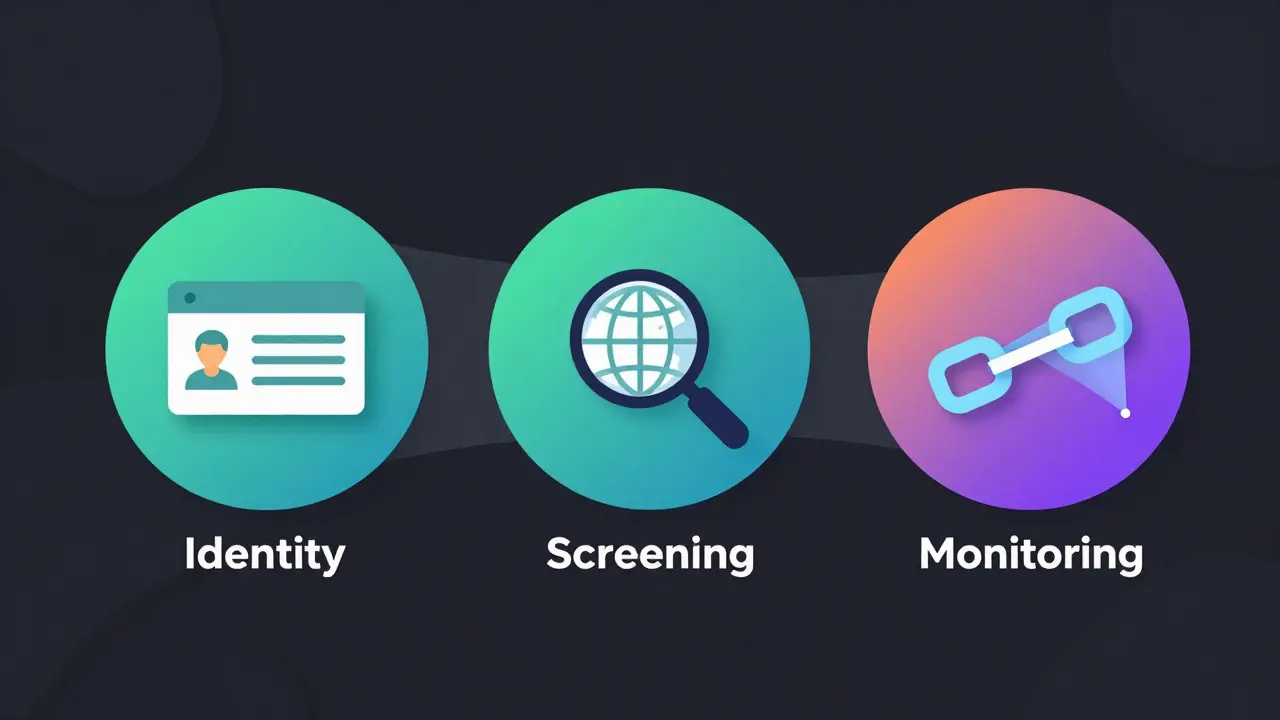
The Three Pillars of Modern KYC Verification
When you sign up for a new exchange, you aren’t just filling out a form. You are going through a three-stage verification process that has become highly standardized across the industry. Understanding these stages helps you prepare the right documents and avoid common delays.
1. Identity Verification (e-KYC)
The first step answers the question: "Who is this person?" You will typically upload a government-issued ID, such as a passport, driver’s license, or national ID card. The system uses optical character recognition (OCR) to read the details automatically. Then, you’ll be asked to take a live selfie or a short video. Advanced biometric algorithms compare the facial geometry in your photo to the image on your ID in real-time. This prevents someone from using a stolen passport or a photo of a photo to create a fake account.
2. Screening and Due Diligence
Once your identity is confirmed, the system checks if you should be doing business with the exchange. This involves scanning your name against global sanctions lists, databases of Politically Exposed Persons (PEPs), and adverse media sources. A PEP might be a head of state, a senior politician, or a judge. These individuals aren’t banned from trading, but they trigger higher levels of scrutiny because they are statistically more likely to be involved in corruption. If your name matches a known criminal or sanctioned entity, your account will be flagged for manual review.
3. Transaction Monitoring
The final pillar looks at your behavior. It asks: "What are they doing?" Even after you pass KYC, the exchange monitors your wallet activity. Using blockchain analysis tools like Chainalysis, they track where your funds come from and where they go. If you suddenly receive a large transfer from a wallet linked to a ransomware attack or a darknet market, the system flags it. This continuous monitoring ensures that compliant users don’t inadvertently interact with illicit funds.
What Documents Do You Actually Need?
Preparing your documents correctly is the key to a smooth onboarding experience. Most exchanges accept similar types of proof, but the quality of your submission matters more than you might think. Here is what you generally need:
- Government-Issued Photo ID: A valid passport is usually the gold standard because it is internationally recognized. Driver’s licenses work well for domestic trading but may face issues if the exchange operates globally. Ensure all four corners of the document are visible and the text is legible.
- Proof of Address (POA): This confirms your residence. Acceptable documents include utility bills (electricity, water, gas), bank statements, or tax returns. Crucially, these documents must be dated within the last three months. Older documents are almost always rejected.
- Biometric Data: You will need a smartphone or webcam capable of capturing high-resolution images. Good lighting is essential; shadows across your face or glare on your ID card are the top reasons for automatic rejection.
If you are traveling, keep a digital copy of your passport handy. Some exchanges allow you to start the process with just your ID and complete the proof of address later, but having everything ready speeds up the timeline significantly.
KYC vs. Privacy: The Ongoing Tension
The requirement to reveal your identity clashes with one of cryptocurrency’s original promises: financial privacy. This tension creates a divide in the market. On one side, you have centralized exchanges (CEXs) like Kraken and Coinbase, which prioritize security and regulatory compliance. On the other, you have decentralized exchanges (DEXs) like Uniswap, which traditionally allowed anonymous trading.
However, the gap is closing. As of 2026, 41% of DeFi platforms now offer optional KYC processes, up from just 25% in 2024. Why? Because institutions won’t touch unverified platforms. If you want to move millions of dollars into DeFi, you need assurance that the protocol isn’t being drained by insiders. Consequently, many hybrid models are emerging where basic trading is anonymous, but high-volume withdrawals or fiat conversions require full KYC.
For the average user, this means total anonymity is becoming harder to maintain. However, privacy-focused solutions are evolving too. Zero-knowledge proofs (ZKPs) are gaining traction, allowing you to prove you meet certain criteria (like being over 18 or not on a sanctions list) without revealing your actual name or address. While not yet mainstream on major exchanges, this technology represents the future balance between compliance and privacy.
How Long Does Verification Take?
Patiently waiting for approval is a thing of the past. Technological advancements have drastically reduced verification times. In 2023, the average KYC check took seven minutes. By 2025, that number dropped to 3.5 minutes for automated approvals. Today, most major exchanges use AI-driven systems that can approve standard cases in under two minutes.
Delays usually happen only in edge cases. If your ID is slightly blurry, if your name has unusual characters, or if you live in a country with complex regulatory status, the system may flag your application for manual review. This human review can take anywhere from a few hours to 48 hours. To avoid this, ensure your photos are crisp, well-lit, and free of glare. If you get rejected, don’t panic-most platforms allow you to resubmit immediately with clearer images.

Tiered Accounts and Withdrawal Limits
Not all KYC requirements are created equal. Many exchanges use a tiered system to balance accessibility with compliance. Here is how it typically works:
| Tier Level | Verification Required | Typical Daily Limit | Best For |
|---|---|---|---|
| Tier 1 (Basic) | Email + Phone Number | $100 - $500 | Casual buyers, small experiments |
| Tier 2 (Standard) | ID + Selfie (Level 1 KYC) | $2,000 - $10,000 | Regular traders, moderate investments |
| Tier 3 (Advanced) | ID + Selfie + Proof of Address (Full KYC) | $50,000+ | High-net-worth individuals, institutions |
This structure allows you to start trading quickly with minimal friction. If you only want to buy $50 worth of Ethereum, you might not even need to upload your passport. But if you plan to withdraw $50,000, you will need to complete the full suite of checks. Always check the specific limits of your chosen exchange, as they vary by region and regulatory jurisdiction.
Choosing a Compliant Exchange
With so many platforms available, how do you know which ones handle KYC responsibly? Look for transparency. Reputable exchanges clearly state their privacy policies and explain exactly how your data is stored and used. They should also be licensed in major jurisdictions like the US, EU, UK, or Singapore.
Avoid platforms that promise "no KYC ever" unless you are an advanced user comfortable with decentralized wallets and bridge risks. Unregulated exchanges often lack insurance funds and customer support. If something goes wrong, you have no recourse. In 2026, trust is built on compliance. Major players like Coinbase, Kraken, and Binance have invested heavily in seamless KYC experiences because they know that a smooth onboarding process is a competitive advantage. Users prefer platforms that respect their time while keeping their assets secure.
Future Trends: What’s Next for KYC?
The landscape is still evolving. We are seeing a push toward standardized international KYC data sharing protocols. Imagine verifying your identity once with a trusted provider and then reusing that credential across multiple exchanges-a concept known as "verify once, use everywhere." This would eliminate the frustration of uploading your passport ten different times.
Additionally, AI-driven risk scoring is becoming more sophisticated. Instead of blanket restrictions, exchanges may soon adjust your limits dynamically based on your transaction history and behavior. And as mentioned earlier, privacy-preserving technologies like zero-knowledge proofs will likely become standard, allowing you to remain anonymous to the public while remaining compliant with regulators.
For now, the message is clear: KYC is here to stay. Embrace it as a necessary step toward a safer, more mature crypto ecosystem. Prepare your documents, choose reputable platforms, and enjoy the peace of mind that comes with knowing your investment is protected by robust security measures.
Is KYC mandatory for all crypto exchanges?
For centralized exchanges (CEXs) operating in regulated jurisdictions like the US, EU, and UK, yes, KYC is mandatory. Decentralized exchanges (DEXs) often do not require KYC for basic trading, but many are introducing optional or mandatory verification for high-volume users or fiat integrations to comply with emerging regulations.
How long does KYC verification usually take?
Most modern exchanges use automated systems that approve standard applications in under 5 minutes. However, if your documents are unclear or you are flagged for manual review due to a name match or unusual activity, it can take anywhere from a few hours to 48 hours.
What happens if my KYC verification fails?
If your verification fails, the exchange will usually notify you via email with the reason, such as a blurry photo or expired ID. You can typically resubmit your documents immediately. If the issue persists, contact customer support for manual assistance. Persistent failures may lead to account suspension until resolved.
Can I trade crypto without KYC in 2026?
Yes, but with limitations. You can use peer-to-peer (P2P) platforms or decentralized exchanges (DEXs) like Uniswap without traditional KYC. However, converting fiat currency to crypto anonymously is difficult, and withdrawal limits on non-KYC accounts are often very low. Additionally, regulatory pressure is increasing on DEXs to implement some form of identity checks.
Is my personal data safe during KYC?
Reputable exchanges use encryption and secure storage methods to protect your data. They are legally bound to keep your information confidential and share it only with regulators if required by law. Always check the exchange’s privacy policy and choose platforms that are transparent about their data handling practices.
Why do exchanges need proof of address?
Proof of address helps determine your legal jurisdiction, which dictates which regulations apply to your account. It also helps prevent fraud by confirming that you are a real person living at a verifiable location, reducing the risk of duplicate accounts or identity theft.
Author
Ronan Caverly
I'm a blockchain analyst and market strategist bridging crypto and equities. I research protocols, decode tokenomics, and track exchange flows to spot risk and opportunity. I invest privately and advise fintech teams on go-to-market and compliance-aware growth. I also publish weekly insights to help retail and funds navigate digital asset cycles.