
Impermanent Loss Calculator
Enter values above to see calculation results
Impermanent loss occurs when the price of your deposited tokens changes significantly. This calculator shows the potential difference between holding your tokens versus providing liquidity.
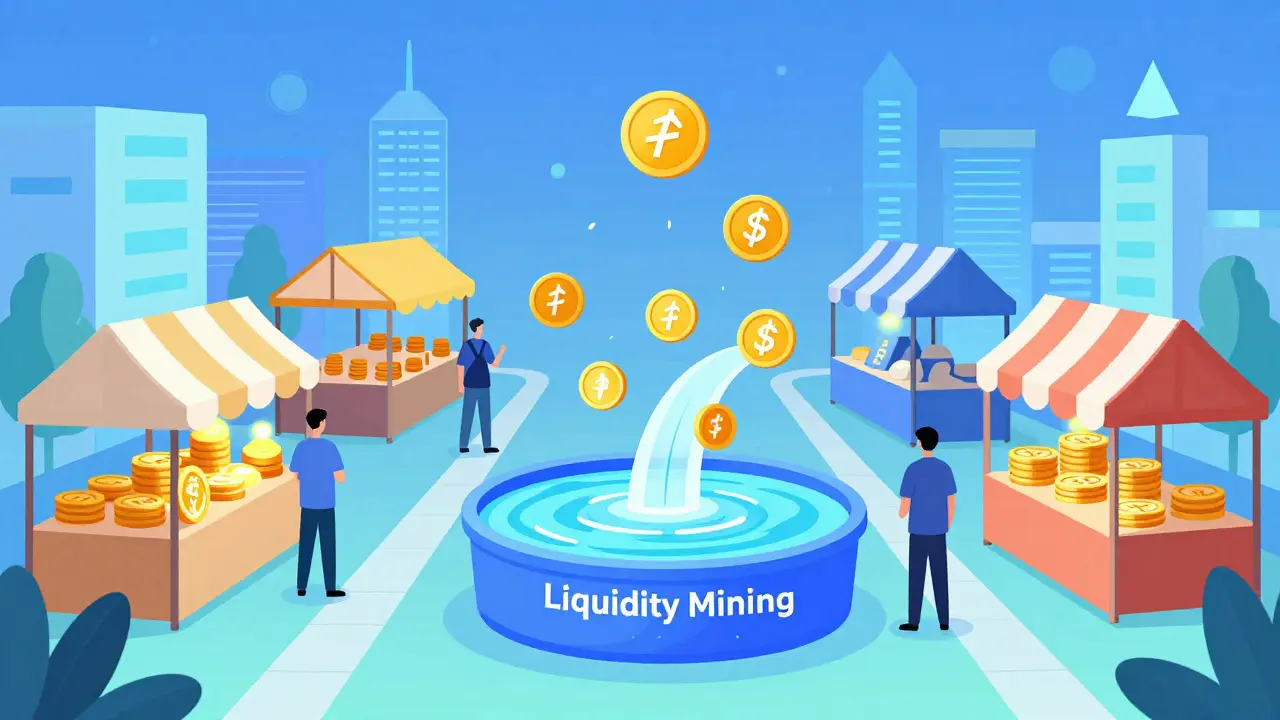
Think of DeFi as a giant, open-air market where anyone can lend, borrow, or trade crypto without a bank. But here’s the catch: to make this market work, someone has to supply the stuff being traded. That’s where liquidity mining and yield farming come in. They’re not the same thing - even though everyone mixes them up. One is about keeping the trading lanes open. The other is about chasing the highest possible return, no matter where it leads.
What Is Liquidity Mining?
Liquidity mining is the backbone of decentralized exchanges like Uniswap, SushiSwap, and Curve. It’s simple in concept: you deposit two tokens - say, ETH and USDT - into a shared pool. In return, you get LP (Liquidity Provider) tokens that prove you own a slice of that pool. Every time someone trades ETH for USDT (or vice versa), a tiny fee is charged. That fee gets split among all LPs in the pool. On top of that, the protocol often pays out extra tokens - usually its own governance token - as a bonus.Think of it like being a market maker on Wall Street, except you’re not working for a bank. You’re directly enabling trades on a blockchain. Without liquidity miners, DEXs would be useless. If no one puts ETH and USDT into the pool, you can’t swap them. No liquidity = no trading = no DeFi.
The big catch? Impermanent loss. If the price of ETH spikes 50% while your funds are locked in the pool, you’ll end up with less value than if you’d just held the ETH in your wallet. That’s because the automated market maker rebalances the pool to keep the ratio of tokens equal. You’re not losing money on paper - until you withdraw. Then you realize you could’ve made more by doing nothing.
What Is Yield Farming?
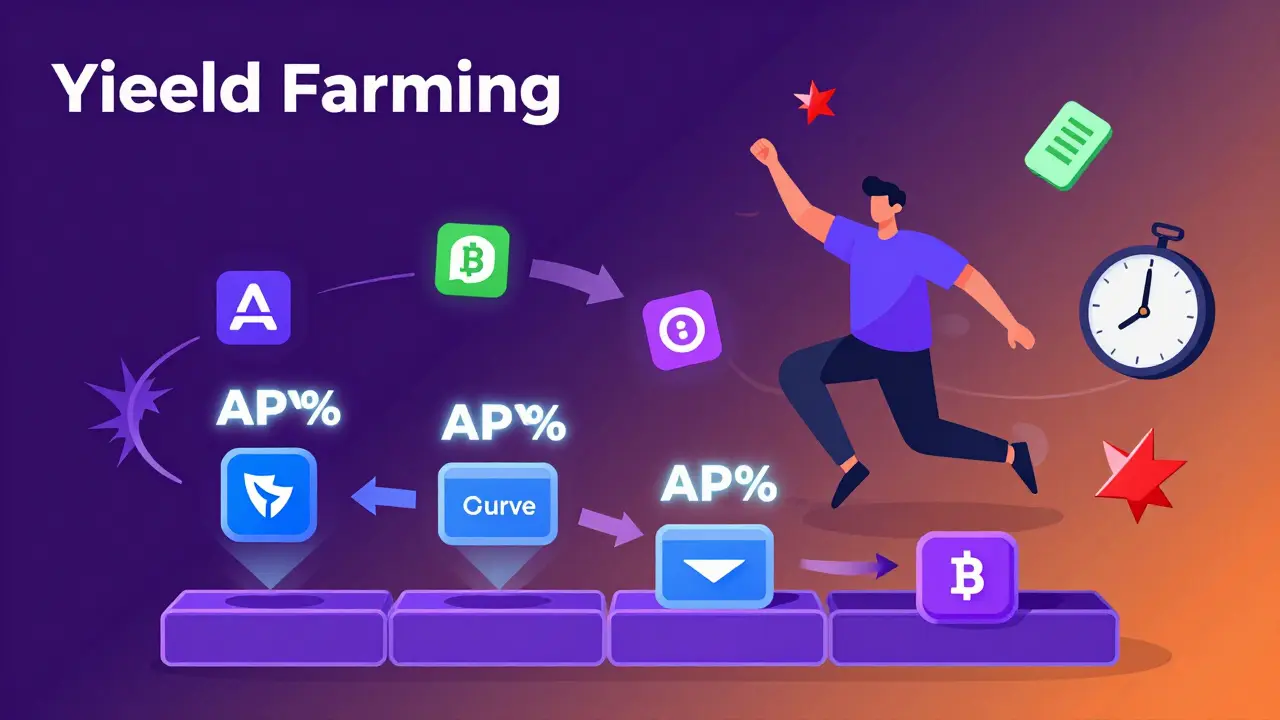
Yield farming is the hustle. It’s not just about one pool. It’s about hopping between protocols, stacking rewards, and squeezing every last percentage point of APY out of your crypto. You might start by putting USDC into Aave to earn interest. Then you take those earnings and move them to Curve to earn trading fees and CRV tokens. Then you stake those CRV tokens in another protocol to earn even more. It’s like playing financial Tetris - constantly rearranging pieces to fit the highest-paying slots.Yield farmers don’t just care about trading fees. They chase governance tokens like YFI, SUSHI, or BAL - tokens that give you voting power and sometimes future revenue shares. Some even use auto-compounding platforms like Yearn Finance to automate the process. These tools rebalance your positions, claim rewards, and reinvest them - all without you lifting a finger.
But here’s the reality: yield farming is exhausting. You need to monitor APYs daily. One week, a new pool on Arbitrum might be offering 120% APY. The next week, it’s down to 12% because everyone jumped in and diluted the rewards. You’re racing against thousands of other users, bots, and algorithms. And if you wait too long to move your funds, you miss the window.
Key Differences Between Liquidity Mining and Yield Farming
| Aspect | Liquidity Mining | Yield Farming |
|---|---|---|
| Primary Goal | Provide trading liquidity to DEXs | Maximize returns across multiple DeFi protocols |
| Main Rewards | Trading fees + protocol governance tokens | APY + multiple token incentives, often stacked |
| Typical Platforms | Uniswap, SushiSwap, Curve Finance | Aave, Compound, Yearn, PancakeSwap |
| Complexity | Low to moderate - one pool, one strategy | High - constant movement, multi-protocol management |
| Risk Profile | High - impermanent loss + smart contract risk | Very high - impermanent loss + rug pulls + gas wars |
| Time Commitment | Passive after setup | Active - daily monitoring and adjustments |
| Capital Efficiency | Low - funds locked in fixed pairs | High - optimized across pools, often leveraged |
Why People Confuse Them
The confusion comes from overlap. Most liquidity mining is a form of yield farming - because you’re earning yield. But not all yield farming is liquidity mining. If you’re lending USDT on Aave and earning 5% interest, that’s yield farming. You’re not providing liquidity to a DEX. You’re lending. If you take that same USDT and put it into a USDT/DAI pool on Uniswap, now you’re liquidity mining. Same asset. Different activity.Plus, platforms like SushiSwap and PancakeSwap do both. They offer liquidity pools (liquidity mining) AND let you stake LP tokens to earn more tokens (yield farming). So you’re doing both at once. That’s why the terms get tangled. But if you’re trying to understand your risk, you need to know which one you’re actually doing.
Risks You Can’t Ignore
Both strategies come with serious risks - and they’re not just about price drops.- Impermanent loss: Happens in liquidity mining when token prices diverge. Even if the market recovers, you’re still down compared to HODLing.
- Smart contract bugs: Code is law - but code can be flawed. In 2022, a single bug in a popular yield aggregator wiped out $100 million in user funds.
- Rug pulls: Developers abandon a project, drain the liquidity pool, and disappear. You’re left with worthless tokens.
- Gas fees: On Ethereum, moving funds between protocols can cost $50-$200 per transaction. On newer chains like Polygon or Arbitrum, it’s cheaper - but still eats into profits.
- Token inflation: Many DeFi projects dump huge amounts of governance tokens to lure users. Once the rewards dry up, the token price crashes.
There’s no safety net. No FDIC insurance. No customer support. If you mess up, your money is gone. And if you’re using leverage or borrowing to farm, one small price swing can liquidate your position.
Who Should Try These Strategies?
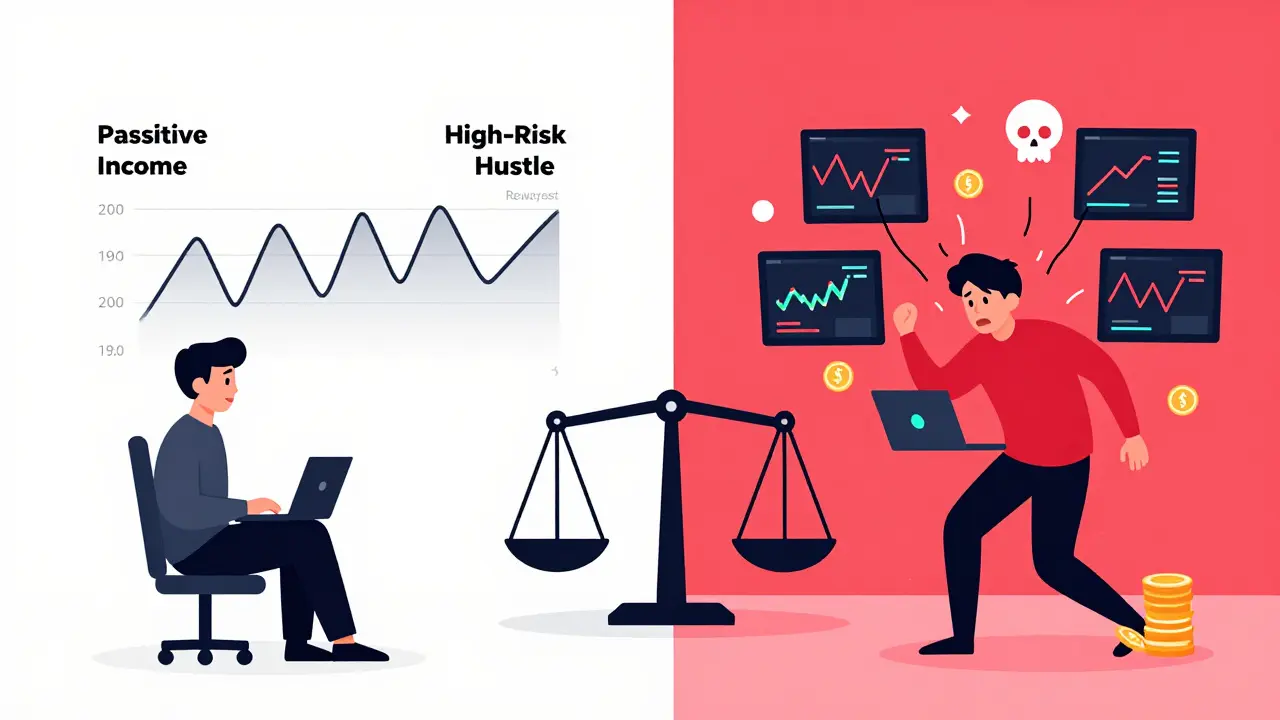
If you’re new to crypto, don’t jump in. Start with staking - it’s simpler, safer, and gives you 5-10% APY without the complexity. If you’re comfortable with crypto and understand how wallets and smart contracts work, here’s who might benefit:- Liquidity mining: People who want passive income and are okay with locking up assets for months. Good for those holding ETH, BTC, or stablecoins and willing to accept impermanent loss as a cost of doing business.
- Yield farming: Crypto-savvy traders who treat DeFi like a full-time job. You need to track APYs, read tokenomics, understand gas optimization, and have the patience to manage multiple wallets and transactions.
Most successful yield farmers don’t chase 1000% APYs. They target 15-30% consistently across trusted protocols like Curve or Aave. They avoid new tokens with no audit history. They use tools like DeFiLlama to check TVL and audit status before depositing.
The Future of DeFi Rewards
The early days of DeFi - where you could earn 100% APY just by depositing a stablecoin - are over. The market has matured. Protocols now focus on sustainable incentives. Uniswap V3 introduced concentrated liquidity, letting LPs focus their funds within specific price ranges to earn more fees with less capital. Yield aggregators now auto-switch between pools to optimize returns. Layer-2 networks like zkSync and Base have slashed gas fees, making frequent transactions affordable.Institutional players are starting to dip their toes in. Hedge funds now use DeFi as a source of alpha, not just speculation. But the core truth hasn’t changed: if a yield seems too good to be true, it probably is. The most reliable returns come from protocols with real usage, strong audits, and active communities - not from tokens with flashy logos and no product.
Liquidity mining and yield farming aren’t get-rich-quick schemes. They’re tools. Used wisely, they can generate steady income. Used recklessly, they can wipe out your portfolio. The difference isn’t in the strategy - it’s in the mindset.
Is liquidity mining the same as yield farming?
No. Liquidity mining is specifically about providing trading pairs to decentralized exchanges to earn fees and tokens. Yield farming is a broader term that includes liquidity mining but also covers lending, borrowing, staking LP tokens, and moving assets between protocols to maximize returns. All liquidity mining is yield farming, but not all yield farming is liquidity mining.
Which one is riskier: liquidity mining or yield farming?
Yield farming is generally riskier. While liquidity mining exposes you to impermanent loss and smart contract bugs, yield farming adds more layers: moving funds between protocols increases gas costs and exposure to rug pulls. Some yield farming strategies use leverage or borrow assets, which can lead to liquidation. Liquidity mining is simpler - you deposit, you earn. Yield farming is like juggling chainsaws.
Can you lose money with liquidity mining?
Yes. Even if the price of your tokens goes up, you can still lose value due to impermanent loss. For example, if you put in 1 ETH and 2000 USDT, and ETH doubles in price, the pool rebalances to keep a 50/50 value split. You’ll end up with less ETH than you started with. If you’d just held the ETH, you’d have more. The fees might cover it - but they might not.
What’s the best platform for beginners to start liquidity mining?
Start with stablecoin pairs on Curve Finance or Uniswap V3. These pools have lower volatility and less impermanent loss risk. Avoid new or obscure tokens. Stick to ETH/USDT, USDC/DAI, or WBTC/ETH. Always check the protocol’s audit status on CertiK or Immunefi before depositing.
Do you need to pay taxes on yield farming rewards?
Yes. In most countries, including the U.S., Canada, and Australia, receiving new tokens as rewards is treated as taxable income at their fair market value when you receive them. Selling or trading those tokens later triggers capital gains tax. Keep detailed records of every transaction - wallets don’t provide tax reports.
Is staking better than yield farming?
For most people, yes. Staking supports blockchain consensus (like Ethereum 2.0) and typically offers 4-10% APY with minimal risk. Yield farming can offer 20-100%+ APY, but it requires active management and carries high risk of loss. If you want passive income without the stress, staking is the safer bet.


Author
Ronan Caverly
I'm a blockchain analyst and market strategist bridging crypto and equities. I research protocols, decode tokenomics, and track exchange flows to spot risk and opportunity. I invest privately and advise fintech teams on go-to-market and compliance-aware growth. I also publish weekly insights to help retail and funds navigate digital asset cycles.