
Dec 21, 2025, Posted by: Ronan Caverly

Russian Ruble Crypto Trading Restrictions: What’s Allowed and What’s Not in 2025

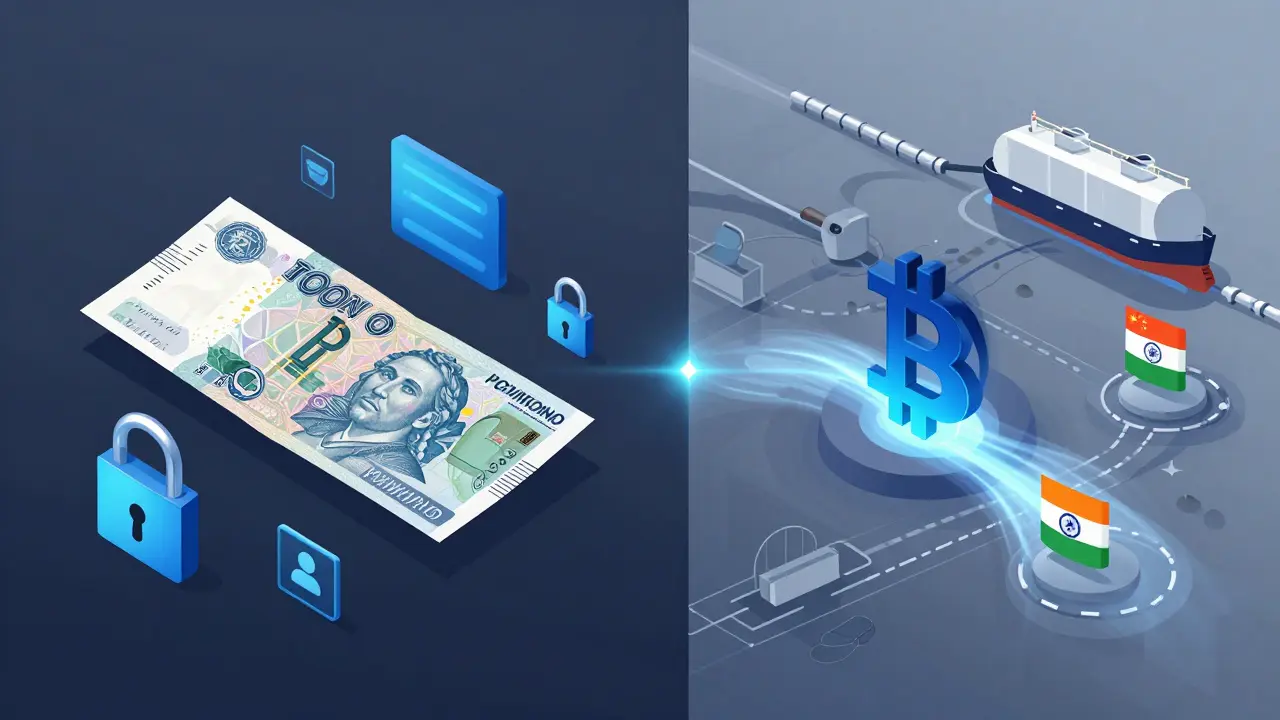
When you hear about Russia and cryptocurrency, you might think of wild underground trading or a total ban. But the truth is more complicated. In 2025, Russia doesn’t ban crypto - it just controls it tightly. The real story isn’t about whether Russians can buy Bitcoin. It’s about Russian ruble crypto trading restrictions - and how the government is using crypto to dodge sanctions while keeping the ruble king at home.

Domestic Crypto Payments Are Still Illegal

You can’t use Bitcoin to pay for groceries in Moscow. You can’t use Ethereum to buy a train ticket in St. Petersburg. That’s still illegal. Since January 2021, Russian law has banned any use of cryptocurrencies as payment within the country. Only the Russian ruble - and its official digital version, the digital ruble - are recognized as legal tender inside Russia.

This isn’t just a rule. It’s a policy choice. The Central Bank of Russia (CBR) sees crypto as a threat to monetary control. If people start paying for coffee with Bitcoin, the ruble loses its grip. And the CBR won’t allow that. Even as crypto prices soared in 2024 and 2025, the bank held firm: no domestic payments. No crypto wallets as bank accounts. No crypto debit cards. Nothing.

But here’s the twist: Russians still own billions in crypto. Estimates put private holdings at over $25 billion. Where’s it all stored? Mostly on foreign exchanges - Binance, Bybit, Kraken. People buy it overseas, send it to personal wallets, and hold it. There’s no legal domestic exchange. No official app. No Russian Coinbase. It’s all done in the shadows.

The ELR: Russia’s Secret Crypto Backdoor

In summer 2024, Russia introduced something called the Experimental Legal Regime (ELR). It’s a three-year trial, running until 2027, and it’s the only legal way Russians can use crypto - but only for international trade.

Under the ELR, Russian exporters and importers can settle cross-border deals in Bitcoin, Ethereum, or other approved digital assets. It’s not a loophole. It’s a weapon. After Western sanctions froze Russian banks out of SWIFT and cut off access to dollar reserves, Moscow needed a new way to trade oil, gas, and metals with China, India, Turkey, and others. Crypto became the workaround.

By March 2025, crypto-facilitated international trade hit 1 trillion rubles ($11 billion). That’s not small change. That’s a major shift in how Russia does business. Companies like Rosneft and Gazprom aren’t just using crypto - they’re building systems around it. They’re working with foreign partners who accept Bitcoin as payment. They’re converting crypto into local currencies abroad, then sending the cash back to Russia through third-party channels.

The ELR doesn’t let just anyone use crypto. Only qualified businesses that pass strict vetting. They need to register with the government, prove their export/import status, and follow detailed reporting rules. And they can’t use Russian banks to process the crypto. Everything goes through foreign gateways.

Who Can Trade Crypto Inside Russia? Only the Rich

If you’re not an exporter, you still can’t trade crypto freely - unless you’re rich. In May 2025, the Central Bank opened the door to crypto derivatives for high-net-worth individuals. The bar? You need either:

  • Assets worth more than 100 million rubles (about $1.1 million), or
  • An annual income over 50 million rubles (about $550,000)

These are called “especially qualified investors.” They can now buy Bitcoin futures, Ethereum options, and other crypto-linked financial products - but only through licensed Russian institutions like Sberbank or the Moscow Exchange. No direct purchases. No wallets. Just derivatives tied to crypto prices.

In the first month, Russian investors bought $16 million worth of these products. That’s not a flood, but it’s a sign. The Finance Ministry wants to open this up to more people. The Central Bank says no. The tension between the two is real. One side wants growth. The other wants control.

Wealthy investor in Moscow viewing crypto derivatives on a digital dashboard, with hidden P2P trading in the background.

What About Mining? Yes, But Only If It’s Official

Russia has cheap electricity - especially in Siberia and the Far East. That makes it perfect for crypto mining. But until recently, mining was a gray area. Now, it’s being pulled into the system.

In October 2025, Deputy Finance Minister Ivan Chebeskov confirmed that Russia is building its own crypto mining infrastructure. The goal? To bring mining under state oversight. Companies that want to mine Bitcoin or Ethereum must now register, report energy usage, and pay taxes. The government isn’t banning mining - it’s taking a cut.

President Putin has even encouraged regions with idle power plants to get into mining. Why? Because it’s a way to monetize wasted energy and generate foreign currency. A mining rig running on Siberian hydro power can turn excess electricity into Bitcoin - which then flows out of Russia as hard currency.

Compliance Is a Minefield

Even if you’re playing by the rules, compliance is brutal. The Central Bank demands:

  • Full KYC for every investor and business using the ELR
  • Anti-Money Laundering (AML) checks on all crypto transactions
  • Reporting of any crypto transaction over 600,000 rubles ($6,600) to tax authorities
  • No direct investment in crypto by banks or financial institutions
  • Strict separation between domestic ruble systems and crypto flows

And if you break the rules? You could face criminal charges. The CBR has pushed for legal penalties for unauthorized crypto use. That includes peer-to-peer trades done through apps like Telegram or local crypto ATMs - which still exist, but are now high-risk.

Siberian power plant with mining rigs converting electricity into Bitcoin, connected to a global network under official approval.

Why Is Russia Doing This?

This isn’t random. It’s a survival strategy.

Sanctions cut Russia off from the global financial system. The ruble crashed. Foreign reserves vanished. Crypto became a lifeline - not for ordinary people, but for the state and its biggest companies. By allowing crypto for international trade, Russia bypasses dollar-based payment systems. It keeps selling oil to India without needing SWIFT. It keeps buying machinery from China without touching U.S. banks.

At the same time, keeping crypto out of daily life protects the ruble. If people started using Bitcoin instead of rubles for salaries or rent, inflation could spiral. The government can’t risk that.

There’s also a quiet shift happening. In October 2025, the Central Bank began studying Bitcoin as a potential hedge against ruble devaluation. That’s huge. For years, the CBR called crypto a bubble. Now, it’s asking: Could Bitcoin be a reserve asset? If so, that could mean official crypto holdings - not just for trade, but for national stability.

The Future: What Comes After 2027?

The ELR ends in 2027. What happens after that? No one knows for sure. But the signs point to more integration - not less.

By 2026, investment funds will likely be allowed to hold crypto assets. That means pension funds, mutual funds, and state-backed portfolios could start including Bitcoin as part of their strategy. That’s institutional adoption - the kind that changes markets.

The Finance Ministry wants a full national crypto strategy. The Central Bank is dragging its feet. But with $25 billion already in private hands and $11 billion flowing through international trade, the genie is out of the bottle.

Russia isn’t going to ban crypto. It’s going to own it - on its own terms. The ruble stays king at home. Crypto becomes the foreign trade currency. And the rich? They get to play with futures. Everyone else? They keep buying Bitcoin on foreign apps - quietly, carefully, and illegally.

What This Means for You

If you’re a Russian citizen: You can’t legally use crypto to pay for anything at home. But you can hold it. And if you’re wealthy, you can trade derivatives. If you’re a business, you can use it for international sales - if you jump through enough hoops.

If you’re outside Russia: Don’t assume Russians are all using crypto to evade sanctions. Most aren’t. The vast majority still use rubles. But the state? It’s using crypto as a tool. And that’s what matters.

The real story isn’t about freedom. It’s about control. Russia isn’t rejecting crypto. It’s weaponizing it - while keeping its own currency alive.

Author

Ronan Caverly

Ronan Caverly

I'm a blockchain analyst and market strategist bridging crypto and equities. I research protocols, decode tokenomics, and track exchange flows to spot risk and opportunity. I invest privately and advise fintech teams on go-to-market and compliance-aware growth. I also publish weekly insights to help retail and funds navigate digital asset cycles.

Comments

Rishav Ranjan

Rishav Ranjan

So Russia lets the rich play with crypto futures but bans Bitcoin for coffee? Classic.

December 21, 2025 AT 07:29
Naman Modi

Naman Modi

They're not banning crypto. They're just making it a luxury item for oligarchs and a tool for sanctions evasion. 😏

December 22, 2025 AT 20:53
Shubham Singh

Shubham Singh

One must admire the strategic precision: suppress domestic adoption to preserve monetary sovereignty, while weaponizing digital assets for international trade. A masterclass in economic realpolitik.

December 24, 2025 AT 02:54
vaibhav pushilkar

vaibhav pushilkar

For anyone trying to hold crypto in Russia: use a hardware wallet, never trust local apps, and always assume your exchange is monitored. The state watches everything.

December 24, 2025 AT 18:57
Dustin Bright

Dustin Bright

so they mine bitcoin in siberia with free power... then sell it for dollars? that's actually kinda genius. 🤯

December 25, 2025 AT 08:52
Sheila Ayu

Sheila Ayu

Wait-so the government says you can’t use crypto to buy groceries… but you can use it to buy weapons from China? That’s not a policy-it’s a farce.!!! And don’t even get me started on the ‘qualified investors’-so only billionaires get to gamble?!!!

December 26, 2025 AT 21:48
Helen Pieracacos

Helen Pieracacos

Wow. So the rich get crypto derivatives, the poor get surveillance, and the state gets hard currency. What a beautiful hierarchy.

December 28, 2025 AT 19:10
SHEFFIN ANTONY

SHEFFIN ANTONY

Let me get this straight: Russia bans crypto for normal people, but lets Gazprom use it to bypass sanctions? That’s not control-that’s hypocrisy on a national scale. The CBR is terrified of losing power, so they let the oligarchs loot the system while the rest of us get taxed on our crypto gains. Pathetic.

December 28, 2025 AT 21:12
Charles Freitas

Charles Freitas

Oh, so the same people who screamed ‘crypto is a scam’ for a decade are now building state-backed mining farms and letting corporations use Bitcoin to dodge SWIFT? 😂 Classic. The hypocrisy is so thick you could spread it on toast. You can’t use crypto to pay for your Uber, but your cousin in Rosneft can trade it for oil in India? Yeah, sure. And I’m the Queen of England.

December 29, 2025 AT 17:11
Lloyd Yang

Lloyd Yang

Let’s not romanticize this. Russia isn’t innovating with crypto-it’s cannibalizing it. They’re taking the decentralized dream, stripping away the ethos, and turning it into a state-controlled financial weapon. Mining? Fine. Derivatives? Okay. But the moment you let the government dictate who can trade, what they can trade, and how it flows out of the country-you’ve killed the soul of crypto. It’s not freedom. It’s financial colonialism with a blockchain logo.


And the fact that they’re studying Bitcoin as a reserve asset? That’s the scariest part. They don’t want to abolish it. They want to own it. And once they do, it won’t be yours anymore. It’ll be theirs. And you? You’ll be stuck holding a digital ghost of what crypto once was.


It’s like watching someone take a wildflower, press it into a frame, and call it art. It’s beautiful. But it’s dead.

December 30, 2025 AT 09:57
Craig Fraser

Craig Fraser

Let’s be honest: this isn’t crypto policy. It’s sanctions damage control dressed up as economic strategy. The moment the West stops being so rigid, Russia will ditch crypto faster than a teenager abandons a TikTok trend.

January 1, 2026 AT 05:56
Grace Simmons

Grace Simmons

Why are Westerners so shocked? Russia has always played the long game. They’re not breaking rules-they’re rewriting them. If you think this is chaos, you haven’t been paying attention. The ruble is still king. Crypto is just the foreign diplomat. Smart. Strong. Unapologetic.

January 2, 2026 AT 11:58
Jacob Lawrenson

Jacob Lawrenson

Imagine mining Bitcoin in Siberia with free power, then using it to buy Chinese machinery while the West cries about sanctions. 🚀🔥 Russia’s basically playing 4D chess while everyone else is still trying to figure out checkers. Respect. 👏

January 2, 2026 AT 23:34
Steve B

Steve B

One must contemplate the metaphysical implications of state-sanctioned decentralization. Is crypto, when harnessed by the apparatus of sovereignty, still crypto? Or has it become merely a new form of fiat, algorithmically disguised? The ontological rupture here is profound.

January 3, 2026 AT 08:47
Sarah Glaser

Sarah Glaser

This is a fascinating case study in how nations adapt under pressure. Russia isn’t rejecting global finance-it’s reengineering it. By keeping crypto out of daily life, they protect the ruble’s domestic stability. By allowing it in international trade, they bypass Western financial chokeholds. It’s not a contradiction. It’s a carefully calibrated survival mechanism.


What’s often missed is how this mirrors other authoritarian economies that selectively adopt global tools while preserving domestic control. China’s digital yuan, Iran’s crypto corridors, Venezuela’s petro-these aren’t anomalies. They’re blueprints. And Russia is now writing its own chapter.


The real question isn’t whether crypto will survive in Russia. It’s whether the world will recognize that sovereignty and decentralization aren’t opposites-they’re tools, and power decides which side of the ledger they land on.

January 4, 2026 AT 22:12
Ashley Lewis

Ashley Lewis

Only the ultra-rich get to trade crypto derivatives? How utterly predictable. Of course the state would make crypto a privilege for the 0.01% while the rest of the population is told to ‘stay in line.’ It’s not economics-it’s class warfare with a blockchain interface.

January 6, 2026 AT 09:34

Write a comment

© 2026. All rights reserved.