
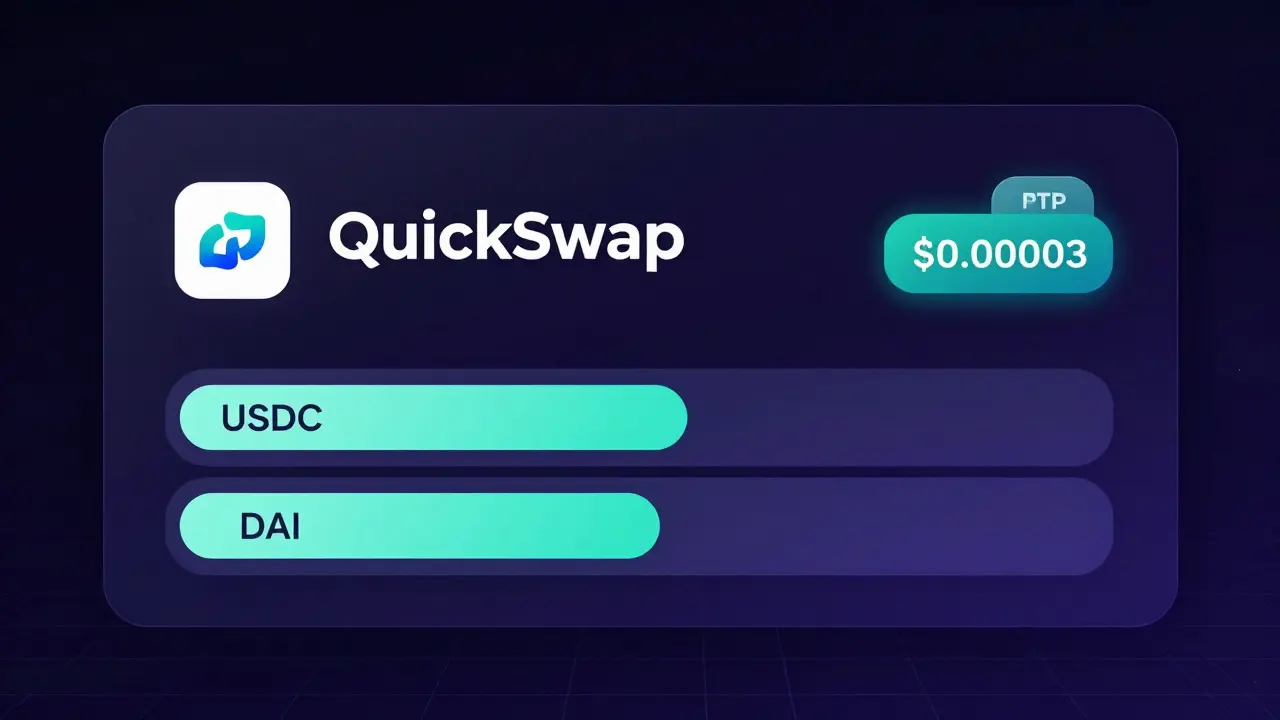
QuickSwap Fee Calculator
Estimate Your Swap Costs
Calculate how much your crypto trade will cost on QuickSwap versus other networks
Estimated Total Cost
Including platform fee and gas
$0.00
| Network | Gas Fee | Platform Fee | Total Cost | Savings |
|---|---|---|---|---|
| Polygon (QuickSwap) | $0.00003 | 0.3% | $0.00 | - |
| Ethereum (Uniswap) | $45.00 | 0.3% | $0.00 | $45.00 |
| BNB Chain (PancakeSwap) | $0.10 | 0.2% | $0.00 | $44.90 |
| Arbitrum (Other) | $0.05 | 0.3% | $0.00 | $44.95 |
Note: Polygon transactions typically confirm in under 3 seconds and cost only $0.00003 in gas fees. Ethereum transactions can take 5-10 minutes and cost $45+ in gas.
There is no such thing as CookSwap - not in any official database, not in any reputable crypto review, and not in the active wallets of traders. If you searched for CookSwap and landed here, you likely meant QuickSwap. It’s a common mix-up. QuickSwap is a real, functioning decentralized exchange built on Polygon, and it’s one of the most popular tools for traders who want fast, cheap swaps without dealing with Ethereum’s high fees.
What QuickSwap Actually Is
QuickSwap is a decentralized exchange (DEX) that lets you trade crypto directly from your wallet - no sign-ups, no KYC, no middleman. It launched in 2020 and runs entirely on Polygon, which is a Layer 2 scaling solution for Ethereum. That means transactions are faster and way cheaper than on Ethereum’s main chain.Unlike centralized exchanges like Coinbase or Kraken, QuickSwap doesn’t hold your funds. You control your private keys. That’s a big deal for privacy and security, but it also means you’re 100% responsible for what happens. If you send tokens to the wrong address or set your slippage too high, there’s no customer service to help you get it back.
The platform is built as a fork of Uniswap V2, but optimized for Polygon. It uses an automated market maker (AMM) model, which means trades happen against liquidity pools instead of order books. If you want to swap ETH for USDC, you’re trading against a pool of other people’s ETH and USDC. The price shifts slightly based on supply and demand - and that’s how it stays fair without needing buyers and sellers to match up manually.
How QuickSwap Works in Practice
To use QuickSwap, you need three things:- A Web3 wallet like MetaMask (version 10.21.1 or higher)
- MATIC tokens for gas fees (as little as $0.00003 per trade)
- The QuickSwap website: quickswap.exchange
That’s it. No app download. No email verification. Just connect your wallet, pick your tokens, and swap. The interface is clean - similar to Uniswap - but optimized for Polygon’s speed. Swaps usually confirm in under 3 seconds. On Ethereum, that same trade might take 5 to 10 minutes and cost $5 or more in gas.
Let’s say you want to swap 100 USDC for DAI. You open QuickSwap, select the tokens, enter the amount, and click swap. The system calculates the price based on current pool liquidity. You’ll see the estimated output and the fee - 0.3% of your trade. Of that, 0.25% goes to liquidity providers, and 0.05% goes to the QuickSwap treasury. Simple. Transparent. No hidden charges.
QuickSwap vs Other DEXs: The Real Differences
QuickSwap doesn’t compete with Coinbase or Binance. It competes with other DEXs like Uniswap, PancakeSwap, and SushiSwap. Here’s how it stacks up:| Feature | QuickSwap | Uniswap (Ethereum) | PancakeSwap | SushiSwap |
|---|---|---|---|---|
| Network | Polygon only | Ethereum | BNB Chain | Multi-chain |
| Avg. Gas Fee | $0.00003 | $45+ | $0.10 | $0.20 |
| 24h Trading Volume | $182M | $1.2B | $420M | $110M |
| Total Value Locked (TVL) | $487M | $8.1B | $3.2B | $1.4B |
| Tokens Listed | ~1,850 | ~4,200 | ~1,500 | ~2,100 |
| Fiat On-Ramp | No | No | No | No |
| Advanced Orders | No | No | No | Yes (limit, stop) |
QuickSwap wins on speed and cost. It loses on liquidity depth and token variety. If you’re trading small amounts of Polygon-native tokens - like $MATIC, $QUICK, or $USDC on Polygon - it’s the cheapest option. But if you need to swap a large sum of a less popular token, you might get a bad price because the pool is shallow. Uniswap’s average pool depth is over $1.2 million. QuickSwap’s? Around $390,000.
The QUICK Token: Governance and Value
QuickSwap has its own token: QUICK. Launched in 2021, it’s used for governance. Holders can vote on proposals - like changing fees, allocating treasury funds, or adding new token pairs. As of October 2025, over 1.35 million wallets hold QUICK.But here’s the catch: QUICK doesn’t pay dividends or rewards. Its value is tied to platform usage. When more people trade on QuickSwap, the treasury earns more fees, and more QUICK gets distributed to liquidity providers. That’s why the token price swings with DeFi trends - not because of the platform’s tech, but because of investor sentiment.
As of October 2025, QUICK traded between $21.45 and $87.90 over the past year. That’s a 63% correlation with the broader DeFi market. In other words, if Uniswap or SushiSwap are trending, QUICK moves with them. It’s not a standalone asset.
Also, the SEC classified QUICK as a security in September 2025. That means U.S. residents can’t vote on governance proposals. They can still trade it, but they can’t influence the protocol. That’s a major limitation for American users who want to participate in the community.
Who Should Use QuickSwap?
QuickSwap isn’t for everyone. Here’s who it’s best for:- Polygon ecosystem users: If you’re already using Polygon-based DeFi apps like Aave or Curve on Polygon, QuickSwap is your natural swap tool.
- High-frequency traders: Arbitrageurs and scalpers save hundreds of dollars monthly on gas fees compared to Ethereum DEXs.
- Beginners who want to try DeFi: Low fees mean you can test swaps without risking big losses.
It’s not for:
- Large traders: Deep orders will get slippage. You’ll need to split trades across multiple pools.
- People who need fiat on-ramps: You can’t buy crypto with a credit card here. You need to bridge from Coinbase or Kraken first.
- Users who want mobile apps: No native app. You’re stuck with browser access.
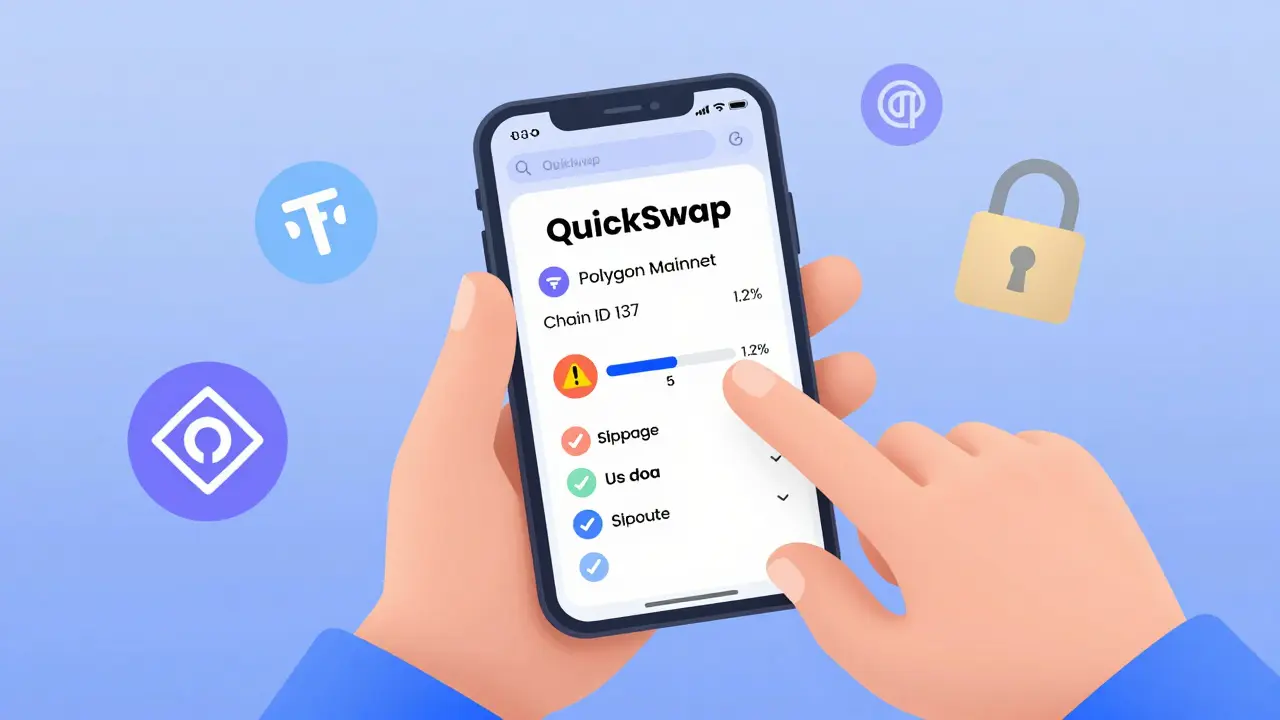
Real User Problems - And How to Avoid Them
Reddit and Trustpilot are full of QuickSwap stories. Most are positive: “Saved $387 in gas last month.” But there’s a dark side too.One user lost $120 because they set slippage tolerance to 5% on a volatile token. The trade executed at a terrible price. Another user bridged ETH from Ethereum to Polygon and waited 72 hours - only to find their funds stuck due to a misconfigured wallet.
Here’s how to avoid these mistakes:
- Slippage settings: Use 0.8% for stablecoins (USDC, DAI), 1.2% for volatile tokens (MEME, low-cap coins).
- Bridge delays: Always wait 72 hours for cross-chain transfers. Don’t assume it’s lost.
- Wallet setup: Make sure your MetaMask is configured for Polygon Mainnet (Chain ID: 137). If it’s on Ethereum, you’ll lose your tokens.
- Don’t trust random tokens: QuickSwap lists over 1,800 tokens. 90% of them are low-quality or scams. Stick to tokens with clear project websites and audit reports.
Community support is strong on Discord (48,300 members). Response time for technical questions is usually under 15 minutes. But again - no phone support. No email tickets. You’re on your own.
What’s Next for QuickSwap?
QuickSwap isn’t standing still. In September 2025, they launched V3, which introduced concentrated liquidity - meaning liquidity providers can earn more by focusing their funds in tighter price ranges. That boosted capital efficiency by 400%.They’re also planning:
- zk-Rollup integration by Q2 2026 - could cut fees another 90%
- Cross-chain swaps with Arbitrum and Optimism by Q4 2025
- $2.1 million treasury allocation to boost USDT/USDC liquidity pools
These upgrades could make QuickSwap even more dominant on Polygon. But there’s a risk: if Ethereum’s L2 scaling fails, or if users shift to other chains like Solana or Base, QuickSwap’s niche could shrink.
Analysts at Coin Bureau give QuickSwap an 85% chance of surviving long-term. Delphi Digital is less confident - only 65%. The difference? One sees a strong niche. The other sees a platform too dependent on one chain.
Final Verdict: Is QuickSwap Worth It?
Yes - if you’re on Polygon. No - if you’re looking for a general-purpose exchange.QuickSwap is the most efficient, low-cost way to trade on Polygon. It’s fast, secure, and transparent. The community is active. The tech is solid. But it’s not a one-stop shop. You need to know what you’re doing. You need to manage your own risk. And you need to accept that if something goes wrong, no one is coming to fix it.
If you’re trading small amounts of Polygon-native tokens, QuickSwap is unbeatable. If you’re trying to move large sums or need advanced features, look elsewhere. And if you were searching for CookSwap - you found the right place. CookSwap doesn’t exist. QuickSwap does.
Is QuickSwap the same as CookSwap?
No, CookSwap does not exist. It’s not a real crypto exchange. If you searched for CookSwap, you likely meant QuickSwap - a legitimate decentralized exchange built on Polygon. QuickSwap is active, well-documented, and used by tens of thousands of traders daily.
Can I buy crypto on QuickSwap with a credit card?
No. QuickSwap is a decentralized exchange - it only lets you swap crypto you already own. To get crypto onto QuickSwap, you need to buy it on a centralized exchange like Coinbase or Kraken, then bridge it to Polygon using their wallet or a bridge like Polygon’s official bridge.
How safe is QuickSwap?
QuickSwap’s smart contracts have been audited by OpenZeppelin and show no critical vulnerabilities. However, like all DeFi platforms, it’s not immune to user error. The biggest risks come from setting wrong slippage, connecting to fake websites, or sending tokens to the wrong address. Always double-check the URL (quickswap.exchange) and never share your private key.
Why are my transactions taking so long on QuickSwap?
QuickSwap transactions on Polygon usually confirm in under 3 seconds. If yours are slow, you’re likely using the wrong network. Make sure your wallet is set to Polygon Mainnet (Chain ID 137), not Ethereum. If you’re bridging assets from Ethereum to Polygon, expect a 72-hour security delay - that’s normal.
Is QuickSwap legal in the United States?
Yes, you can trade on QuickSwap from the U.S. - but you can’t vote on governance proposals. The SEC classified the QUICK token as a security in September 2025, so U.S. users are blocked from participating in the DAO. Trading is still allowed through non-custodial wallets like MetaMask.
Does QuickSwap have a mobile app?
No, QuickSwap does not have a native mobile app. You can access it through your mobile browser using MetaMask or another Web3 wallet. The interface works fine on phones, but you won’t get push notifications or one-tap trading like you would on a centralized app.
What’s the minimum amount I can trade on QuickSwap?
There’s no minimum trade amount. You can swap as little as $0.01 worth of tokens. However, you need at least $0.10 worth of MATIC for gas fees to cover the transaction. Always keep a small balance of MATIC in your wallet just for swaps.


Author
Ronan Caverly
I'm a blockchain analyst and market strategist bridging crypto and equities. I research protocols, decode tokenomics, and track exchange flows to spot risk and opportunity. I invest privately and advise fintech teams on go-to-market and compliance-aware growth. I also publish weekly insights to help retail and funds navigate digital asset cycles.