
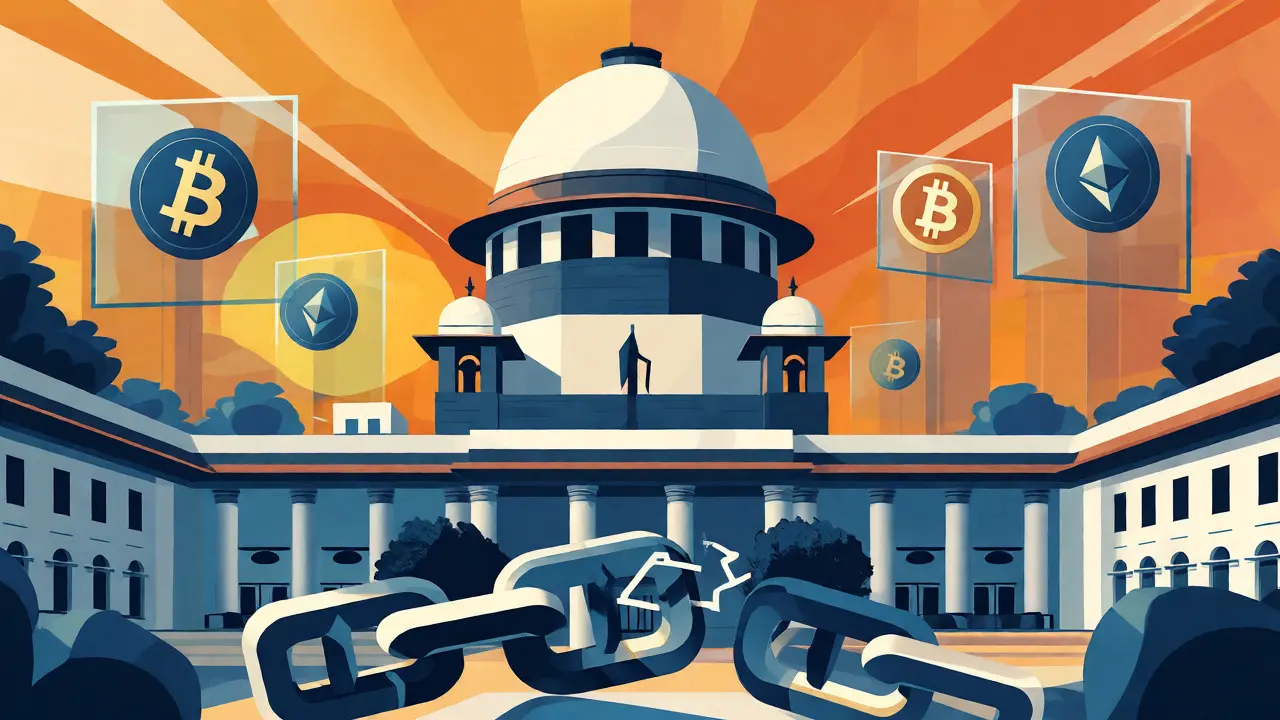
Imagine waking up to find your bank account frozen because you bought a few dollars' worth of Bitcoin. For millions of Indians, this wasn't a hypothetical nightmare-it was reality between 2018 and 2020. Then came the Supreme Court of India's landmark ruling that changed everything. This decision didn't just lift a ban; it reshaped how an entire nation interacts with digital money. If you've ever wondered why Indian crypto markets exploded after years of silence, or why you're now paying steep taxes on every trade, the answer lies in this pivotal legal battle.
| The Verdict: | The Supreme Court struck down the Reserve Bank of India's (RBI) blanket ban on banks dealing with crypto in March 2020. |
| The Impact: | Crypto trading became legal again, leading to a surge in adoption and user registration on local exchanges. |
| The Cost: | Legal clarity came with high prices: a flat 30% tax on gains and 1% Tax Deducted at Source (TDS) on trades. |
| Current Status: | Trading is legal but heavily taxed. The government has yet to pass comprehensive legislation, leaving regulatory gaps. |
The Ban That Backfired
To understand the magnitude of the Supreme Court's intervention, you have to look at what happened before. In April 2018, the Reserve Bank of India (RBI), the country's central banking institution, issued a circular titled 'Prohibition on dealing in Virtual Currencies.' It wasn't a suggestion. It was a hard stop. Banks were forbidden from providing any services related to virtual currencies. No fiat deposits, no withdrawals, no clearing. If you tried to move money into a crypto exchange like WazirX or CoinDCX, your bank could shut down the transaction instantly.
The RBI argued that cryptocurrencies posed risks to financial stability and consumer protection. They claimed these assets were used for illegal activities like money laundering. But here’s the problem: there was no law actually banning crypto. The RBI used its regulatory powers to create a de facto ban without legislative backing. This created a paradox where owning Bitcoin wasn't illegal, but buying it through traditional banking channels was practically impossible.
Enter the Internet and Mobile Association of India (IAMAI). They challenged the RBI’s authority, arguing that the ban was disproportionate. Why punish all users when only a fraction might be involved in illicit activities? The case dragged on, but the stakes couldn't have been higher. The crypto community in India was suffocating, forced to use peer-to-peer methods that were slow, risky, and lacked liquidity.
March 2020: The Day the Lights Came On
On March 4, 2020, the Supreme Court delivered its judgment in Internet and Mobile Association of India v Reserve Bank of India. The verdict was clear: the RBI’s circular was unconstitutional. The court applied the principle of proportionality, stating that while the regulator had concerns, a complete prohibition was excessive given the lack of evidence that crypto had caused significant harm to the economy. More importantly, since Parliament hadn't passed a law banning crypto, the central bank couldn't unilaterally outlaw it.
This wasn't just a technical win; it was a cultural shift. Almost overnight, banks reopened their doors to crypto exchanges. User registrations on platforms like ZebPay and Unocoin skyrocketed by 300-400% within months. People who had been sidelined could finally participate in the global digital asset market. The ruling validated cryptocurrency as a legitimate asset class in the eyes of the judiciary, even if the legislature remained silent.
However, don't mistake legality for freedom. The court didn't say crypto was risk-free. It simply said the RBI overstepped its bounds. This distinction matters because it opened the door for the government to step in later with its own rules-which they eventually did, though not in the way many hoped.

The High Price of Legality: Taxes and Compliance
If you think winning the right to trade means you get to keep all your profits, think again. Once the ban was lifted, the government introduced a taxation regime that is among the strictest in the world. As of 2026, two major rules dominate the landscape:
- Flat 30% Tax on Gains: Unlike stocks or mutual funds, where holding periods affect tax rates, crypto gains are taxed at a flat 30% regardless of how long you hold the asset. There are no deductions allowed except for the cost of acquisition.
- 1% TDS on Trades: Every time you sell a crypto asset above a certain threshold, 1% of the transaction value is deducted at source. This applies to both sellers and buyers in some contexts, creating a massive compliance burden for high-frequency traders.
These rules were designed to curb speculation and bring transparency. But for many traders, they feel punitive. Imagine making a small profit on a quick flip, only to see half of it eaten up by taxes and TDS adjustments. Critics argue this stifles innovation and drives serious investors toward jurisdictions with friendlier regimes, like Dubai or Singapore. Yet, the government maintains that these measures are necessary to prevent money laundering and ensure that the vast, informal economy pays its share.
Regulatory Limbo: The Government’s Silence
Here’s the twist nobody saw coming. After the Supreme Court cleared the path, the government proposed the Cryptocurrency and Regulation of Official Digital Currency Bill, which hinted at banning private cryptocurrencies while promoting a Central Bank Digital Currency (CBDC). But the bill never passed. We are still waiting for comprehensive legislation.
In recent hearings in late 2025, the Supreme Court expressed frustration with this delay. Justices Surya Kant and N. Kotiswar Singh questioned why the government hasn't acted, describing the current state as a "blind eye" approach. They warned that unregulated trading could become a modern version of Hawala-an informal system of transferring money outside official channels. The court isn't anti-crypto; they want guardrails. They recognize that global finance is evolving, and India can't afford to be left behind due to legislative inertia.
This uncertainty creates a tricky environment for businesses. Exchanges must comply with existing KYC (Know Your Customer) norms and maintain detailed records, but they operate without clear guidelines on newer technologies like Decentralized Finance (DeFi) or Non-Fungible Tokens (NFTs). Are NFT sales subject to the same 30% tax? How do you treat staking rewards? These questions remain largely unanswered, forcing companies to hire expensive legal teams just to stay compliant.

How This Compares Globally
It helps to see where India stands compared to other major economies. While China banned crypto outright in 2021, pushing mining operations abroad, India chose a middle ground: legal but heavily taxed. The European Union implemented MiCA (Markets in Crypto-Assets), a comprehensive framework offering clarity. The US relies on enforcement actions by agencies like the SEC, creating a patchwork of regulations.
| Region | Legal Status | Tax Approach | Regulatory Clarity |
|---|---|---|---|
| India | Legal to trade, not legal tender | High (30% + 1% TDS) | Low (Pending legislation) |
| USA | Legal, classified as property | Capital gains (short/long term) | Medium (Agency-led) |
| EU | Legal under MiCA | Varies by member state | High (Unified framework) |
| China | Banned | N/A | Total prohibition |
India’s unique position-judicially supported but legislatively neglected-makes it a fascinating case study. It shows how courts can fill the vacuum left by politicians, but also highlights the limits of judicial power. You can’t tax what you don’t regulate properly, and you can’t innovate freely when the rules keep changing.
What Should Investors Do Now?
If you’re looking to enter or expand your portfolio in India, here’s the practical reality. First, accept that taxes are non-negotiable. Factor the 30% gain tax and 1% TDS into your ROI calculations. Many beginners ignore this and end up with negative returns after filing returns. Second, keep meticulous records. With no netting of losses against gains across different crypto assets (a controversial rule that may change), tracking every transaction is vital.
Third, watch the news. The Supreme Court continues to pressure the government. Any new bill could alter the tax structure or introduce licensing requirements for exchanges. Staying informed protects you from sudden policy shifts. Finally, consider using established Indian exchanges that handle TDS compliance automatically. Trying to DIY your tax filings on complex DeFi transactions can lead to audits and penalties.
The journey from a total ban to a taxable, legal market has been turbulent. But it proves one thing: technology moves faster than bureaucracy. The Supreme Court ensured that Indians weren't locked out of the future of money. Now, it’s up to the lawmakers to build a bridge that supports growth without compromising stability.
Is cryptocurrency legal in India today?
Yes, buying, selling, and holding cryptocurrencies is legal in India following the Supreme Court's 2020 ruling that struck down the RBI's banking ban. However, crypto is not recognized as legal tender, meaning you cannot legally refuse to accept Rupees for goods and services.
Why did the Supreme Court strike down the RBI crypto ban?
The Court ruled that the RBI's ban was disproportionate and unconstitutional because there was no specific law prohibiting cryptocurrencies. The RBI failed to provide empirical evidence that the ban was necessary to protect the economy, making the blanket restriction on banking services excessive.
What are the current taxes on crypto in India?
As of 2026, India imposes a flat 30% tax on profits from cryptocurrency transfers, regardless of the holding period. Additionally, a 1% Tax Deducted at Source (TDS) is applicable on transactions exceeding specified thresholds to ensure transparency and track trading activity.
Can I deduct losses from my crypto gains?
Currently, you cannot offset losses from one cryptocurrency against gains from another. Losses can only be carried forward for eight assessment years. This rule prevents taxpayers from reducing their liability by mixing profitable and losing positions in the same year.
Has the government passed a crypto law yet?
No comprehensive legislation has been enacted. The Cryptocurrency and Regulation of Official Digital Currency Bill, 2021, was proposed but not passed. The government currently regulates crypto primarily through taxation and anti-money laundering guidelines, while the Supreme Court continues to urge for clearer laws.
Author
Ronan Caverly
I'm a blockchain analyst and market strategist bridging crypto and equities. I research protocols, decode tokenomics, and track exchange flows to spot risk and opportunity. I invest privately and advise fintech teams on go-to-market and compliance-aware growth. I also publish weekly insights to help retail and funds navigate digital asset cycles.