

Imagine trying to manage a library where every single book must be checked out by one librarian at a time. Now imagine adding ten more librarians, each handling a specific section of the library. The chaos clears up, and books move faster. That is exactly what sharding technology does for data systems. It breaks massive datasets or ledgers into smaller, manageable pieces called "shards," allowing them to process information in parallel rather than sequentially.
In 2026, sharding has moved from theoretical computer science experiments to the backbone of how we handle global-scale data. Whether you are looking at traditional enterprise databases or decentralized blockchain networks, the core problem remains the same: single nodes hit a ceiling on how much they can process. Sharding offers the escape route. But the story isn't just about splitting data; it's about how that split changes security, speed, and cost across two very different worlds.
The Core Mechanics: How Sharding Actually Works
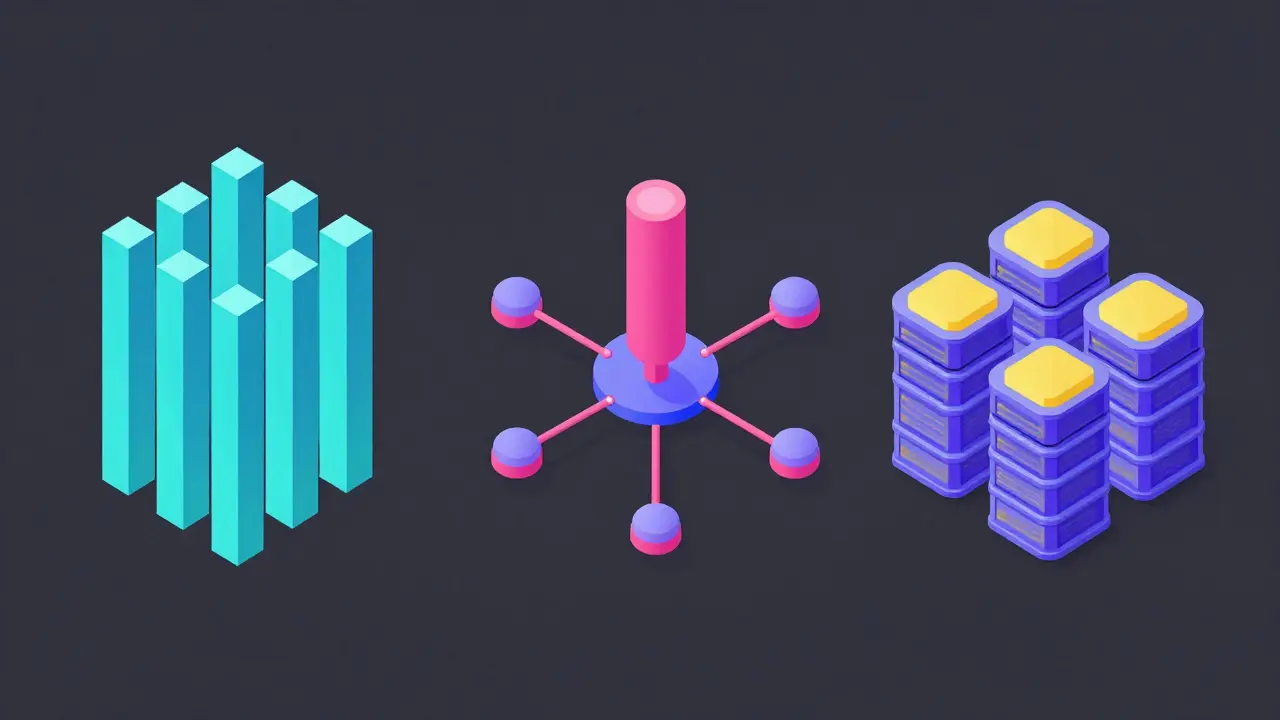
To understand where sharding is heading, you first need to grasp the three main ways engineers slice up data today. These strategies define how your data finds its home in a distributed system.
- Hash-based sharding: This method uses a mathematical hash function to scatter data evenly across shards. It’s great for balance but terrible for range queries (like finding all transactions between January and March). You have to check every shard because the data is scattered randomly.
- Range-based sharding: Here, data is divided by key values, such as timestamps or user IDs. It’s perfect for ordered data but risky. If too many users join with similar IDs, one shard becomes overloaded while others sit idle-a problem known as "hot spotting."
- Directory-based sharding: A central lookup table tells the system exactly which shard holds which data. This offers maximum flexibility for rebalancing but introduces a single point of failure. If the directory goes down, the whole system stalls.
The future of sharding isn't about picking one winner among these three. It’s about automating the choice. Modern systems now use hybrid approaches that dynamically switch strategies based on real-time load patterns, reducing the manual overhead that used to plague database administrators.
Blockchain Sharding: The Great Pivot to Data-Sharding
If you followed blockchain news in the early 2020s, you heard endless talk about "shard chains." The idea was simple: split the network into multiple chains that process transactions in parallel. Bitcoin handles about 7 transactions per second (TPS). Ethereum handled roughly 15 TPS. By splitting validators into groups, proponents argued, we could multiply throughput linearly.
That plan hit a wall. Security became the bottleneck. In a classical sharded model, if an attacker controls 51% of the total network power, they might only need to control a fraction of that to take over a single small shard. As Vitalik Buterin noted in his research, this creates a trade-off: more shards mean less security per shard, unless you force every validator to secure every shard-which defeats the purpose of scaling.
This realization triggered a massive strategic shift. Instead of sharding transaction execution, the industry began sharding data availability. This approach, known as Danksharding, decouples validation from processing. Validators still check everything for security, but the heavy lifting of storing transaction data is distributed using advanced cryptography.
| Feature | Classical Sharding | Data-Sharding (Danksharding) |
|---|---|---|
| Processing Model | Validators split into groups | All validators verify data availability |
| Security Risk | High (small shards vulnerable) | Low (base layer security preserved) |
| Primary Goal | Increase TPS directly | Reduce costs for Layer 2 rollups |
| Cross-Shard Complexity | Extremely high | Moderate (handled via messaging layers) |
Ethereum’s Roadmap: From Proto-Danksharding to Full Scale
The most significant milestone in this evolution was the launch of Proto-Danksharding (EIP-4844) during the Cancun-Deneb upgrade in March 2024. This wasn't full sharding yet, but it was the critical infrastructure step. It introduced "blobs"-binary large objects-that carry transaction data temporarily.
Here is why blobs matter: they are not stored permanently in the Ethereum Virtual Machine (EVM). They exist for about 18 days (4,096 epochs) before being deleted. This temporary storage is designed specifically for Layer 2 rollups like Arbitrum and Optimism. Before EIP-4844, these rollups had to store their compressed transaction data on Ethereum’s main chain, which was expensive. With blobs, they pay a fraction of the cost.
In 2026, the impact is clear. Transaction costs on major Layer 2s dropped by 80-100%. Users who once paid $10 for a simple swap now pay pennies. The total value locked in Ethereum Layer 2 protocols exceeded $8 billion in 2024, validating this market demand. Full Danksharding, which will increase blob capacity from 6 to 64 per block, is still several years away. However, the foundation is laid. When implemented, it could theoretically support millions of transactions per second across hundreds of independent Layer 2 chains.

Beyond Ethereum: Competing Sharding Models
While Ethereum pivoted to data-sharding, other projects doubled down on classical or hybrid models. Understanding these alternatives helps clarify why there is no single "best" sharding solution.
- Zilliqa: One of the first blockchains to implement pure sharding. It divides its validator set into shards that process transactions in parallel, achieving 2,000-3,000 TPS. It works well for simple payments but struggles with complex cross-shard smart contracts.
- Polkadot: Uses a "parachain" architecture. Instead of splitting one chain, it connects multiple specialized chains to a central relay chain. This allows for application-specific scaling but requires validators to stake DOT to secure the entire ecosystem.
- Near Protocol: Implemented "Nightshade," a sharding approach that focuses on data availability sampling. Like Ethereum, Near aims to keep state lightweight while ensuring data is verifiable without downloading everything.
- Cosmos: Takes a different angle with Inter-Blockchain Communication (IBC). Rather than sharding a single chain, it enables independent blockchains to talk to each other. This creates a heterogeneous network effect where scaling happens through interoperability, not just partitioning.
The common thread here is specialization. General-purpose blockchains are hard to shard efficiently. Domain-specific chains or Layer 2 solutions that focus on one task (like gaming or payments) benefit more from sharding because their data patterns are predictable.
Traditional Databases: The Quiet Revolution
It’s easy to forget that sharding started long before blockchain. In the world of traditional distributed databases, sharding is mature technology. Companies like Google, Amazon, and Meta rely on it daily.
Google’s Spanner system automatically splits and merges ranges based on load. Amazon DynamoDB uses consistent hashing to manage shards seamlessly. Meta’s internal database, Apollo, relies on careful shard key selection to handle billions of social graph connections.
The challenge in traditional databases is not theoretical security-it’s operational complexity. Choosing a bad shard key is permanent. If you shard by user ID, but later want to query by location, you’re stuck. Resharding terabytes of data takes hours or days and disrupts service. The future here is automation. New database-as-a-service platforms are beginning to abstract sharding entirely, letting developers write code as if they were using a single server, while the backend handles the distribution invisibly.
Technical Hurdles: Cross-Shard Communication and Finality
No discussion of sharding’s future is complete without addressing its biggest headache: cross-shard communication. When a transaction needs data from Shard A and writes to Shard B, latency spikes. You cannot simply run both operations simultaneously because of race conditions.
In blockchain, this affects finality. In a non-sharded chain, once a block is confirmed, the transaction is final. In a sharded system, if a transaction spans multiple shards, it must wait for confirmations from all involved shards. This reduces the throughput gains you hoped for. Solutions involve asynchronous message passing, but that adds complexity for developers building decentralized applications (dApps).
Another issue is data availability sampling. Protocols like Danksharding rely on cryptographic techniques like KZG commitments to prove data exists without downloading it all. While elegant, this introduces new attack vectors. If the sampling rate is too low, attackers might hide missing data. If it’s too high, bandwidth costs rise. Balancing this equation requires constant refinement of light client protocols and proof sizes.
What Comes Next? The Heterogeneous Future
By late 2026, it is becoming clear that we won’t see one unified sharding standard. Instead, we are moving toward a heterogeneous ecosystem. Classical sharding will remain useful for high-throughput, low-complexity tasks. Data-sharding will dominate base-layer blockchains like Ethereum to support Layer 2 rollups. Meanwhile, traditional databases will continue to refine automated sharding for enterprise workloads.
The role of cryptography will grow even more important. Verkle trees, proposed by Vitalik Buterin, may replace Merkle trees in Ethereum’s structure, further reducing proof sizes and making sampling more efficient. As these tools mature, the barrier to entry for running a node will drop, enhancing decentralization alongside scalability.
For developers and businesses, the takeaway is practical: stop worrying about whether sharding is "good" or "bad." It is essential infrastructure. The question now is how to design applications that leverage sharded environments without falling victim to cross-shard latency or hot-spotting issues. The future belongs to those who build for parallelism from day one.
What is the difference between classical sharding and Danksharding?
Classical sharding splits the network into separate chains that process transactions independently, which can compromise security if a shard has few validators. Danksharding (data-sharding) keeps the base layer secure by having all validators verify data availability, while distributing the actual transaction data storage across the network using blobs. This reduces costs for Layer 2 rollups without sacrificing base-layer security.
When will full Danksharding be implemented on Ethereum?
As of May 2026, full Danksharding is estimated to be several years away. It requires significant protocol-level changes to consensus clients to handle increased blob capacities (from 6 to 64 per block) and implement robust distributed data sampling protocols. Proto-Danksharding (EIP-4844) is already live and providing immediate benefits to Layer 2 solutions.
How does sharding improve database performance?
Sharding improves performance by distributing data and computational load across multiple servers or nodes. This reduces bottlenecks associated with single-machine limits, lowers query response times from seconds to milliseconds, and enhances fault tolerance since a failure in one shard does not crash the entire system.
What are the risks of hash-based sharding?
Hash-based sharding distributes data evenly but makes range queries inefficient because data is scattered randomly. To find data within a specific range, the system must query every shard, increasing latency. It also lacks optimization for temporal trends or specific access patterns.
Why did Ethereum shift from shard chains to data-sharding?
Ethereum shifted because classical sharding created security vulnerabilities. Smaller shards required fewer validators to be compromised, threatening the network's integrity. Data-sharding preserves the security of the base layer by keeping validation distributed while offloading data storage to reduce costs for Layer 2 rollups.
What is a "blob" in the context of Ethereum?
A blob (binary large object) is a new type of transaction data introduced in EIP-4844. Blobs are attached to blocks but are not stored permanently in the EVM state. They exist for approximately 18 days, providing cheap, temporary storage for Layer 2 rollups to post their transaction data, significantly reducing gas fees.
Author
Ronan Caverly
I'm a blockchain analyst and market strategist bridging crypto and equities. I research protocols, decode tokenomics, and track exchange flows to spot risk and opportunity. I invest privately and advise fintech teams on go-to-market and compliance-aware growth. I also publish weekly insights to help retail and funds navigate digital asset cycles.