

You hold a governance token. That means you don’t just own a piece of the pie; you help decide how it’s baked. In the world of decentralized finance (DeFi), these tokens are the keys to the kingdom. They grant holders voting rights and decision-making authority over protocols that handle billions of dollars in assets. But not all governance tokens are created equal. Some represent massive ecosystems with deep liquidity, while others are niche experiments. As we move through 2026, understanding which tokens carry the most weight is crucial for anyone looking to participate in or profit from decentralized governance.
Why Governance Tokens Matter More Than Ever
Governance tokens are cryptocurrencies that allow holders to vote on protocol changes, fee structures, and future development directions. Unlike utility tokens, which might only give you access to a service, governance tokens offer actual control. This shift from centralized decision-making to community-led governance has been one of the defining features of the blockchain industry. It aligns the incentives of developers, users, and investors. When you hold a governance token, your financial interest is tied directly to the health and success of the protocol. If the protocol fails, your token loses value. If it thrives, so does your stake. This alignment creates a powerful ecosystem where stakeholders are motivated to act in the best interest of the network.
The market capitalization of these tokens serves as a rough proxy for their influence and stability. Higher market caps often indicate broader adoption, deeper liquidity, and more robust security. However, size isn’t everything. Smaller tokens can offer higher leverage for individual voters, allowing them to sway decisions more easily. The key is to understand what each token represents and how its governance model works.
The Heavyweights: Top Governance Tokens by Market Cap
As of early 2026, several tokens dominate the landscape. These projects have proven their resilience and utility, attracting significant capital and active communities. Here are the leaders by market capitalization:
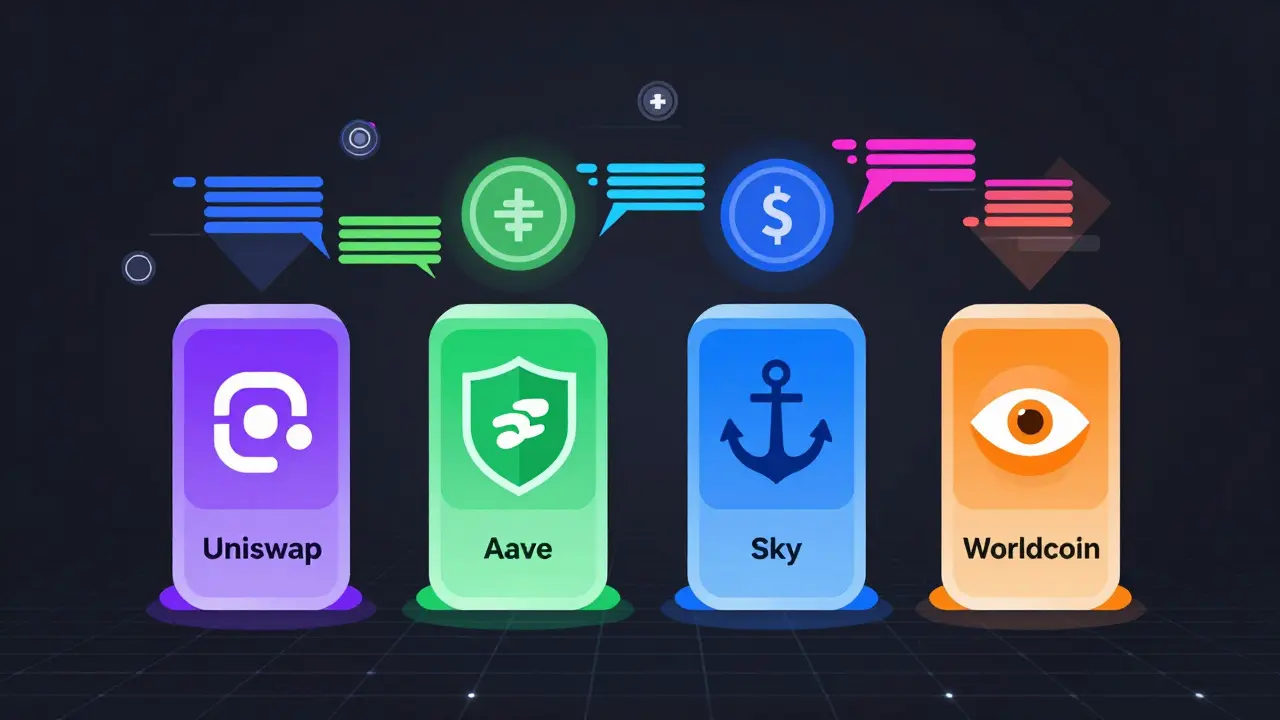
- Uniswap (UNI): With a market cap of $2.44 billion, Uniswap remains the king of decentralized exchanges (DEXs). Its governance token allows holders to vote on fee structures, new feature proposals, and treasury management. UNI has a total supply of 1 billion tokens, with 60% allocated to the community.
- Aave (AAVE): Trading at a market cap of $1.71 billion, Aave is the leading lending protocol. AAVE holders manage risk parameters, approve new asset listings, and oversee protocol upgrades. Only 16 million tokens exist, making it a relatively scarce asset.
- Sky (SKY): Formerly known as MakerDAO, Sky has rebranded and continues to be a pillar of stablecoin issuance. With a market cap of $1.65 billion, SKY governs the DAI stablecoin ecosystem, ensuring its peg and managing collateral types.
- Worldcoin (WLD): At $1.12 billion, Worldcoin focuses on identity verification and universal basic income distribution via blockchain. WLD holders vote on fund allocations and privacy policies.
Other notable mentions include Dash (DASH) at $410 million, Curve DAO Token (CRV) at $359 million, Ethereum Name Service (ENS) at $224 million, and ZKsync (ZK) at $175 million. Each of these plays a critical role in its respective niche, from privacy-focused transactions to zero-knowledge proof scaling solutions.
| Token | Market Cap | Total Supply | Community Allocation | Primary Function |
|---|---|---|---|---|
| Uniswap (UNI) | $2.44B | 1 Billion | 60% | DEX Governance & Fee Management |
| Aave (AAVE) | $1.71B | 16 Million | 60% | Lending Protocol Risk Parameters |
| Sky (SKY) | $1.65B | N/A | N/A | Stablecoin Ecosystem Governance |
| Worldcoin (WLD) | $1.12B | N/A | N/A | Identity & Fund Allocation |
| Dash (DASH) | $410M | N/A | N/A | Privacy Transactions & Masternodes |
Tokenomics: How Distribution Shapes Power
The way a governance token is distributed affects who holds power. Many top tokens allocate a significant portion of their supply to the community to ensure decentralization. For example, Uniswap gives 60% of its 1 billion UNI tokens to the community. This broad distribution encourages widespread participation and reduces the risk of whale manipulation. Similarly, Aave distributes 60% of its much smaller 16 million supply to the community, creating a tight-knit but influential group of voters.
Curve DAO Token (CRV) takes a different approach. With a total supply of 3 billion tokens, 50% goes to the community. CRV holders manage liquidity pools, adjust fees, and distribute incentives. The large supply allows for granular voting and extensive staking opportunities. On the other end of the spectrum, Maker (MKR) operates with an unlimited supply and only 30% community distribution. MKR holders manage collateral types and maintain the stability of the DAI stablecoin. Their governance involves burning tokens during emergencies, linking governance directly to protocol solvency.
Some tokens use deflationary mechanics to increase scarcity over time. dYdX (DYDX) is a prime example. With 100% community distribution and a 1 billion token supply, DYDX incorporates protocol fee buybacks. This means that as the exchange generates revenue, it buys back and burns tokens, reducing supply and potentially increasing value for remaining holders. This model aligns long-term value appreciation with protocol sustainability.
Beyond Price: Developer Activity and Technical Merit
Market cap tells you how much money is in the room, but developer activity tells you if the project is alive. In 2026, Radworks (formerly Radicle) ranks first among governance tokens by development activity. This indicates sustained engineering commitment and a focus on open-source collaboration. API3 ranks third, driven by its first-party oracle framework. API3 allows data providers to operate Airnodes, connecting APIs directly to blockchains without intermediaries. Holders stake into insurance pools, backing oracle data feeds. This ties governance directly to risk management, ensuring that voters have skin in the game when it comes to data accuracy.
Reserve also demonstrates consistent engineering activity according to Santiment data. This reinforces its position as one of the most active governance tokens during the current market cycle. High developer activity suggests that the protocol is evolving, fixing bugs, and adding features. It’s a strong signal of long-term viability, often preceding price appreciation.
Trading Volumes and Liquidity: Can You Exit?
Liquidity is king. Even if you love a governance token, you need to be able to sell it if things go wrong. Uniswap (UNI) generated $233.59 million in 24-hour volume, showing immense liquidity. Aave (AAVE) recorded even higher volume at $347.74 million, despite having fewer tokens in circulation (3.11 million vs. UNI’s 60.65 million). This high turnover reflects active trading and confidence in the asset.
Sky (SKY) showed $17.05 million in 24-hour volume, while Worldcoin (WLD) demonstrated $112.53 million. These volumes provide a snapshot of market interest. High volume means you can enter and exit positions with minimal slippage. Low volume can lead to drastic price swings based on small trades. Always check the order book before committing significant capital.

Specialized Niches: Gaming and Emerging Protocols
Governance isn’t limited to DeFi. Gaming tokens like Axie Infinity (AXS) offer a unique blend of play-to-earn mechanics and community governance. AXS has a total supply of 270 million tokens, with 168.24 million in circulation. While its all-time high was $164.90, current pricing reflects broader market adjustments. HYPE serves as another example, providing governance functions alongside staking, gas fee payments, and trading discounts. These tokens illustrate how governance can extend beyond financial protocols into entertainment and social networks.
Emerging tokens like SushiSwap (SUSHI), HashKey Platform Token (HSK), Drift (DRIFT), and Spark (SPK) demonstrate the breadth of governance tokenization. SUSHI, for instance, offers majority community distribution and unlimited supply, focusing on fee management and staking. PancakeSwap (CAKE) manages pools, lotteries, and farms with 60% community allocation. Balancer (BAL) enables pool and fee management with 50% community distribution. These smaller-cap tokens often offer higher risk but also higher potential rewards for early adopters.
Strategic Characteristics: Choosing Your Path
Different governance tokens optimize for distinct strategic objectives. dYdX prioritizes deflationary mechanics through fee buybacks, aligning long-term value appreciation with protocol sustainability. Uniswap emphasizes broad community allocation, enabling wide stakeholder participation. Curve focuses on long-term engagement incentives through staking mechanisms. Aave concentrates on ecosystem stability through careful risk parameter governance. These differentiated approaches reflect competing theories of optimal governance token design. There is no one-size-fits-all solution. Your choice should depend on your risk tolerance, investment horizon, and desire for active participation.
If you want stability and established infrastructure, look at Aave or Uniswap. If you’re interested in innovative mechanics like deflationary models, consider dYdX. For those seeking exposure to emerging trends, smaller caps like Altlayer (ALT) or Beefy (BIFI) might offer interesting opportunities, though they come with higher volatility.
What is the difference between a governance token and a utility token?
A utility token provides access to a specific service or product within a blockchain ecosystem, such as paying for transaction fees or accessing storage space. A governance token, on the other hand, grants holders voting rights and decision-making authority over the protocol’s development, including parameter changes, upgrades, and treasury management. Governance tokens are about control; utility tokens are about usage.
How do I participate in governance voting?
Participation usually requires holding the token in a non-custodial wallet connected to the protocol’s governance platform. Most major protocols like Uniswap and Aave use Snapshot, an off-chain voting system that uses signatures rather than on-chain transactions, making it gas-free. You propose votes, delegate your voting power to trusted experts, or vote directly on active proposals. Always read the proposal details carefully before casting your vote.
Is it safe to invest in governance tokens?
Like all cryptocurrencies, governance tokens carry significant risk. Prices can be highly volatile, and smart contract vulnerabilities exist. Additionally, governance attacks, where whales manipulate votes to drain funds, are a theoretical risk. Diversification is key. Never invest more than you can afford to lose. Research the team, the code audits, and the community activity before buying.
Why does market cap matter for governance tokens?
Market cap indicates the total value of all outstanding tokens. A higher market cap generally suggests greater stability, liquidity, and institutional interest. It makes the token harder to manipulate. However, market cap doesn’t guarantee good governance. A small token with an engaged, active community can be more valuable in terms of real-world impact than a large, dormant one.
What is token delegation?
Delegation allows token holders to assign their voting power to another address, often an expert or organization they trust, without transferring ownership of the tokens. This helps increase voter turnout and ensures that informed decisions are made. You can revoke your delegation at any time. It’s a practical way to participate in governance without spending hours researching every proposal.
Author
Ronan Caverly
I'm a blockchain analyst and market strategist bridging crypto and equities. I research protocols, decode tokenomics, and track exchange flows to spot risk and opportunity. I invest privately and advise fintech teams on go-to-market and compliance-aware growth. I also publish weekly insights to help retail and funds navigate digital asset cycles.