
Remember when using a decentralized exchange meant waiting minutes for a transaction to clear while paying high gas fees? Those days are fading fast. By mid-2026, the gap between centralized exchanges (CEXs) and decentralized ones has narrowed significantly, thanks largely to platforms like Vertex Protocol, which is a hybrid decentralized exchange that combines spot trading, perpetual futures, and money markets into a single interface with cross-chain liquidity. Since launching just over a year ago, Vertex has surged to become the second-largest perpetual DEX by average daily volume. It’s not just another clone; it’s solving the biggest headache in DeFi: fragmented liquidity.
If you’re tired of bridging assets manually or choosing between speed and security, this review breaks down whether Vertex Protocol is the right tool for your trading stack. We’ll look at how its technology works, what it costs to trade, and where it stands against giants like dYdX and Hyperliquid.
What Is Vertex Protocol?
Vertex Protocol is an all-in-one DeFi platform offering spot trading, leveraged perpetual contracts, and yield-bearing money markets. Unlike traditional automated market makers (AMMs) that rely on isolated liquidity pools, Vertex uses a synchronous orderbook model. This means it functions more like a traditional stock exchange but operates on-chain for settlement.
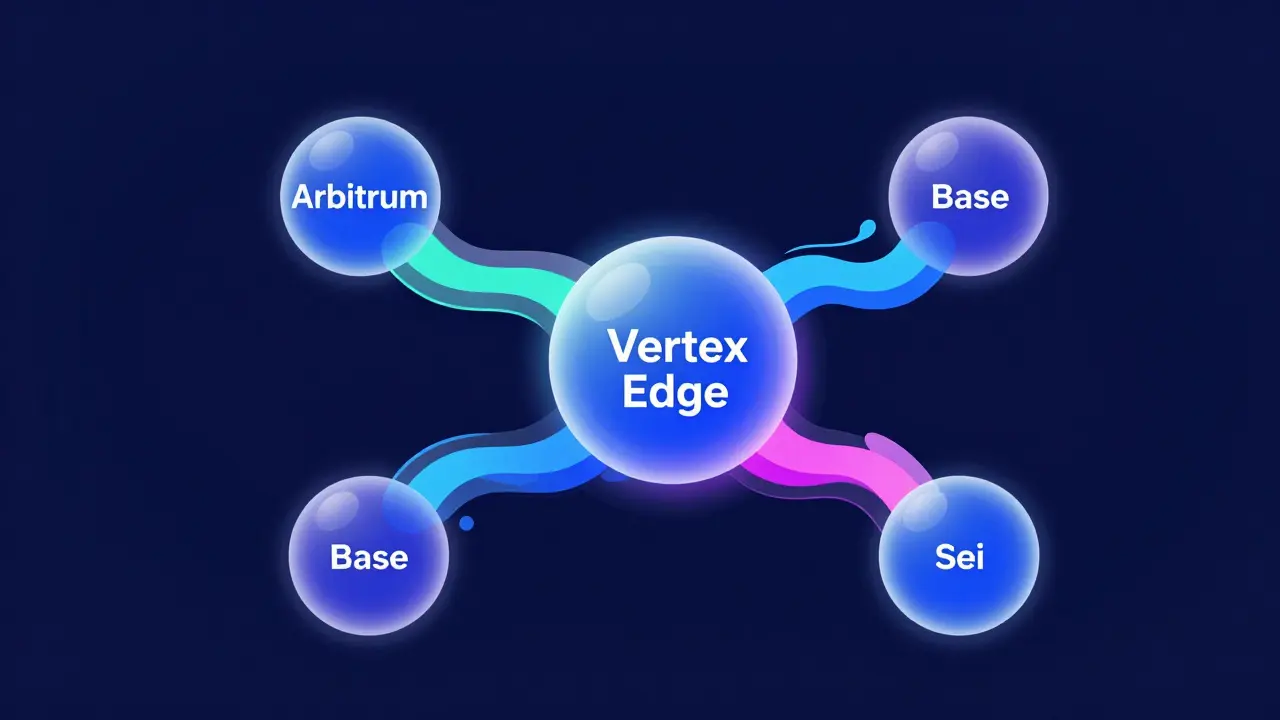
The core innovation here is Vertex Edge, which is the protocol's cross-chain liquidity aggregation engine. Instead of keeping liquidity siloed on one blockchain, Vertex Edge pulls depth from Arbitrum, Base, Sei, Blast, Mantle, and Sonic. It merges these sources into a single unified orderbook. For you, the trader, this means deeper liquidity, less slippage, and no need to move your funds across bridges before placing a trade. The sequencer matches orders off-chain for speed-latency sits between 5 and 15 milliseconds-and settles them on-chain for transparency.
How Trading Works on Vertex
Trading on Vertex feels familiar if you’ve used Binance or Coinbase Advanced Trade, but with full custody of your keys. Here’s how the mechanics play out:
- Spot Trading: You can buy and sell major cryptocurrencies directly. With over fifty pairs available, including select forex options, the breadth is competitive.
- Perpetual Futures: This is where Vertex shines. You can open leveraged positions up to 20x without expiration dates. The platform supports market, limit, and stop orders, giving you precise control over entry and exit points.
- Margin Modes: You have two choices. Universal Cross Margin lets you pool collateral from multiple positions to maximize capital efficiency. Isolated Margin keeps each position separate, so a liquidation in one trade doesn’t wipe out your entire account.
The risk engine monitors your positions continuously. If your margin falls below the required level, the system executes automatic liquidations to protect the protocol’s solvency. This automation ensures that even during volatile markets, the system remains stable.
Fees and Costs: Is It Cheap to Trade?
Cost matters, especially if you’re an active trader. Vertex Protocol offers some of the most aggressive fee structures in the industry right now.
| Fee Type | Vertex Protocol | dYdX | Hyperliquid |
|---|---|---|---|
| Maker Fee | 0% | 0.02% - 0.04% | 0.02% - 0.05% |
| Taker Fee | 0.02% | 0.05% - 0.07% | 0.05% - 0.07% |
| Network Gas Fees | Low (Arbitrum L2) | Variable (StarkNet/Ethereum) | Zero (L1 Blockchain) |
Notice the zero percent maker fee? That’s a game-changer for limit orders. You only pay 0.02% when you take liquidity (market orders). Compared to competitors who charge higher taker fees, Vertex saves you money on every aggressive trade. Plus, since the primary deployment is on Arbitrum, depositing and withdrawing USDC or ETH is cheap and fast. You don’t need external bridges; you send funds directly to your Vertex wallet address on Arbitrum.
Vertex Edge: Solving Liquidity Fragmentation
The biggest problem in DeFi has always been fragmentation. If you want to trade BTC/USDC, you might find good depth on Arbitrum but terrible depth on Base. Traditionally, you’d have to bridge your funds to the chain with better liquidity. Vertex Edge eliminates this step entirely.
Here’s the workflow: When you place an order, the Vertex sequencer looks at liquidity across all connected chains (Arbitrum, Base, Sei, etc.). It matches your order against the best available price, regardless of which chain the liquidity sits on. Then, it hedges the position internally and rebalances liquidity between chains to manage risk. You see one orderbook. You get one price. You don’t care about the underlying chain complexity.
This creates a flywheel effect. As more chains join, liquidity deepens. As liquidity deepens, slippage drops. As slippage drops, more traders join. By February 2026, this model had already generated $67 billion in cumulative derivatives volume.
Earning Yield: The Money Market Feature
Most perpetual DEXs leave your idle cash sitting there doing nothing. Vertex changes that with its integrated money market. When you deposit assets like USDC or ETH into Vertex, they aren’t just collateral-they earn yield.
The protocol plans to offer unified interest rates across all chains. This means if you deposit USDC via Arbitrum or via Base, you earn the same APY. This feature improves capital efficiency significantly. Between trades, your collateral works for you. It’s a small detail, but it adds up over time, especially for large accounts.
VRGX Token: Governance and Rewards
The native token, VRTX, serves as the governance and utility token for the ecosystem. With a total supply of 1 billion tokens and roughly 528 million in circulation, the tokenomics are designed to align incentives.
Holding VRTX isn’t just about speculation. Staking the token provides tangible benefits:
- Fee Discounts: Reduce your trading costs further.
- Boosted Rewards: Earn higher yields from the money market and liquidity pools.
- Governance Rights: Vote on protocol upgrades and parameter changes.
Vertex vs. The Competition
How does Vertex stack up against other heavyweights? Let’s compare it to three major players: dYdX, GMX, and Hyperliquid.
vs. dYdX: dYdX was the pioneer of orderbook DEXs. However, Vertex offers lower fees (0% maker vs. dYdX’s positive maker fees) and broader cross-chain support. While dYdX focuses heavily on StarkNet and Ethereum, Vertex aggregates from six different chains, providing more diverse liquidity sources.
vs. GMX: GMX relies on an AMM model with glp/glp pools. It’s simple and effective but suffers from impermanent loss risks for liquidity providers and potential slippage for large traders. Vertex’s orderbook model provides exact pricing execution, which professional traders prefer. Additionally, Vertex’s integrated money market offers yield on collateral, which GMX lacks in the same seamless way.
vs. Hyperliquid: Hyperliquid runs on its own Layer-1 blockchain, offering gas-free trading and incredible speed. Vertex achieves similar speeds (5-15ms latency) through its off-chain matching engine but retains the security of established Layer-2 networks like Arbitrum. If you value decentralization and multi-chain flexibility over a dedicated L1, Vertex is the stronger choice. Also, Vertex doesn’t require a dedicated mobile app; it works perfectly in any web browser.

Risks and Considerations
No platform is perfect. Before you deposit funds, consider these factors:
- Smart Contract Risk: Like all DeFi protocols, Vertex relies on smart contracts. While audits are standard, bugs can exist. Always start with small amounts to test the waters.
- Leverage Danger: 20x leverage sounds exciting, but it amplifies losses just as quickly as gains. Use isolated margin if you’re new to avoid wiping out your entire balance.
- Custody Responsibility: You hold your keys. If you lose your seed phrase, there is no customer support to reset your password. Secure your wallet properly.
- Regulatory Uncertainty: Crypto regulations vary by region. Ensure that trading perpetual futures is legal in your jurisdiction. In New Zealand, for example, crypto trading is permitted, but tax implications apply.
Who Should Use Vertex Protocol?
Vertex Protocol is ideal for:
- Active Traders: Those who execute frequent trades and benefit from zero maker fees and low taker fees.
- Cross-Chain Users: Traders who hold assets on multiple chains (Base, Arbitrum, Sei) and hate bridging.
- Capital Efficiency Seekers: Users who want their idle collateral to earn yield while waiting for setups.
- DeFi Purists: Individuals who want CEX-like performance without surrendering custody to a central entity.
If you’re a casual holder who buys once a month and forgets about it, Vertex might be overkill. A simple spot exchange or hardware wallet setup suits you better. But if you’re trading daily, Vertex’s infrastructure saves you time and money.
Final Thoughts
Vertex Protocol represents a significant leap forward for decentralized trading. By combining the speed of centralized exchanges with the security of DeFi, and adding the convenience of cross-chain liquidity, it addresses the core pain points of the current market. The 0% maker fee and integrated money market make it financially attractive for serious traders. As it continues to integrate more chains and refine its risk engine, Vertex is poised to challenge the dominance of legacy CEXs. Just remember to manage your leverage wisely and secure your wallet.
Is Vertex Protocol safe to use?
Vertex Protocol uses non-custodial architecture, meaning you retain control of your private keys. Trades are settled on-chain, ensuring transparency. However, like all DeFi platforms, it carries smart contract risks. It is recommended to start with small amounts and keep your wallet secure.
What blockchains does Vertex Protocol support?
Vertex currently aggregates liquidity from Arbitrum, Base, Sei, Blast, Mantle, and Sonic. The primary deployment for deposits and withdrawals is on Arbitrum, but the unified orderbook allows access to liquidity across all these chains.
Does Vertex Protocol charge fees for spot trading?
Yes, but they are very low. Maker fees are 0%, and taker fees are 0.02%. This applies to both spot and perpetual futures trading, making it one of the cheapest options in the DeFi space.
Can I earn yield on my collateral on Vertex?
Yes. Vertex features an integrated money market that allows you to earn yield on idle balances such as USDC or ETH. This improves capital efficiency by putting your collateral to work between trades.
How does Vertex handle liquidations?
Vertex uses an automated risk engine that monitors positions in real-time. If your margin falls below the maintenance requirement, the system automatically liquidates the position to prevent negative balances and protect protocol solvency.
Author
Ronan Caverly
I'm a blockchain analyst and market strategist bridging crypto and equities. I research protocols, decode tokenomics, and track exchange flows to spot risk and opportunity. I invest privately and advise fintech teams on go-to-market and compliance-aware growth. I also publish weekly insights to help retail and funds navigate digital asset cycles.