
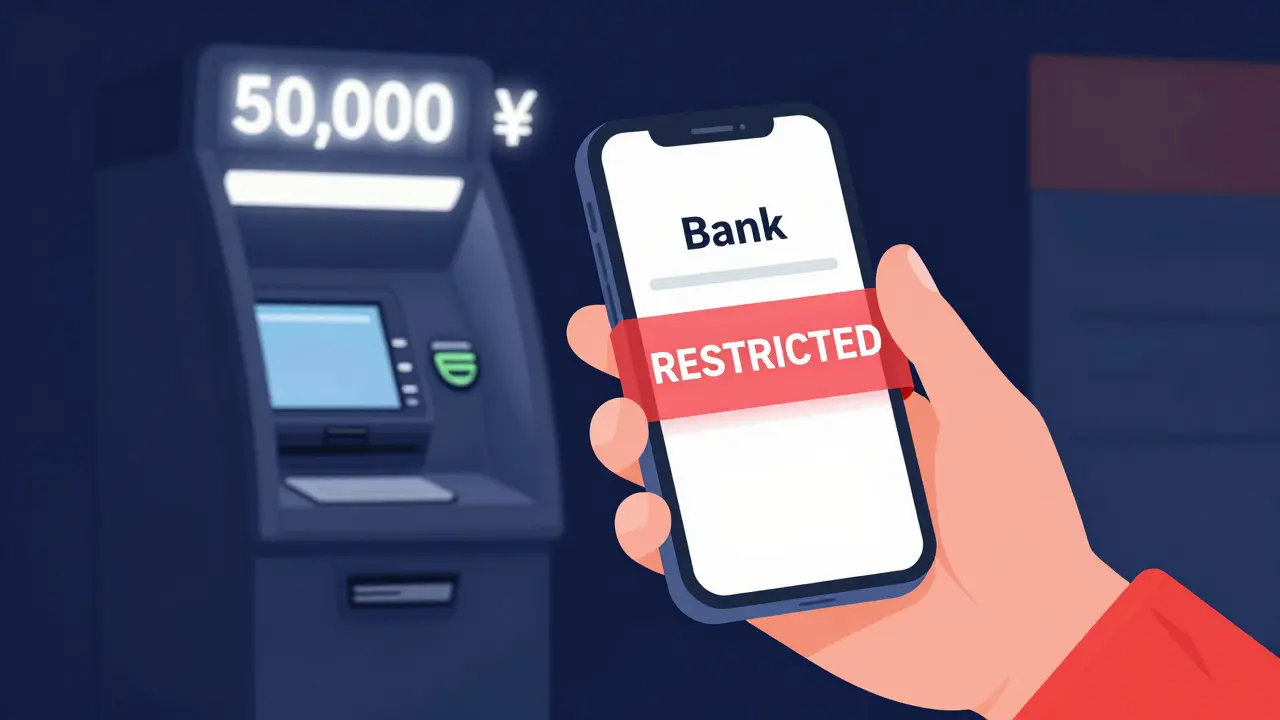
If you've recently tried to move money from a crypto wallet to a Russian bank account, you might have noticed that the process is no longer as simple as a few clicks. Since late 2025, the Russian banking system has shifted from a passive observer to an active gatekeeper. Banks are no longer just watching your transactions; they are proactively limiting your access to cash based on patterns that look like cryptocurrency conversions.
The 50,000 Ruble Wall
The most immediate reaction you'll encounter from a bank is a sudden, sharp limit on your cash withdrawals. Under Federal Law No. 3-1092818-2025 is the core legislation granting Russian banks the authority to restrict daily cash withdrawals for accounts flagged as suspicious , banks can cap your daily withdrawals at 50,000 rubles (roughly $600). This isn't a permanent ban, but a 48-hour "cooling off" period while the bank investigates the source of your funds.
Why is this happening? The Central Bank of Russia (CBR) found that nearly 90% of fraud cases in early 2025 involved crypto conversions. To fight this, the CBR issued Directive No. 74-P, which forces banks to flag specific behaviors. If you trigger these flags, you'll likely get an SMS notification within 15 minutes, and your account will be restricted almost instantly.
What Exactly Triggers a Bank Flag?
Banks aren't just looking at the amount of money; they are looking at how you behave. Your account is more likely to be flagged if you do any of the following:
- Odd Timing: Withdrawing funds between 11:00 PM and 5:00 AM.
- Unusual Locations: Using an ATM more than 50 kilometers away from where you live.
- Odd Amounts: Moving sums that aren't divisible by 1,000 rubles (which looks like an automated exchange conversion).
- Digital Footprints: Using QR codes or virtual cards instead of a physical plastic card for the transaction.
- Rapid Movement: Withdrawing cash within 24 hours of receiving a transfer over 200,000 rubles via the Faster Payments System.
- Communication Spikes: Receiving three or more messages from unknown numbers just before a large withdrawal.
These triggers are designed to catch P2P traders. For instance, if you're using Paxful or LocalBitcoins, any transaction over 100,000 rubles is automatically categorized as high-risk by the CBR's internal monitoring guidelines.
| Region | Primary Mechanism | Immediate User Impact | Reporting Threshold |
|---|---|---|---|
| Russia | Behavioral Monitoring | 48-hour 50k ruble limit | Based on triggers/patterns |
| USA | Bank Secrecy Act | Reporting to FinCEN | $10,000 USD |
| EU | 6AMLD Directive | VASP compliance | Variable by member state |

The P2P Struggle and "The Underground"
For the average person using P2P platforms, the experience has become a nightmare. Users on forums like BitBoom report accounts being frozen for days, requiring them to visit a branch in person. Banks like Sberbank and Tinkoff Bank are now demanding notarized transaction histories. This is a huge problem for anyone using decentralized wallets where no central authority can provide a "stamp of approval."
Interestingly, this crackdown has created a weird paradox. While the government wants to stop crypto to fiat Russia conversions for citizens, they are actually legalizing crypto for big international trade to bypass sanctions. They are essentially trying to kill the "retail" crypto market while building a controlled "institutional" pipeline. This means the bank might block your 50,000 ruble withdrawal but allow a corporation to move millions for oil exports.

How to Reduce Your Risk of Getting Flagged
You can't completely avoid the system, but you can make your account look less like a "crypto bridge." Experts suggest a few survival strategies:
- Maintain a "Natural" History: Don't use a brand new account for crypto withdrawals. Banks prefer accounts with at least three months of regular spending (groceries, utilities, gas).
- Stick to Known Contacts: Transactions with verified, long-term contacts have a 73% lower chance of being flagged compared to random P2P sellers.
- Diversify Your Banks: Many active traders now use an average of 3.7 different bank accounts, staggering their withdrawals to avoid hitting the 200,000 ruble "rapid movement" trigger.
- Avoid the "Dead of Night": Do your banking during standard business hours. 3:00 AM withdrawals are an immediate red flag.
Be careful with the diversification strategy, though. Anti-money laundering (AML) algorithms are getting better at spotting patterns across different banks. If you're moving identical amounts across four different accounts, the system might still catch you.
Future Outlook: The Digital Ruble and Criminal Penalties
The pressure isn't letting up. By December 2025, banks will likely be required to verify the source of funds for any withdrawal over 100,000 rubles regardless of other triggers. Even more serious is the legislation moving through the Duma that could introduce criminal penalties for "organized conversion schemes," with potential prison time for those running large-scale unofficial exchanges.
The long game here is the Digital Ruble, set for a phased rollout in September 2026. The government wants to move everyone away from unregulated coins and into a state-controlled digital currency. By making it a headache to withdraw crypto to fiat, they are effectively pushing people toward the state's own digital ecosystem.
What happens if my account is frozen after a crypto withdrawal?
Typically, you will face a 48-hour limit of 50,000 rubles. To fully unfreeze the account, you'll likely need to provide proof of income or a notarized history of the cryptocurrency transactions. In some cases, this requires an in-person visit to your bank branch.
Is it illegal to withdraw crypto to a Russian bank?
It is not strictly illegal to own or sell crypto, but the act of converting it to fiat is heavily monitored. Using "organized schemes" to bypass bank limits, however, could lead to criminal charges under new legislation moving through the Duma.
Why do banks care about the time of my withdrawal?
The Central Bank of Russia identifies withdrawals between 11 PM and 5 AM as a high-risk indicator. This pattern is common among automated bots and fraudulent schemes, so it triggers an automatic flag for manual review.
Will the Digital Ruble replace cryptocurrency in Russia?
The government's goal is to reduce unregulated crypto circulation by 85% by 2027. The Digital Ruble is intended to provide the benefits of digital assets (speed, programmability) while remaining under full central bank control.
Can I avoid restrictions by using a virtual card?
Actually, using virtual cards or QR codes instead of a physical card is one of the 12 specific characteristics that banks use to flag suspicious activity. It is generally safer to use a physical card at a local ATM.


Author
Ronan Caverly
I'm a blockchain analyst and market strategist bridging crypto and equities. I research protocols, decode tokenomics, and track exchange flows to spot risk and opportunity. I invest privately and advise fintech teams on go-to-market and compliance-aware growth. I also publish weekly insights to help retail and funds navigate digital asset cycles.