
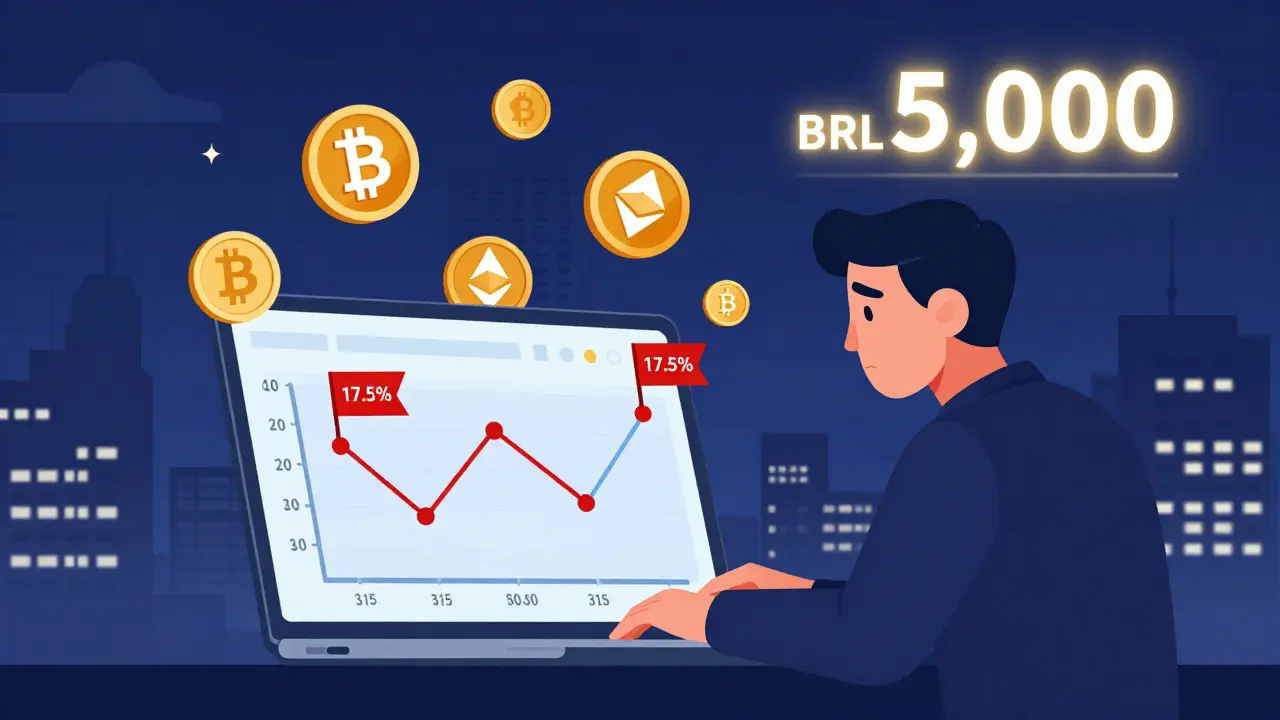
Brazilian Crypto Tax Calculator
Tax Calculator
Calculate your tax liability under Brazil's new 17.5% flat tax rate. Note: Tax applies when monthly transaction value exceeds BRL 5,000.
Tax Calculation Results
Important: All transactions above BRL 5,000 monthly value must be reported to Receita Federal do Brasil.
Even if you don't owe tax on the transaction value, you must report if it exceeds the threshold.
Starting June 12, 2025, Brazil changed everything for crypto investors. If you’re buying, selling, or trading Bitcoin, Ethereum, or any other digital asset in Brazil, you now pay a flat 17.5% tax on every profit - no exceptions, no loopholes, no matter how small or how long you held it. This isn’t a tweak. It’s a full overhaul. The old system, where small trades under BRL 5,000 slipped under the radar, is gone. Now, every transaction above that monthly threshold is tracked, reported, and taxed. And it’s not just sales to real money anymore - swapping Bitcoin for Solana? Taxable. Earning staking rewards? Taxable. Mining crypto? Also taxable.
What Exactly Gets Taxed?
The Brazilian tax authority, Receita Federal do Brasil (RFB), doesn’t care if you’re a weekend trader or a full-time investor. If you made money from crypto, you owe tax. Here’s what counts:- Selling crypto for Brazilian reais (BRL)
- Trading one cryptocurrency for another (like ETH for BTC)
- Staking rewards and yield farming income
- Crypto mining profits
- Airdrops received and later sold
- Payments received in crypto for goods or services
Even if you didn’t cash out, trading crypto-to-crypto triggers a taxable event. Say you bought 0.5 BTC for BRL 15,000 in January and traded it for 12 ETH in March when ETH was worth BRL 18,000. That BRL 3,000 profit? Taxed at 17.5%. You don’t need to convert to BRL to trigger the tax - the value at the time of trade is what matters.
How the Tax Works: Simple, But Strict
The 17.5% rate is flat. No brackets. No holding period discounts. No annual exemption like the UK’s £3,000 allowance. Even if you only made BRL 500 in profit, you still pay 17.5% - unless your total monthly crypto activity stays under BRL 5,000 in value. That’s the only threshold that matters: if your trades in a single month total less than BRL 5,000, you don’t report. But once you cross that line, every single transaction from that month forward must be tracked and reported.Let’s say you made BRL 20,000 in crypto profits over the year. Your tax bill is BRL 3,500 - no more, no less. No deductions for losses in other months. You can’t offset gains against losses unless you file a formal tax return with full records. And you must report even if you lost money overall. The RFB wants to see every trade, every wallet address, every exchange you used.
Reporting: The eCac Portal and the Burden of Proof
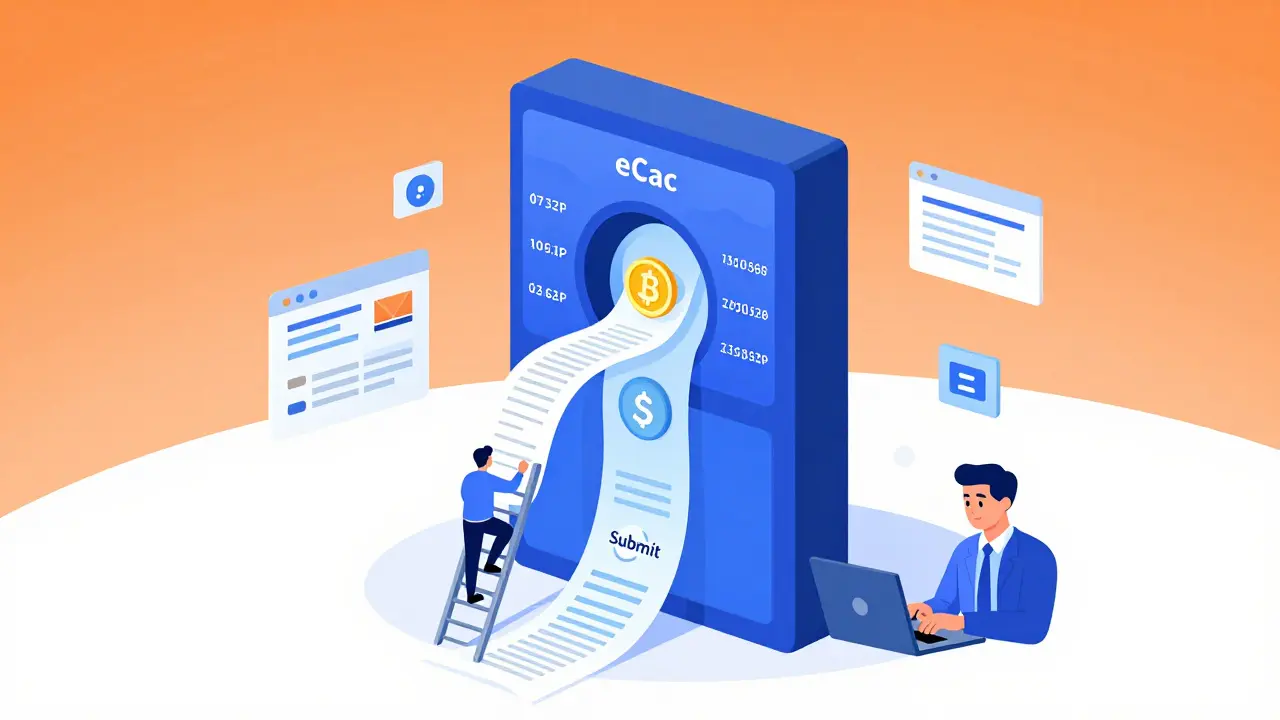
All reporting happens through the eCac portal - Brazil’s online tax system. You need to submit your crypto activity by April 30 of the following year. For 2025, that’s April 30, 2026. But here’s the catch: the RFB doesn’t give you templates or easy tools. You’re expected to know how to calculate cost basis, track transaction dates, and document wallet addresses.Many investors use third-party tools like Koinly or CoinTracker to auto-import trades from exchanges like Binance, Kraken, or Mercado Bitcoin. But even those tools can’t fix bad data. If you used a non-KYC wallet or traded on a decentralized exchange (DEX) like Uniswap, you’re on your own. The RFB doesn’t care if you didn’t know how to track it. If you can’t prove your cost basis, they assume your entire sale amount is profit - and tax you on that.
Professional traders say the system is fair because it’s predictable. Retail investors? They’re overwhelmed. One Reddit user in São Paulo posted: “I traded 17 times last month. Each trade was under BRL 300. But together, I hit BRL 5,200. Now I have to log every single one, with timestamps, prices, and wallet IDs. I didn’t even realize I was crossing the line.”

How Brazil Compares to the Rest of the World
Brazil’s 17.5% rate sits in the middle of global crypto tax policies - but its lack of exemptions makes it one of the strictest.| Country | Tax Rate | Exemptions | Holding Period Benefits |
|---|---|---|---|
| Brazil | 17.5% flat | None on gains; only BRL 5,000/month transaction threshold | No |
| Germany | 0% if held >1 year | €600 annual tax-free gain | Yes |
| Portugal | 28% (if held <1 year) | None for individuals | Yes (lower rate for long-term) |
| United Kingdom | 10-20% depending on income | £3,000 annual allowance | No |
| United States | 0-37% depending on income | $0 for individuals; long-term rates apply | Yes |
Brazil removed the safety net that other countries still offer. In Germany, you can hold Bitcoin for a year and pay nothing. In the UK, you get a £3,000 cushion. Brazil gives you nothing - unless your monthly volume stays under BRL 5,000. That’s a big difference. It’s not just about the rate. It’s about the lack of mercy.
Why Brazil Made This Move
The numbers speak for themselves. Between January and September 2024, Brazilians traded over $43.5 billion in cryptocurrency - up 24.2% from the year before. The government saw an opportunity. Crypto wasn’t just a fringe trend anymore. It was a financial force.Finance Minister Fernando Haddad called it “tax equity.” Crypto isn’t special. If you make money from stocks, you pay tax. Same for real estate. So why should crypto be different? The message was clear: if you profit, you pay. No more free rides.
But there’s another reason: control. Brazil’s Central Bank is testing Drex, its own digital currency. The government wants to know who’s doing what with digital money - whether it’s issued by them or by private companies. The new tax rules are part of a broader regulatory push under the Virtual Assets Act (Law 14,478/2022). That law gave the Central Bank oversight of exchanges, the Securities Commission (CVM) authority over tokenized securities, and COAF the power to flag suspicious activity.
This isn’t just about money. It’s about visibility. The RFB now expects every crypto transaction to leave a paper trail. And they’re building the tools to find it.
What Happens If You Don’t Report?
Don’t think you can hide. Brazil’s tax authority has access to data from all licensed exchanges. If you used Binance, Kraken, or any local platform, they already have your transaction history. If you used a non-KYC wallet, they’ll still find you - through bank transfers, crypto-to-BRL conversions, or even third-party reports.Penalties are harsh:
- Failure to report: 75% of the unpaid tax amount
- Underreporting: 150% of the difference
- Fraud: Up to 200% penalty + criminal charges
And it’s not just a fine. Your bank account can be frozen. Your assets can be seized. And once flagged, you’ll be under audit for years. The RFB doesn’t just send letters - they follow up with phone calls, in-person visits, and even audits of your personal finances.
Who’s Affected the Most?
The new rules hit retail investors hardest. If you’re buying $50 worth of Bitcoin every week, you’re now in the system. You didn’t think you were doing anything illegal. But now, you’re responsible for tracking 52 trades a year - each with its own cost basis, timestamp, and value in BRL.Professional traders and institutional investors see it differently. They’ve always kept records. They’ve always paid taxes. For them, the 17.5% flat rate is a relief. No more confusing calculations based on holding periods or income brackets. Just one number. Predictable. Clean.
But for the average person who bought crypto as a side hustle? It’s a nightmare. One investor in Curitiba told a local news outlet: “I made BRL 1,200 last year. I paid BRL 210 in tax. But the time I spent gathering receipts, uploading files, and figuring out the system? That cost me more than the tax.”
What Should You Do Now?
If you’re trading crypto in Brazil, here’s what you need to do - right now:- Track every transaction - even tiny ones. Use a crypto tax tool like Koinly or CoinTracker. Import your exchange history and wallet addresses.
- Calculate your cost basis - what you paid for each asset, including fees. Don’t guess. Use the exact purchase price.
- Separate your wallets - if you use multiple wallets, make sure you have records for all of them.
- Save all screenshots - of trades, receipts, and confirmations. You’ll need proof if audited.
- File by April 30, 2026 - don’t wait. The system is slow. The portal crashes. Start early.
If you’re unsure, hire a tax advisor who knows crypto. Not just any accountant. One who’s handled Brazilian crypto filings before. The cost is worth it. A bad filing can cost you 10 times more than the tax itself.
What’s Next for Brazil?
This isn’t the end. It’s the beginning. Brazil’s crypto tax policy is still evolving. The RFB is working on better integration with exchanges. They’re testing automated reporting systems. They’re likely to expand the BRL 5,000 threshold downward in the next two years.Other Latin American countries are watching closely. Argentina and Colombia already have crypto tax rules - but they’re messy and inconsistently enforced. Brazil’s clear, strict model could become the regional standard.
And with Drex, Brazil’s central bank digital currency, coming online, the line between crypto and state money is blurring. The government isn’t trying to kill crypto. It’s trying to own it. And if you’re in Brazil, you’re part of that system now - whether you like it or not.
Is there still a tax-free threshold for small crypto trades in Brazil?
No - but there’s a monthly transaction threshold. If your total crypto trading volume in a single month stays under BRL 5,000, you don’t have to report. Once you hit or exceed that amount, every trade from that month must be reported and taxed. There’s no exemption on profits - only on transaction volume.
Do I pay tax if I trade Bitcoin for Ethereum?
Yes. Trading one cryptocurrency for another is a taxable event in Brazil. The profit is calculated based on the value of the Bitcoin when you bought it versus the value of the Ethereum when you received it. Even if you didn’t convert to BRL, the gain is still subject to the 17.5% tax.
What happens if I lose money on crypto trades?
You still have to report your losses - but you can’t use them to offset gains in Brazil. Unlike in the U.S. or UK, Brazil doesn’t allow netting losses against profits. Each trade is taxed individually. So even if you lost BRL 10,000 overall, you still pay tax on any individual profitable trade above the BRL 5,000 monthly threshold.
Do I need to report crypto I hold but didn’t sell?
No - you only report when you sell, trade, or earn income from crypto. Holding Bitcoin or Ethereum without selling doesn’t trigger tax. But if your monthly trading volume exceeds BRL 5,000, you must report all transactions during that period - even if some were losses.
Can I avoid tax by using a non-KYC wallet?
Not really. While non-KYC wallets aren’t directly reported to the RFB, any time you convert crypto back to BRL through a licensed exchange, that transaction is tracked. The tax authority can trace funds from exchanges to bank accounts. If you deposit BRL into your account and can’t explain the source, you’ll be audited. Avoiding KYC doesn’t mean avoiding tax - it just makes getting caught more likely.
Are staking rewards taxed in Brazil?
Yes. Staking rewards, DeFi yields, and mining income are treated as ordinary income and taxed at 17.5% when you receive them - not when you sell. You must report the value in BRL at the time you received the reward. If you later sell those rewards, you pay another 17.5% on any profit from that point forward.
What if I traded crypto before June 2025?
The 17.5% rule applies to all gains realized after June 12, 2025. If you sold crypto before that date, those gains are not taxed under the new law. But if you held crypto purchased before 2025 and sold it after June 12, 2025, the profit from that sale is taxable. You must calculate the cost basis from your original purchase date - even if it was years ago.


Author
Ronan Caverly
I'm a blockchain analyst and market strategist bridging crypto and equities. I research protocols, decode tokenomics, and track exchange flows to spot risk and opportunity. I invest privately and advise fintech teams on go-to-market and compliance-aware growth. I also publish weekly insights to help retail and funds navigate digital asset cycles.