
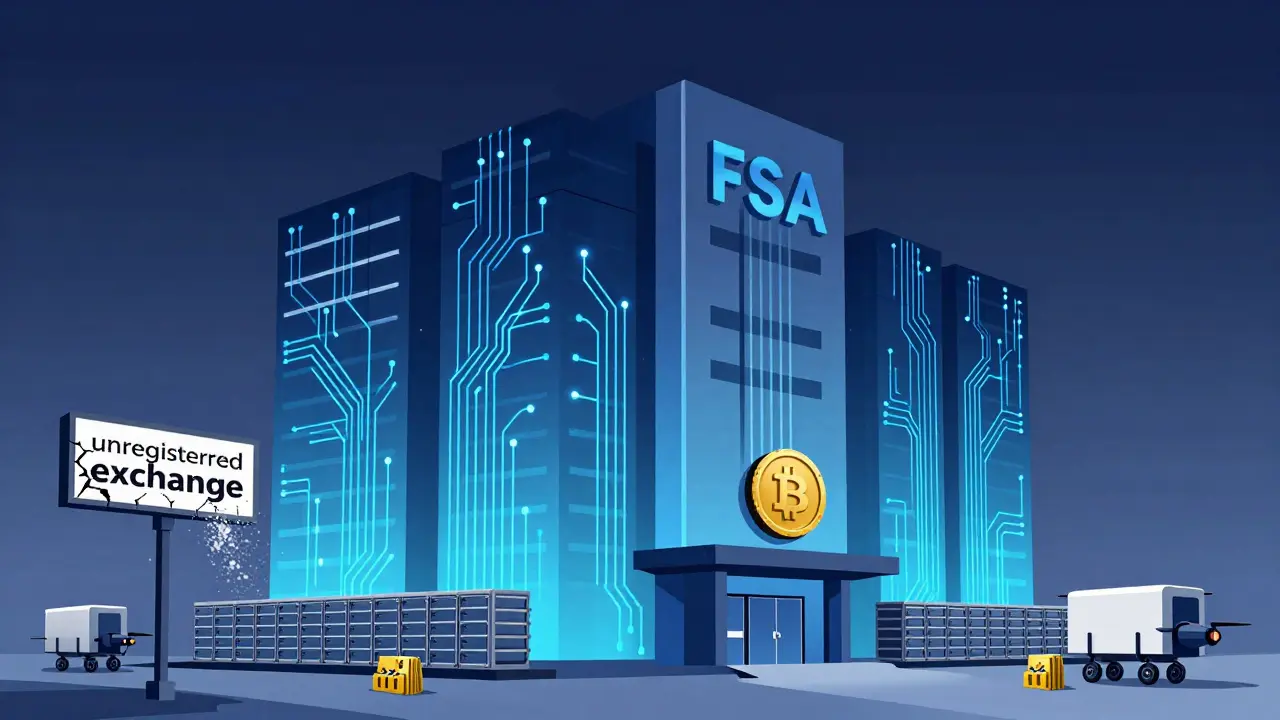
Japan doesn't just allow crypto exchanges - it controls them. If you think running a crypto business in the U.S. or Europe is tough, try doing it in Japan. The Financial Services Agency (FSA) doesn't just ask for paperwork. It demands proof - real, physical, technical proof - that you're serious about protecting users. And if you fail? You don't get a warning. You get shut down.
Why Japan's Rules Are Different
Most countries treat crypto like a wild experiment. Japan treats it like a bank. After the Mt. Gox collapse in 2014, which lost 850,000 BTC, Japan didn't panic. It built a system. The Payment Services Act (PSA) was rewritten in 2017, then updated again in 2020 and 2023. It didn't just add rules - it rewrote the entire playbook for how digital assets should be handled. The FSA didn't just say "be careful." It made rules so strict that only serious players survive. By 2025, Japan had 17.1 million crypto users. That’s more than the population of Australia. And every single one of them is protected by one of the world’s toughest regulatory frameworks.The Two Laws That Rule Crypto in Japan
There are two legal pillars holding up Japan’s crypto system: the Payment Services Act (PSA) and the Financial Instruments and Exchange Act (FIEA). Until mid-2025, the PSA was the main rulebook. It defined crypto as "crypto-assets," not money, not commodities - something entirely new. Exchanges had to register. They had to prove they had offices in Japan. They had to lock up customer funds. But in June 2025, the FSA made a major move. It started shifting certain digital assets under the FIEA. Why? Because some tokens aren’t just digital cash. They’re investment contracts. They behave like stocks. They pay dividends. They give voting rights. Those aren’t payment tools - they’re securities. And securities? They’ve always been tightly controlled under the FIEA. This shift means token issuers now need to file disclosures, prevent insider trading, and follow the same rules as companies listing on the Tokyo Stock Exchange. Spot Bitcoin ETFs? They’re now legally possible. And they’re coming. The formal bill is expected in early 2026. Japan isn’t just regulating crypto - it’s integrating it into its financial system.The Cold Wallet Mandate: No Exceptions
Here’s where Japan goes further than any other country. By law, at least 95% of all customer crypto must be stored in cold wallets. Not "try to." Not "recommended." Mandatory. Cold wallets mean offline storage - hardware devices, paper keys, air-gapped systems. No internet connection. No hackers. And if an exchange wants to keep any crypto online - in a hot wallet - it must back every single yen of it with its own money. So if $1 million in user funds are in a hot wallet, the exchange must hold $1 million in cash or liquid assets to cover losses. That’s not insurance. That’s personal liability. The exchange’s balance sheet is on the line. This isn’t a suggestion. This is a legal requirement enforced by surprise audits. In 2024, one exchange lost its license because it stored 8% of user funds in a hot wallet without matching reserves. The FSA didn’t give it a second chance.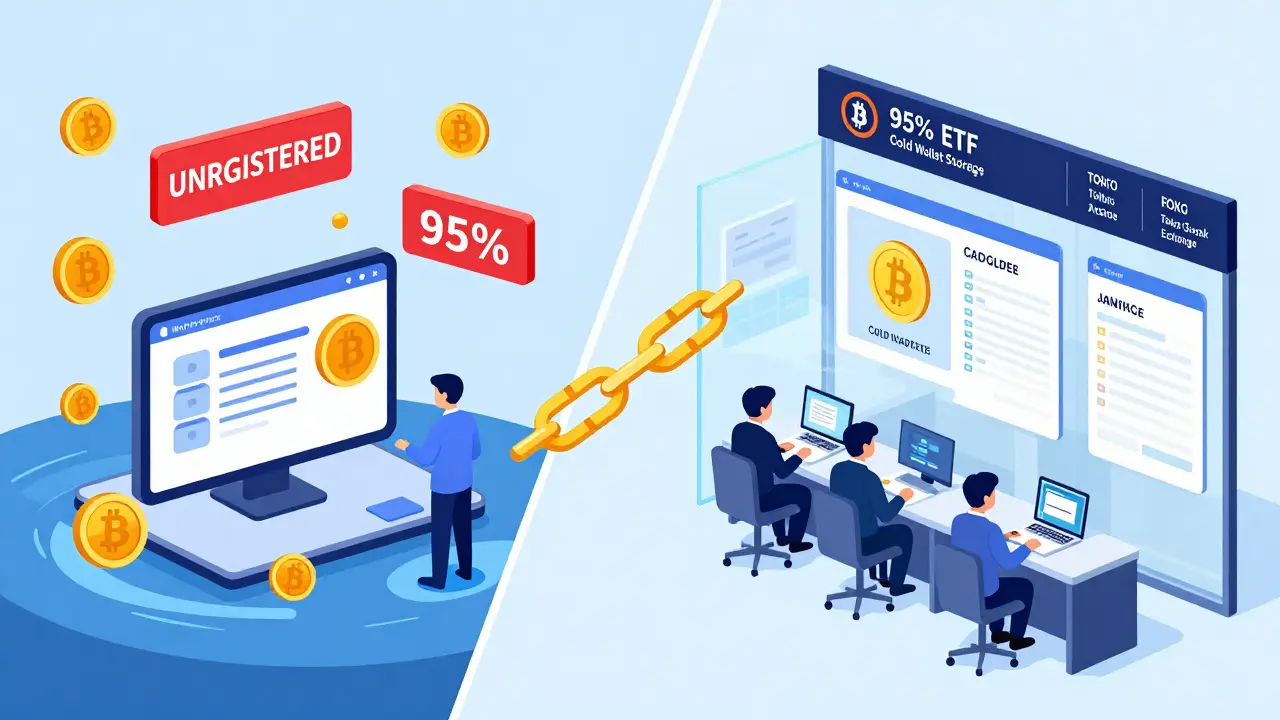
Registration Isn’t a Form - It’s a Project
You can’t just fill out an online form and get approved. To register with the FSA, you need:- A Kabushiki Kaisha (a Japanese joint-stock company) incorporated in Japan
- A physical office in Japan - not a virtual address, not a co-working space. A real office with a sign, employees, and a Japanese phone line
- A Japanese bank account - no offshore banking allowed
- Minimum capital of 10 million yen (about $65,000 USD), but most serious applicants hold over 100 million yen
- At least two qualified compliance officers who’ve passed FSA background checks
- A full AML/CFT system that logs every transaction and flags suspicious behavior in real time
- Proof of cold storage infrastructure - including third-party audits of wallet security
What Happens If You Skip Registration?
Operating without FSA approval isn’t a gray area. It’s a crime. Unregistered exchanges are blocked from Japanese banks. Payment processors refuse to work with them. The FSA publishes a public blacklist. If you’re on it, you can’t hire Japanese employees. You can’t rent office space. You can’t even advertise. In 2024, the FSA shut down three offshore exchanges that were targeting Japanese users. One was based in Cyprus. Another in the Seychelles. Both had millions in user funds. The FSA didn’t just freeze accounts - they worked with police to freeze bank accounts of the operators. Criminal charges followed.
Why This Matters for Investors
Japanese crypto users have the lowest rate of exchange-related losses in the world. Why? Because the FSA forces exchanges to act like banks. Customer funds are segregated. No mixing with company money. No using deposits to fund trading. No leveraging user assets. Every yen of user crypto is accounted for. The FSA also requires full transparency. Exchanges must publish monthly reports on their custody practices, capital reserves, and security incidents. If a hack happens, they must report it within 24 hours. No delays. No cover-ups. And while other countries debate whether crypto should be taxed, Japan already taxes it - at up to 55% for short-term gains. But here’s the twist: the FSA is pushing for tax reform. They want to align crypto gains with stock gains - a flat 20% rate. Why? Because they want more people to invest safely, not avoid crypto because of punitive taxes.The Bigger Picture: Japan as a Global Model
Japan isn’t trying to stop innovation. It’s trying to make innovation safe. While the U.S. argues over whether crypto is a security or a commodity, Japan just made it both - depending on how it behaves. DeFi protocols? The FSA has a dedicated study group meeting every two months with academics and developers. They’re not banning smart contracts. They’re figuring out how to regulate them without killing them. Companies like Metaplanet hold billions in Bitcoin because they trust the system. The FSA doesn’t just protect users - it protects legitimate businesses. If you follow the rules, you get access to one of the most stable, transparent, and growing crypto markets in the world.What’s Next in 2026?
By mid-2026, Japan will have fully transitioned to the FIEA framework for investment-grade tokens. Expect:- Regulated spot Bitcoin ETFs launching on the Tokyo Stock Exchange
- Token issuers required to file quarterly financial disclosures
- Clear rules on governance tokens and voting rights
- Stricter penalties for market manipulation and insider trading
- Lower crypto taxes - likely moving from 55% to 20%
Is it legal to trade crypto in Japan without using a licensed exchange?
Yes, individuals can buy and hold crypto without using a licensed exchange. You can use peer-to-peer platforms, wallets, or even buy directly from private sellers. But if you’re running a business that exchanges crypto for fiat or other digital assets - even once - you must be FSA-registered. The law targets operators, not users.
Can foreign crypto exchanges operate in Japan without a local office?
No. The FSA requires every crypto exchange serving Japanese users to have a legal entity registered in Japan, a physical office, a Japanese bank account, and local compliance staff. Even large global exchanges like Binance and Kraken had to set up Japanese subsidiaries to continue serving users after 2019. No exceptions.
What happens if a Japanese crypto exchange gets hacked?
If the hack affects hot wallets (online storage), the exchange must cover losses using its own capital - because it was required to back those funds 1:1. If the hack affects cold wallets (offline), the FSA investigates whether security protocols were followed. If negligence is found, the exchange loses its license. In 2024, one exchange lost its license after failing to update its multi-signature wallet software for over a year.
Are stablecoins regulated differently in Japan?
Yes. Stablecoins pegged to fiat currencies (like USD or JPY) are treated as payment instruments under the PSA. But if a stablecoin has features like interest payments, governance rights, or algorithmic supply changes, the FSA may classify it under the FIEA as a security. This means issuers must disclose reserves, audit mechanisms, and redemption policies - just like a mutual fund.
Why does Japan require a Japanese bank account for crypto exchanges?
It’s about traceability. Japanese banks are required to report suspicious activity to the Financial Intelligence Unit. By forcing exchanges to use local banks, the FSA ensures every dollar flowing into or out of a crypto platform is monitored under Japan’s strict AML laws. Offshore accounts would create blind spots - and the FSA won’t tolerate them.
If you're thinking of launching a crypto service in Japan - don't. Not unless you're ready to build a real company, not just a website. The FSA doesn't want tech startups. It wants financial institutions.


Author
Ronan Caverly
I'm a blockchain analyst and market strategist bridging crypto and equities. I research protocols, decode tokenomics, and track exchange flows to spot risk and opportunity. I invest privately and advise fintech teams on go-to-market and compliance-aware growth. I also publish weekly insights to help retail and funds navigate digital asset cycles.