
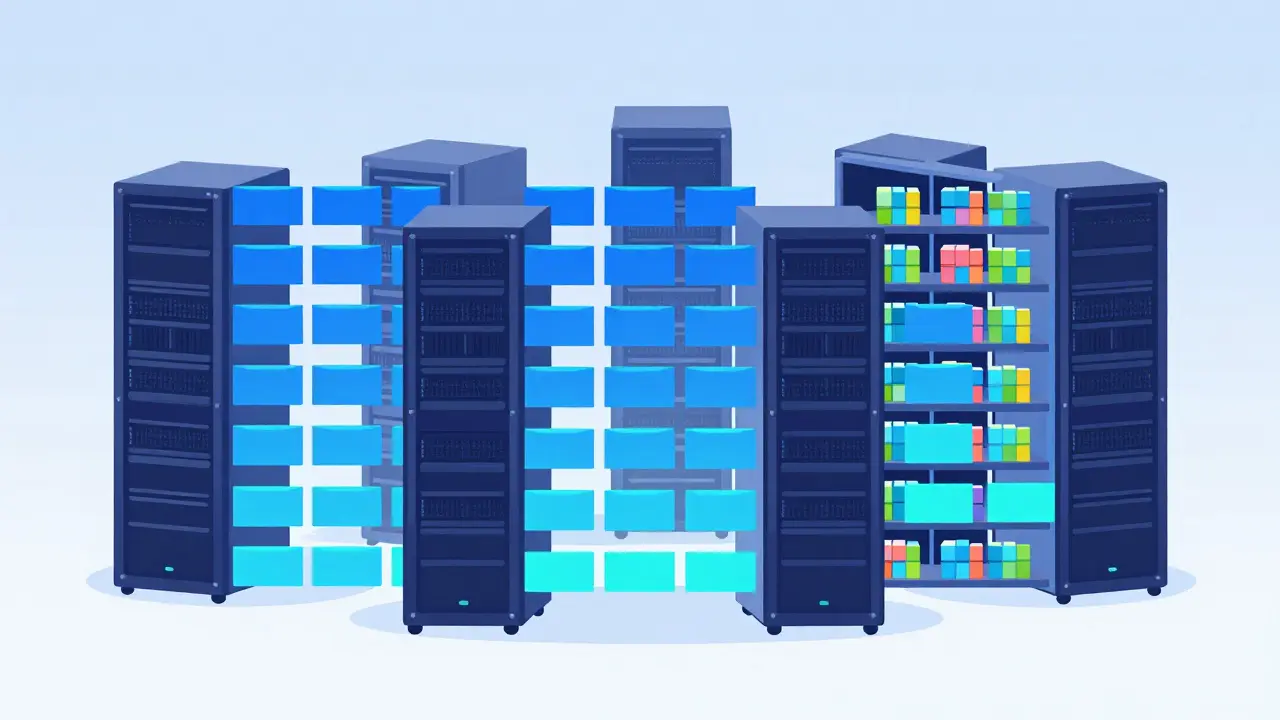
You might have heard developers arguing about Data Sharding being superior to transaction sharding. It sounds like a heated debate, but there is a massive catch here. One of those terms describes a solid architectural pattern used by companies like Facebook and Amazon. The other? It’s basically a misunderstanding. If you’ve been trying to implement "transaction sharding" in your blockchain node or database cluster, you’ve probably been fighting a ghost.
Data sharding is the act of slicing a database horizontally across multiple servers. Think of it like organizing a library by genre instead of keeping every book on one giant shelf. You put mystery novels on Shelf A and science fiction on Shelf B. When someone comes in asking for a mystery novel, they go straight to Shelf A. In tech terms, this splits large datasets so no single server gets overwhelmed. As of late 2023, systems handling billions of records rely on this to stay fast.
The Truth About Data Sharding
To get this right, you need to know what Data Sharding actually does in practice. It isn't magic; it's just distribution. When you shard, you decide on a shard key. This key determines where a specific piece of data lives. For example, if you are building a social platform, you might split users by their ID numbers. Users 1 through 1 million go to Server 1. Users 1 million through 2 million go to Server 2.
This approach has three main strategies:
- Range-Based: Splitting data by value ranges, such as dates or numerical IDs. It keeps related data together but can lead to uneven loads if some ranges grow faster than others.
- Hash-Based: Using a mathematical function like MurmurHash3 to assign data to shards randomly. This ensures even distribution, but querying a range (like all posts from last week) becomes harder because those posts are scattered everywhere.
- Directory-Based: Keeping a separate lookup table that points to where each piece of data is stored. It adds complexity but allows for flexible rebalancing.
Tools like MongoDB and Cassandra have built-in support for this. In MongoDB version 6.0, you can define sharding configurations that automatically handle new nodes joining the cluster. However, the trade-off is immediate. Queries that span multiple shards slow down significantly because the system has to gather results from different servers before sending them back to you.
Why "Transaction Sharding" is a Trap
Now, let's address the elephant in the room. When you search for transaction sharding, you often find vendors using it as marketing speak. Technically, you cannot shard a transaction in the same way you shard data. A transaction is a logical unit of work-an atomic operation that either succeeds completely or fails completely (ACID compliance). You don't cut a transaction into pieces and store those pieces separately.
Instead, what people usually mean when they say "transaction sharding" is distributed transactions. They want to perform a financial update that touches two different shards at once. For example, transferring money between User A (on Shard 1) and User B (on Shard 2).
Here is where the problems start:
- Latency Spike: Moving data within a single machine takes milliseconds. Moving data across machines to coordinate a transaction introduces network delay. Benchmarks show cross-shard transactions can be 3 to 5 times slower than local ones.
- Locking Issues: To keep data consistent, both shards need to agree on the change. This requires complex coordination protocols like Two-Phase Commit (2PC), which can deadlock your system if the network hiccups.
- Consistency Trade-offs: According to the CAP theorem, you usually sacrifice consistency for availability in these setups. You might see a balance update briefly reflect incorrectly before syncing.
In 2023, experts like Baron Schwartz from Percona noted that he had reviewed over 200 production database implementations and never seen a system that truly "shards transactions" rather than data. It remains a confusing misnomer used to describe the difficulty of managing state across boundaries.

Blockchains and State Sharding
Since you are exploring this topic in the context of Blockchain technology, it is worth distinguishing how scaling works there. Blockchains face the exact same issue as traditional databases: limited space and speed. Bitcoin handles roughly 7 transactions per second. Ethereum aims much higher. To fix this, researchers introduced the concept of state sharding.
State sharding is essentially data sharding applied to the blockchain ledger. Instead of one copy of the entire history on every node, the "state" (current account balances and smart contract storage) is split into smaller partitions called shards. Each shard processes its own subset of transactions independently.
This brings up a critical point: Blockchains avoid the pitfalls of traditional "transaction sharding" by changing the consensus mechanism. Unlike a SQL database requiring strong consistency across nodes immediately, blockchains use probabilistic finality or long wait times for safety. Projects like Ethereum 2.0 aim to process thousands of transactions per second by splitting the load. However, this introduces the "cross-shard communication problem." If you want to swap tokens between two different shards, you need a special protocol to verify the move happened safely. It is functionally identical to the cross-shard transaction headaches we saw in enterprise databases.

The Reality Check: Comparing Approaches
| Feature | Traditional Replication | Data Sharding | Distributed Transactions (Mislabelled) |
|---|---|---|---|
| Primary Goal | Read Speed / Fault Tolerance | Write Speed / Storage Capacity | Logical Grouping |
| Scalability | Limited by Single Node Power | Near-Linear Horizontal Scaling | Bottlenecked by Coordination Latency |
| Complexity | Low | Medium (Routing Logic Required) | Very High (Consensus Protocols) |
| Best Use Case | Amazon DynamoDB Reads | Social Media Feeds | Cross-Shard Transfers |
Choosing Your Strategy for 2026
If you are designing a system today, assuming we are looking forward to early 2026, the landscape is shifting towards automation. Cloud providers like AWS Aurora have begun hiding sharding complexity behind serverless interfaces. However, understanding the mechanics still matters.
Avoid relying on any terminology that suggests "transaction sharding" is a magic bullet. Focus instead on Data Sharding strategies that minimize cross-shard interactions. Design your application so that most transactions stay within a single shard (e.g., a user profile, their comments, and likes should all live on the same shard). This is known as co-location.
When cross-shard operations are unavoidable:
- Use asynchronous patterns where possible (message queues) to decouple the steps.
- Implement idempotency to prevent double processing if a failure occurs during transmission.
- Accept eventual consistency rather than demanding immediate ACID guarantees.
Misunderstanding these concepts leads to wasted engineering time. Developers report spending weeks configuring "sharding" logic only to realize the vendor was just describing standard replication. By sticking to verified architectural principles like range or hash-based data partitioning, you gain control. You avoid the performance cliffs caused by unnecessary inter-node coordination.
Does transaction sharding really exist?
No, "transaction sharding" is generally considered a misnomer. While data is physically sharded across servers, transactions are logical units that may span multiple shards. The confusion arises from the challenge of executing distributed transactions efficiently.
Why is cross-shard transaction slow?
It requires multiple servers to communicate and agree on a change before confirming success (consensus). This adds network latency and lock overhead compared to local transactions that run on a single machine instantly.
Which database uses data sharding effectively?
MongoDB, Cassandra, and MySQL Cluster (Vitess) offer robust native or community-supported sharding capabilities. They provide tools to manage shard distribution and balance load automatically.
How does blockchain state sharding work?
State sharding splits the global ledger into smaller segments. Nodes only validate transactions relevant to their assigned shard. This increases throughput but complicates transfers between different shards requiring specialized protocols.
Is sharding better than simple replication?
For write-heavy workloads, yes. Sharding divides the processing power. Replication duplicates data for reads but doesn't solve write bottlenecks since every replica must process the write sequentially.


Author
Ronan Caverly
I'm a blockchain analyst and market strategist bridging crypto and equities. I research protocols, decode tokenomics, and track exchange flows to spot risk and opportunity. I invest privately and advise fintech teams on go-to-market and compliance-aware growth. I also publish weekly insights to help retail and funds navigate digital asset cycles.