

The days of anonymous crypto trading in Europe are officially over. If you run a crypto business in the European Union today, you aren't just dealing with code and blockchain; you are navigating one of the strictest financial crime frameworks on the planet. With the Anti-Money Laundering Authority (AMLA) now fully operational and the Markets in Crypto-Assets Regulation (MiCA) setting the standard for market integrity, the rules have shifted from vague guidelines to hard mandates.
For founders and compliance officers, this isn't about ticking boxes anymore. It is about survival. The cost of getting it wrong ranges from massive fines to losing your license entirely. But getting it right opens up access to institutional capital that simply won't touch unregulated platforms. Here is exactly what you need to know about the current landscape, the costs involved, and how to stay compliant without burning through your runway.
The Core Framework: MiCA Meets AML
To understand where things stand in mid-2026, you have to look at how two major pillars interact. First, there is MiCA. This regulation gave us the definition of a Crypto-Asset Service Provider (CASP). If you exchange fiat for crypto or hold custody of digital assets, you fall under this umbrella. Second, there is the evolving Anti-Money Laundering (AML) regime, which dictates how you handle customers and transactions.
Previously, countries like Germany, France, and Estonia had slightly different interpretations of these rules. That fragmentation caused headaches for businesses trying to scale across borders. Now, the EU has moved toward a single rulebook. The goal is simple: harmonize supervision so that a company licensed in one member state can operate everywhere else without re-applying, provided they meet the central standards.
The key shift here is the role of the European Banking Authority (EBA). While AMLA handles the heavy lifting of financial crime prevention, the EBA still oversees market integrity aspects under MiCA. This creates a dual-supervision model. You might find yourself answering questions from both bodies, but their goals align: stop money laundering while keeping the market stable.
The Travel Rule: No More Hiding Behind Wallets
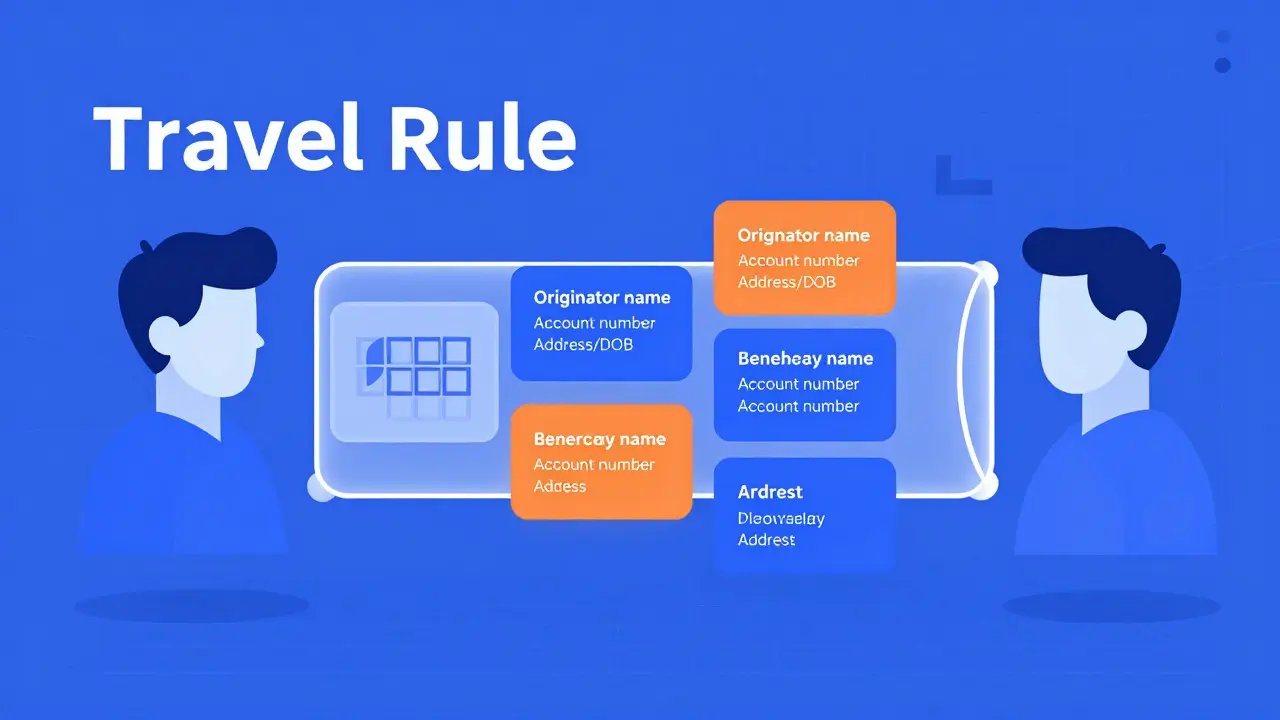
If there is one rule that changes daily operations more than any other, it is the Travel Rule. In the US, this rule often kicks in only for larger transfers. In the EU, there is no minimum threshold. Every time you move crypto from one CASP to another, you must send specific data along with the funds.
You need to collect and transmit six distinct pieces of information for every transaction:
- Originator name
- Originator account number
- Originator physical address OR date of birth
- Beneficiary name
- Beneficiary account number
- Beneficiary physical address
This sounds straightforward until you realize you are connecting with dozens of different partners. As of late 2025, firms reported integrating with 28 separate national Financial Intelligence Units (FIUs). The technical challenge is immense. You cannot just build a custom API for every partner. Most successful companies use middleware solutions like Traveler or Sygna to automate this data exchange. Without automation, manual verification bottlenecks will kill your user experience.
What happens if the receiving wallet is self-hosted? The rules get tighter. For transfers exceeding €1,000 to a self-hosted wallet, you must verify the recipient's identity. This effectively kills the anonymity many early adopters relied on. Privacy advocates argue this stifles innovation, but regulators see it as essential for tracking illicit flows.
Tiered Due Diligence: Know Your Customer Levels
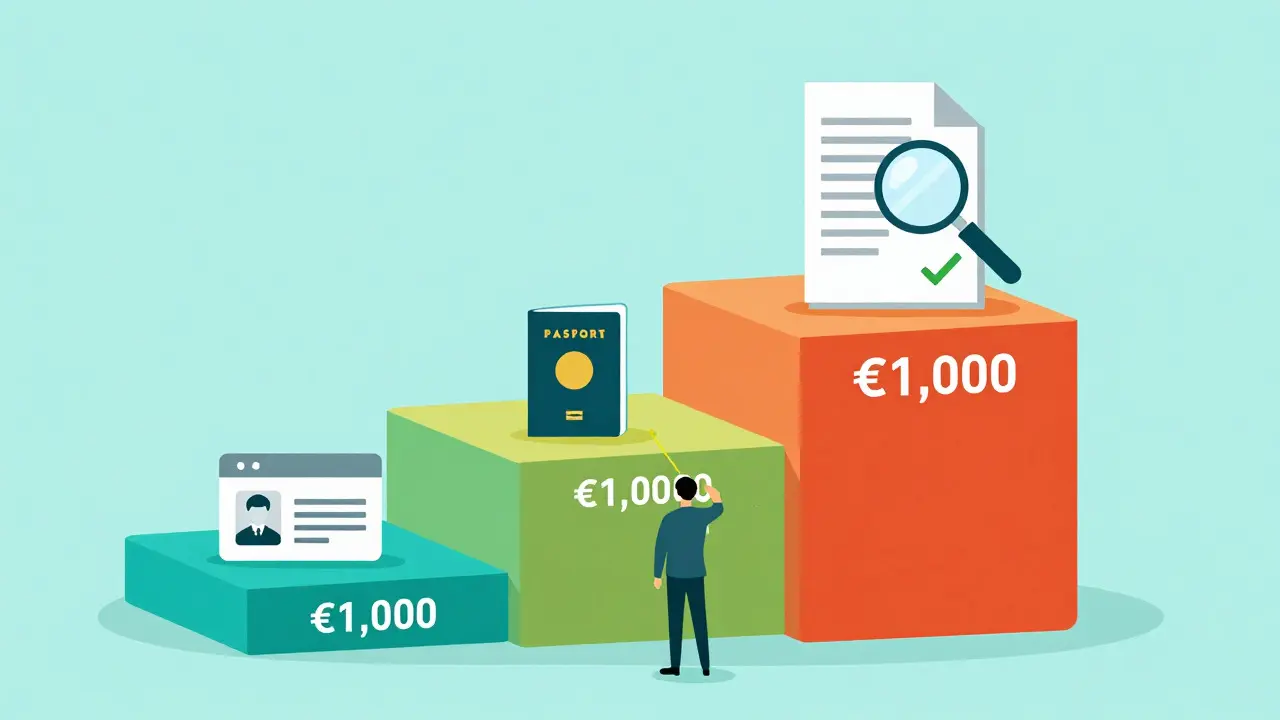
You don't treat a €50 purchase the same way you treat a €50,000 deposit. The EU mandates a risk-based approach to Customer Due Diligence (CDD). AMLA’s work programs emphasize tiered verification levels to balance security with usability.
| Transaction Value | Verification Level | Required Actions |
|---|---|---|
| Under €1,000 | Basic | Name and address confirmation |
| €1,000 - €10,000 | Enhanced | Identity document verification (passport/ID) |
| Over €10,000 | Strict Enhanced | Source of funds proof + senior management approval |
Notice the jump at €10,000. This is where most friction occurs. You need documented proof of where the money came from. Is it salary? Sale of property? Inheritance? Vague answers lead to frozen accounts. Senior management must personally approve these high-value entries. This adds a layer of accountability that prevents rogue employees from bypassing checks.
The Cost of Compliance: Real Numbers
Let's talk money. Building a compliant infrastructure is expensive. According to industry reports from mid-2025, obtaining full MiCA authorization takes between 9 and 12 months. During this period, you need to dedicate 3 to 5 full-time staff members just to prepare the application.
The setup costs are significant. Small to medium-sized enterprises report spending between €350,000 and €500,000 initially. This covers legal fees, compliance software, and the salaries of specialized hires. Then there is the ongoing cost. Integrating with national FIUs for the Travel Rule alone can cost around €185,000 per connection if done manually. Using standardized middleware reduces this timeline from six months to eight weeks but still carries a setup fee of approximately €420,000.
Training is another hidden cost. ESMA guidelines mandate 40 hours of annual AML training for compliance staff and 16 hours for operational staff. These aren't optional webinars; they require quarterly knowledge assessments. Failure to train staff properly is a common reason for regulatory penalties during audits.
DeFi and the Regulatory Gray Area
Decentralized Finance (DeFi) remains the biggest headache for regulators. Traditional AML rules apply to centralized entities-companies with CEOs and bank accounts. DeFi protocols often run on smart contracts with no clear owner. Who do you fine when a protocol allows money laundering?
The EU’s approach here is aggressive. Regulators are looking at the interfaces and front-ends of DeFi platforms. If a website provides a user-friendly gateway to a decentralized protocol, it may be classified as a CASP. Professor Angela Walch criticized this in late 2025, arguing that prescriptive rules could stifle innovation. However, cases handled by Germany’s BaFin show that criminals are exploiting these gaps. Expect tighter scrutiny on DeFi aggregators and launchpads in the coming year.
Looking Ahead: The 2027 AML Regulation
The current framework is just the beginning. On July 1, 2027, the new EU-wide AML Regulation will replace previous directives. This will introduce stricter deadlines and broader obligations. Key changes include:
- A five-working-day deadline for responding to FIU requests (down from variable national timelines).
- A Europe-wide cash payment cap of €10,000 for business transactions.
- Mandatory verification for cash payments of €3,000 or more.
- Expansion of obliged entities to include crowdfunding platforms and professional sports agents.
AMLA Chair Bruna Szego has signaled that privacy-enhancing technologies will face heightened scrutiny. If your platform uses mixers or privacy coins, expect targeted guidance in early 2026. The message is clear: transparency is non-negotiable.
Do I need a MiCA license to operate in the EU?
If you are a Crypto-Asset Service Provider (CASP), such as an exchange or custodial wallet provider, yes. MiCA requires a single EU-wide license to operate across all 27 member states. Operating without this license exposes you to severe penalties and potential shutdown orders.
What is the minimum threshold for the Travel Rule in the EU?
There is no minimum threshold. The Travel Rule applies to all crypto-to-crypto transfers between regulated entities. You must transmit originator and beneficiary data for every transaction, regardless of size.
How much does it cost to set up AML compliance for a crypto startup?
Initial setup costs typically range from €350,000 to €500,000. This includes legal advice, compliance software integration, and staffing. Ongoing costs involve annual training, audit fees, and potential middleware subscriptions for Travel Rule connectivity.
When does the new EU AML Regulation take effect?
The comprehensive EU-wide AML Regulation is scheduled to take effect on July 1, 2027. It will replace existing directives and introduce stricter due diligence timelines and broader definitions of obliged entities.
Are DeFi protocols subject to AML rules?
Currently, the focus is on centralized interfaces. If a DeFi project offers a user-friendly front-end or acts as an intermediary, regulators may classify it as a CASP. Purely decentralized protocols without identifiable operators remain in a gray area, but enforcement actions against front-ends are increasing.
Author
Ronan Caverly
I'm a blockchain analyst and market strategist bridging crypto and equities. I research protocols, decode tokenomics, and track exchange flows to spot risk and opportunity. I invest privately and advise fintech teams on go-to-market and compliance-aware growth. I also publish weekly insights to help retail and funds navigate digital asset cycles.