
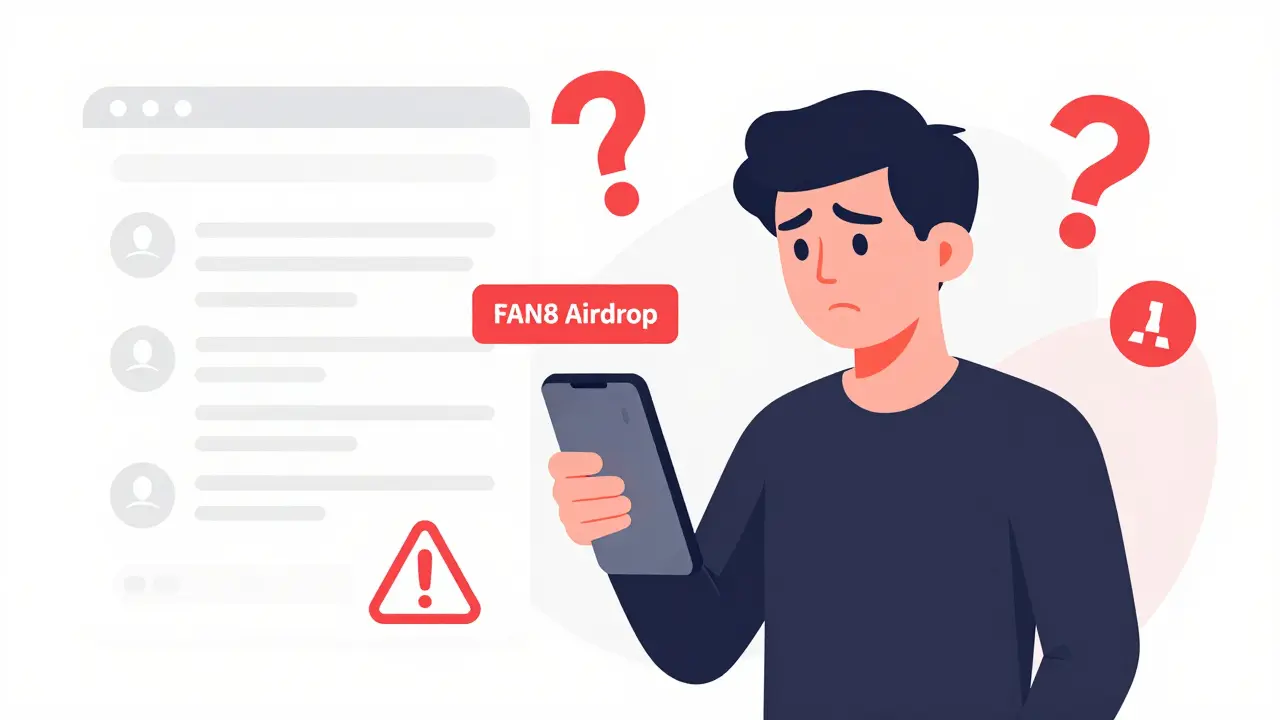
Have you seen the buzz about the FAN8 airdrop? If you’re scrolling through Telegram groups or Twitter feeds right now, you might think it’s the next big free money opportunity. But here is the hard truth: as of July 2026, there is zero credible evidence that an official FAN8 airdrop exists. In fact, digging into this topic reveals a classic pattern often used by scammers targeting eager crypto users.
We need to talk about why this confusion is happening, how to spot the difference between a legitimate project like Berachain or Kaito AI and a potential trap, and most importantly, how to keep your wallet safe while hunting for real opportunities.
The Reality Check: Does the FAN8 Airdrop Exist?
Let’s get straight to the point. You won’t find FAN8 listed on major, reputable tracking platforms like CoinMarketCap or CoinGecko with active trading volume. When I checked the data available up to mid-2026, listings for FAN8 show $0 USD price and $0 trading volume. That isn’t just "low liquidity"; that is a ghost town.
Legitimate airdrops come from projects with clear roadmaps, active development teams, and verified social media channels. Projects like Berachain, which distributed 79 million tokens to early participants, or Kaito AI, which rewarded Genesis NFT holders, had massive community engagement and transparent distribution mechanisms before their tokens even hit exchanges.
FAN8 lacks these fundamentals. There are no whitepapers, no official announcements from recognized industry leaders, and no presence on trusted airdrop aggregators like Airdrops.io. If a project doesn’t have a digital footprint beyond shady Telegram links, it’s not an opportunity-it’s a risk.
Why Are People Talking About FAN8?
If the project seems empty, why is there noise? The answer lies in name confusion and targeted marketing. Several other projects use similar naming conventions, leading to genuine mix-ups among new investors.
- Fanswap (FAN): This project ran a legitimate airdrop back in October 2021. They distributed 2,850,000 FAN tokens (5% of supply) to early users. However, that event ended years ago. Any site claiming to offer a "new" Fanswap airdrop in 2026 is lying.
- FanFare: Another distinct project that offered tokens via a Telegram bot. Users earned points for basic tasks. Again, this is unrelated to FAN8.
- FanTV ($FAN): Mentioned in early 2025 lists alongside projects like Crypto Dungeon. While active then, it has no connection to the mysterious FAN8 token.
Scammers thrive on this ambiguity. They create fake websites that look professional, copy-paste information from old, legitimate projects, and attach a slightly different ticker symbol-like FAN8-to catch people who aren’t paying close attention. They bank on your fear of missing out (FOMO).
Red Flags: How to Spot a Fake Airdrop
In the crypto world, if something sounds too good to be true, it almost certainly is. Here is a checklist to help you determine if an airdrop offer is legitimate or a scam. Use this every time you encounter a new token drop.
- No Official Website or Whitepaper: Legitimate projects explain their technology. If you can’t find a detailed document explaining what the token does, walk away.
- Social Media Silence: Check Twitter (X), Discord, and Telegram. Do the accounts have verified badges? Are they interacting with real users, or just posting generic hype? Fake accounts often have low follower counts but high engagement bots.
- Pressure to Act Fast: Scammers use urgency. Phrases like "Claim within 24 hours or lose forever" are designed to bypass your critical thinking. Real projects give ample time for claims.
- Requests for Private Keys: This is the biggest red flag. No legitimate service will ever ask for your seed phrase or private key. If a site asks for this to "verify" your wallet, close the tab immediately.
- Unverified Contracts: On block explorers like Etherscan or BscScan, check if the contract source code is verified. Unverified contracts mean anyone can manipulate the code, including draining your wallet.

The Mechanics of a Crypto Airdrop Scam
Understanding how these scams work helps you avoid them. Most fake airdrop schemes follow a predictable path. First, you receive a notification in your wallet saying you’ve received tokens. These tokens are worthless-they cost nothing to generate.
Next, you visit a website to "swap" or "claim" these tokens for real value. The site looks sleek and modern. It asks you to connect your wallet. Once connected, it prompts you to approve a transaction. This approval is the trap. By approving, you grant the scammer permission to transfer funds from your wallet, not just receive tokens. In seconds, your ETH, USDT, or other assets vanish.
This method was widely used during the peak of meme coin crazes in 2023 and 2024. Even in 2026, sophisticated phishing sites continue to trick users who don’t double-check URLs. Always bookmark official project pages directly from their verified social media bios, never click links from DMs.
Real Airdrops vs. Fake Ones: A Comparison
To make the distinction crystal clear, let’s compare a hypothetical fake FAN8-style scam with a legitimate project structure based on recent industry standards.
| Feature | Legitimate Project (e.g., Story Protocol) | Suspicious Project (e.g., FAN8 rumors) |
|---|---|---|
| Announcement Channel | Official blog, verified Twitter, Discord | Random Telegram DMs, unverified websites |
| Token Utility | Clear use case (governance, fees, access) | Vague promises of "high returns" or "revolutionary tech" without details |
| Contract Verification | Source code verified on blockchain explorer | Unverified contract or no contract address provided |
| Cost to Participate | Free (only gas fees for interaction) | May ask for upfront payment or private keys |
| Community Presence | Active, organic discussions over months | Sudden spike in bot-like comments |
How to Safely Hunt for Real Airdrops in 2026
Just because FAN8 is likely a dead end doesn’t mean you should stop looking for opportunities. The airdrop space is still alive, but it requires more diligence than ever. Here is how to approach it safely.
1. Stick to Established Ecosystems
Focus on networks with strong track records. For example, the Base Layer 2 ecosystem and Eclipse have hosted numerous verified airdrops. Projects building on these chains often undergo stricter scrutiny, reducing the risk of outright fraud.
2. Use Reputable Aggregators
Websites like Airdrops.io, CoinMarketCap’s airdrop section, and specialized newsletters curate lists. They vet projects before listing them. If an airdrop isn’t on these major platforms, treat it with extreme skepticism.
3. Engage Early and Authentically
Real airdrops reward participation. This means using testnets, joining Discords, creating content, and providing feedback. It’s not about clicking one button; it’s about contributing to the community. If a project asks for nothing but your wallet address, it’s suspicious.
4. Use a Burner Wallet
Never interact with new, unproven protocols using your main holding wallet. Create a separate wallet with minimal funds. If you get scammed, the loss is contained. This is a simple habit that has saved thousands of users from catastrophic losses.
What Should You Do With Your Current FAN8 Tokens?
If you somehow already hold FAN8 tokens in your wallet, do not panic, but act carefully. First, check the token contract address on a block explorer. Compare it with any official sources you can find. If there are no official sources, assume it is a spam token.
Do not try to sell it on decentralized exchanges unless you are absolutely sure of the pair. Many scam tokens have honeypot mechanisms where you can buy but cannot sell. If you want to remove them from view, you can send them to a burn address (a wallet with no known private key). Note that this costs gas fees, so only do this if the clutter bothers you significantly. Otherwise, simply ignore them. They have no value and pose no threat unless you interact with their associated smart contracts.
Conclusion: Patience Pays Off
The allure of free crypto is powerful, but the cost of being wrong is high. The FAN8 airdrop appears to be another example of market noise designed to exploit curiosity. By focusing on verified projects, understanding the mechanics of scams, and prioritizing security, you protect your capital and position yourself for real gains when legitimate opportunities arise. Stay skeptical, stay informed, and never rush into a claim.
Is the FAN8 airdrop legitimate?
There is no credible evidence that a legitimate FAN8 airdrop exists. The token shows zero trading volume and lacks official documentation, making it highly likely to be a scam or a defunct project.
How can I verify if a crypto airdrop is real?
Check for official announcements on verified social media channels, look for the project on reputable trackers like CoinMarketCap, ensure the smart contract is verified on a block explorer, and never share your private keys.
What is the difference between FAN8 and Fanswap?
Fanswap (FAN) is a distinct project that conducted a legitimate airdrop in 2021. FAN8 is a different, unrelated token with no verified history or active community, often confused due to similar naming.
Should I pay to claim a FAN8 airdrop?
No. Legitimate airdrops are free, though you may pay small network gas fees. Any request for upfront payment, private keys, or seed phrases is a definitive sign of a scam.
Where can I find safe airdrop opportunities in 2026?
Use trusted aggregators like Airdrops.io, follow official announcements from established ecosystems like Base or Ethereum L2s, and engage with communities that have long-standing reputations.
Author
Ronan Caverly
I'm a blockchain analyst and market strategist bridging crypto and equities. I research protocols, decode tokenomics, and track exchange flows to spot risk and opportunity. I invest privately and advise fintech teams on go-to-market and compliance-aware growth. I also publish weekly insights to help retail and funds navigate digital asset cycles.