
You deposit $1,000 worth of Ethereum and stablecoins into a decentralized finance (DeFi) pool. A month later, the price of Ethereum has gone up. Your wallet balance is higher than $1,000. You are happy-until you check what your portfolio would look like if you had just held those tokens in your wallet instead. That hypothetical holding value is now $200 higher than your current LP position. This difference is called Impermanent Loss, which is the opportunity cost experienced by liquidity providers when token prices diverge compared to simply holding assets. It is not money that has vanished from existence; it is money you *could* have made if you hadn't provided liquidity.
Understanding how to calculate this loss is the single most important skill for anyone providing liquidity on platforms like Uniswap or Sushiswap. Without this math, you are guessing whether the trading fees you earn will cover the divergence penalty. In this guide, we break down the exact formulas, show you how to use them in real scenarios, and explain why the "impermanent" part matters more than you think.
The Core Formula for 50/50 Pools
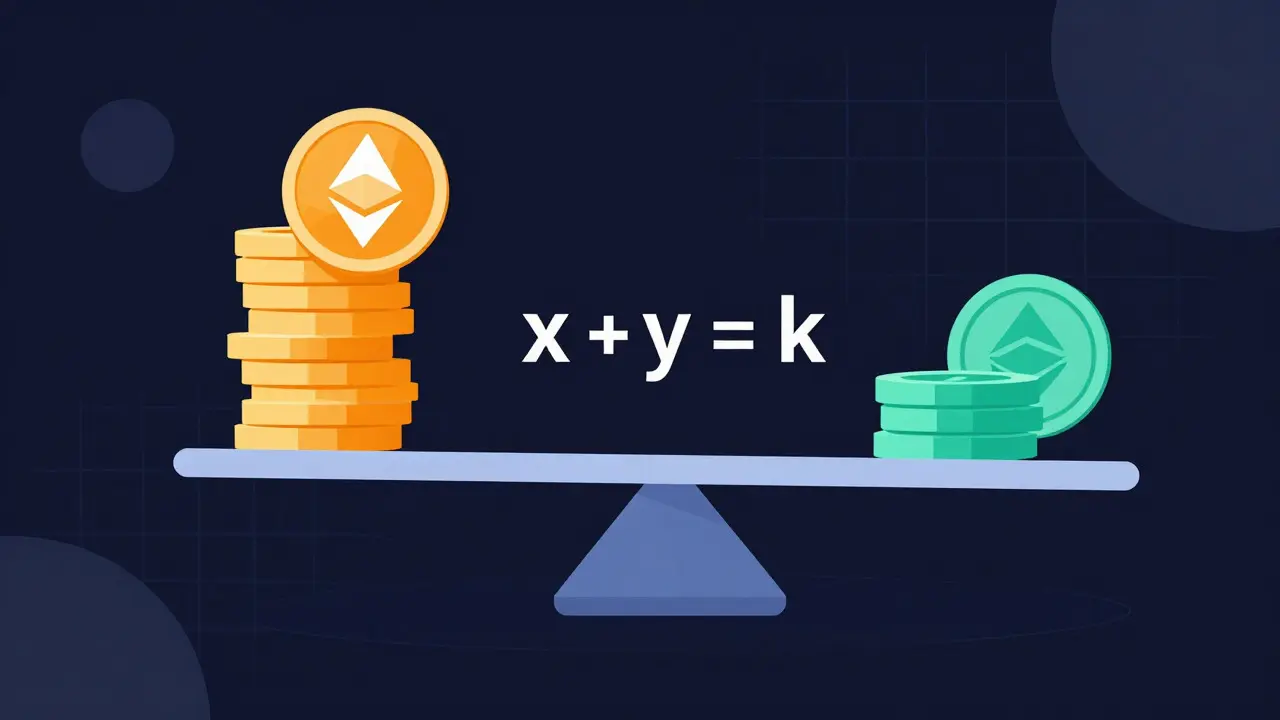
Most beginners start with standard Automated Market Maker (AMM) pools where two assets are weighted equally (50/50). Think of the classic ETH/USDC pair on Uniswap v2. The math here relies on the constant product formula ($x \times y = k$), which ensures that as one asset’s price rises, the pool automatically sells some of it to buy the other, keeping the total value balanced but changing the ratio of tokens you hold.
To calculate impermanent loss (IL) in these pools, you need one variable: d. This represents the price change ratio. If the price doubles, $d = 2$. If the price halves, $d = 0.5$. The formula is straightforward:
IL = (2 * √d) / (1 + d) - 1
Let’s walk through a concrete example. Imagine you deposited 1 ETH and 2,000 USDC when ETH was priced at $2,000. Total value: $4,000. Now, imagine ETH rises to $4,000. Here, $d = 2$ (a 2x increase).
- Calculate the square root of $d$: $\sqrt{2} \approx 1.414$
- Multiply by 2: $1.414 \times 2 = 2.828$
- Add 1 to $d$: $1 + 2 = 3$
- Divide step 2 by step 3: $2.828 / 3 \approx 0.9428$
- Subtract 1: $0.9428 - 1 = -0.0572$
Your impermanent loss is approximately -5.7%. This means your LP position is worth 5.7% less than if you had just held 1 ETH and 2,000 USDC in your wallet. Note that the result is always negative or zero; you never gain an "impermanent gain."
| Price Change (d) | Scenario Example | Impermanent Loss |
|---|---|---|
| 1.25x | Token goes up 25% | -0.6% |
| 2x | Token doubles | -5.7% |
| 3x | Token triples | -13.4% |
| 4x | Token quadruples | -20.0% |
| 5x | Token increases 5-fold | -25.5% |
These numbers come from verified data points used by major DeFi calculators like CoinGecko and Daily Defi. Notice how the loss accelerates non-linearly. A small move creates negligible loss, but high volatility punishes liquidity providers heavily.
Why Is It Called "Impermanent"?
This is where many new users get tripped up. The term was popularized by researcher Pintail in 2019 to highlight a crucial distinction: the loss is only realized if you withdraw your funds while the price divergence exists.
If ETH stays at $4,000 forever, and you pull out your liquidity, that 5.7% gap becomes a permanent loss relative to your HODL strategy. However, if ETH price eventually returns to $2,000 (the entry price), the price ratio $d$ becomes 1 again. Plugging $d=1$ into the formula gives you 0%. The impermanent loss disappears entirely.
This does not mean you made no profit. During the time ETH moved from $2k to $4k and back, arbitrageurs traded against your pool, paying you fees. Those fees remain yours. So, even if the IL vanishes, your net position might still be better than HODLing if the fee income exceeded the temporary drag of the loss. Understanding this dynamic prevents panic withdrawals during volatile markets.
Advanced Scenarios: Concentrated Liquidity and Weighted Pools
The simple formula above works for basic 50/50 pools. But DeFi has evolved. Platforms like Uniswap v3 introduced concentrated liquidity, allowing you to deploy capital within specific price ranges. This boosts capital efficiency but changes the IL calculation significantly.
In Uniswap v3, if you set a narrow range (e.g., ETH between $3,000 and $3,500) and the price moves outside that range, your position converts entirely into the asset that has decreased in value relative to the range. If ETH drops below $3,000, you hold only USDC. If it rises above $3,500, you hold only ETH. At this point, your impermanent loss equals the full divergence between the two assets because you no longer hold a balanced basket.
Research by Gauntlet Network in late 2023 showed that Uniswap v3 positions with narrow ranges can experience up to 38% more impermanent loss than equivalent v2 positions when prices exit the range. Conversely, if the price stays inside your range, the IL is lower than v2 because your capital is working harder.
For weighted pools (like Balancer’s 80/20 or 98/2 pools), the math gets heavier. The formula adjusts based on the weight ($w$) of each asset:
IL = (2 * √(d^w * (1-w)^(1-w))) - (d^w + (1-w)^(1-w))
Generally, the more asymmetric the weights, the higher the impermanent loss for the same price movement. An 80/20 pool will suffer more IL than a 50/50 pool during volatility because the larger asset dominates the valuation swing.
Tools vs. Manual Calculation
Do you really need to do this math by hand? For quick checks, no. Several tools automate this process, but understanding the inputs helps you trust the output.
- CoinGecko Impermanent Loss Calculator: One of the most widely used tools. It allows you to input asset pairs and price changes to see theoretical IL. It explicitly states that fees are not included, so treat it as a worst-case scenario baseline.
- Daily Defi Calculator: Offers detailed breakdowns for various pool types, including weighted pools. It’s favored by power users who manage multiple strategies.
- Zapper.fi & DeBank: These portfolio trackers integrate IL estimates directly into your dashboard. They use real-time chain data to show your current unrealized IL versus potential fees earned.
A pro tip from community experts: Use these tools to simulate "what-if" scenarios before depositing. Ask yourself, "If this token drops 50%, will my expected annual percentage yield (APY) cover the resulting IL?" If the answer is no, the pool might be too risky for your horizon.
When Does Impermanent Loss Become Profitable?
Here is the counter-intuitive truth: Impermanent loss is often overhyped as a danger, while its offset-fee accumulation-is underappreciated. According to analysis by Alex Beckett and others, actual net losses are often 0.5-1.5 percentage points lower than theoretical IL calculations because fees compound over time.
Consider this scenario: You provide liquidity to a volatile pair with a 50% APY in fees. Over six months, you earn roughly 25% in fees. Meanwhile, the token price fluctuates, creating a theoretical IL of 15%. Your net result is +10% compared to HODLing. You beat the market by taking on IL risk.
However, the reverse is also true. In April 2024, a user reported a $4,200 loss after providing liquidity to a low-volume, high-volatility token. The IL hit 38.7%, but the fee APY was only 12.3%. The fees couldn’t keep up with the divergence. This highlights the golden rule: High volume pools generate enough fees to offset IL; low volume pools do not.
Practical Steps to Manage IL Risk
You cannot eliminate impermanent loss-it is baked into the math of AMMs. But you can manage it. Here is a checklist for protecting your capital:
- Pick Stable Pairs When Possible: Providing liquidity for USDC/USDT or similar stablecoin pairs minimizes IL because the price ratio rarely deviates from 1. Curve Finance specializes in this, offering near-zero IL for pegged assets.
- Monitor Fee-to-IL Ratios: Before entering a pool, estimate the maximum IL for a 2x or 3x price move. Compare this to the pool’s historical fee generation. If the IL exceeds likely fee income, stay away.
- Use Broad Ranges in V3: If using Uniswap v3, avoid overly narrow ranges unless you are actively managing the position. Wider ranges reduce the chance of exiting the zone and suffering max IL.
- Rebalance Periodically: If a price move causes significant IL, consider withdrawing and re-depositing to reset your token ratios. This turns impermanent loss into realized gains/losses, allowing you to adjust your strategy.
Remember, impermanent loss is an opportunity cost, not a theft. It reflects the trade-off between passive holding and active market making. By mastering the calculation, you stop fearing the number and start using it as a decision-making tool.
Is impermanent loss a permanent loss?
It becomes permanent only if you withdraw your liquidity while the price divergence exists. If the token prices return to their original ratio, the impermanent loss disappears. However, any trading fees earned during that period remain yours, potentially resulting in a net gain compared to holding.
How do I calculate impermanent loss for a 2x price increase?
For a standard 50/50 pool, use the formula IL = (2 * √d) / (1 + d) - 1. With a 2x increase, d=2. The calculation is (2 * 1.414) / 3 - 1, which equals approximately -5.7%. This means your LP position is 5.7% less valuable than if you had just held the tokens.
Does Uniswap v3 have higher impermanent loss?
Yes, potentially. Uniswap v3 uses concentrated liquidity. If the price moves outside your selected range, your position holds only one asset, maximizing impermanent loss. Studies show narrow-range v3 positions can suffer 38% more IL than v2 equivalents when prices exit the range, though they earn higher fees while in range.
Can trading fees offset impermanent loss?
Yes, frequently. In high-volume pools, the cumulative trading fees paid by traders can exceed the value of the impermanent loss. Research indicates that in many active pools, fee income reduces the net impact of IL by 0.5-1.5 percentage points or more, sometimes turning a theoretical loss into a net profit.
What is the best way to avoid impermanent loss?
The most effective way is to provide liquidity for stablecoin pairs (like USDC/USDT) where price divergence is minimal. Alternatively, choose highly correlated asset pairs or use broad price ranges in concentrated liquidity protocols to minimize exposure to extreme volatility.
Author
Ronan Caverly
I'm a blockchain analyst and market strategist bridging crypto and equities. I research protocols, decode tokenomics, and track exchange flows to spot risk and opportunity. I invest privately and advise fintech teams on go-to-market and compliance-aware growth. I also publish weekly insights to help retail and funds navigate digital asset cycles.