
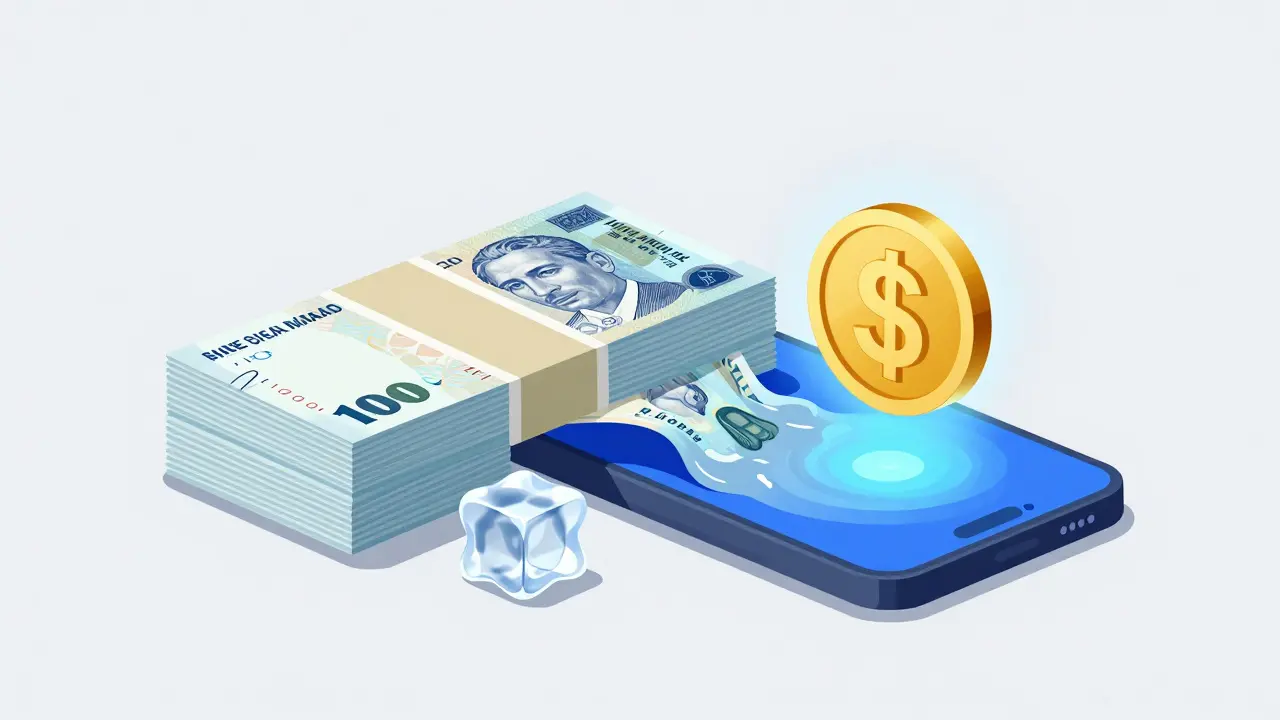
Imagine waking up and discovering that the money in your pocket is worth 26% less than it was last month. For people in Venezuela, this isn't a nightmare-it's Tuesday. When your local currency evaporates faster than an ice cube in the sun, you stop looking for "investments" and start looking for a way to simply buy bread. This is why Cryptocurrency is a decentralized digital medium of exchange that uses cryptography to secure transactions and control the creation of new units has shifted from a tech-hobby to a basic survival tool in Venezuela.
The Death of the Bolívar and the Rise of Digital Dollars
The traditional currency, the bolívar, has become essentially useless for anyone trying to save for the future. With annual inflation hitting 229% as of May 2025, the currency has lost over 70% of its value since the start of that year alone. When a currency crashes this hard, people naturally seek a "safe haven." While the U.S. dollar is the gold standard, getting physical greenbacks into the country can be a logistical headache due to sanctions and banking restrictions.
Enter USDT is a stablecoin pegged to the U.S. dollar, designed to provide a stable store of value on the blockchain operated by Tether. In Caracas, you won't often hear people talk about "stablecoins"; instead, they talk about "Binance Dollars." This nickname exists because Binance is one of the world's largest cryptocurrency exchanges providing a peer-to-peer marketplace for trading digital assets has become the unofficial central bank for the average citizen.
How the "Binance Dollar" Economy Actually Works
If you walk through a market in Caracas today, you'll notice something strange: prices aren't just in bolívars. Many receipts now show totals in "Binance dollars." The economy has effectively split into three different exchange rates that operate at the same time:
- The official rate set by the Central Bank of Venezuela (BCV), which is rarely used in real-world street trades.
- The "dólar negro" (black market rate), based on physical cash exchanges.
- The USDT peer-to-peer (P2P) rate, which is increasingly becoming the primary benchmark for pricing goods and services.
For a local merchant, using TRC-20 is a token standard on the TRON network that allows for faster and cheaper transfers of USDT compared to the Ethereum network means they can accept payments for a bag of coffee or a phone repair without paying massive network fees. In July 2025, the private sector saw roughly $119 million in crypto transactions, proving that this isn't just a few techies-it's a full-scale commercial shift.
| Feature | Venezuelan Bolívar | Physical USD Cash | USDT (Stablecoins) |
|---|---|---|---|
| Value Stability | Extremely Low | High | High |
| Ease of Transfer | Easy (Digital) | Hard (Physical) | Very Easy (P2P) |
| Accessibility | Universal | Limited/Risky | Requires Smartphone |
| Transaction Speed | Instant | Instant (Cash) | Minutes |
Sending Money Home: Bypassing the Middleman
For the millions of Venezuelans living abroad, sending money back to their families is a lifeline. Traditionally, this meant dealing with predatory exchange rates or slow banking systems. Now, a huge portion of those remittances is moving through digital assets. In 2023, about 9% of the $5.4 billion in remittances were processed via crypto. Why? Because it bypasses the banking restrictions and the government's attempt to control currency flow.
A family member in Spain can buy Bitcoin is the first decentralized cryptocurrency that allows peer-to-peer transfers without the need for a central authority and send it to a relative in Maracaibo in minutes. The recipient then sells that Bitcoin for USDT or bolívars on a P2P platform to pay for groceries. It turns a multi-day banking process into a few clicks on a smartphone.
The Survival Toolkit: Dealing with Blackouts and Bad Internet
You can't use a blockchain if your power is out. This is the biggest hurdle in Venezuela. The country suffers from chronic electricity failures and spotty internet, which makes relying on a digital wallet a gamble. To survive this, users have developed a set of informal "workarounds":
- The P2P Trust Network: Many trades happen in WhatsApp or Telegram groups where people agree on a price and a meeting spot for cash, using the app only as a ledger.
- Offline Buffering: Users often time their transactions around the known schedules of power outages.
- Hybrid Payments: A business might accept a crypto payment but allow the customer to "settle" the balance in physical cash if the network is down.
Despite these glitches, the learning curve is surprisingly short. Most people can figure out the basics of a P2P trade in about two to three weeks, mostly through word-of-mouth from neighbors rather than any formal course.
Government Failures and the "Petro" Lesson
The Venezuelan government tried to get in on the action with their own state-backed currency called the Petro is a cryptocurrency launched by the Venezuelan government in 2018, theoretically backed by oil reserves . It was supposed to be the answer to sanctions and inflation. Instead, it became a textbook example of why trust is everything in finance. Because the public didn't trust the Maduro administration to actually back the currency with oil, the Petro failed miserably and was discontinued in 2024.
This failure actually pushed people further toward decentralized options. When the government's version failed, it proved that only a system with no single point of failure-like Bitcoin or USDT-could actually protect their wealth. Even with occasional government crackdowns on mining rigs or exchanges, the demand is too high for the state to stop it. It's a bottom-up revolution born of necessity.
Is Crypto a Real Solution or Just a Band-Aid?
It's important to be honest here: crypto isn't fixing Venezuela's economy. It can't stop political instability or fix a broken power grid. It is a tactical tool for survival. If you're a worker in Caracas, using USDT means your salary doesn't lose 20% of its value by the time you walk to the grocery store. That's a huge win for an individual, but it doesn't solve the structural collapse of the nation.
Furthermore, relying on centralized stablecoins like USDT carries its own risks. If the company issuing the coin has a problem, the users in Venezuela-who have no other options-are the ones who feel it most. However, compared to the bolívar, a centralized stablecoin is a luxury. The trend toward "blockchain dollarization" is likely irreversible because once a population loses faith in their national currency, they rarely ever go back.
Why do Venezuelans prefer USDT over Bitcoin for daily spending?
The main reason is stability. Bitcoin's price can swing wildly in a single day, which is risky when you're trying to budget for rent and food. USDT is pegged to the US Dollar, meaning 1 USDT is always meant to be 1 USD. This makes it a predictable tool for pricing goods and saving value without the volatility of BTC.
What are "Binance Dollars" exactly?
"Binance Dollars" is a colloquial term used in Venezuela to refer to USDT held within the Binance ecosystem. Because Binance is the most popular P2P platform in the country, the value of USDT on the Binance P2P market has become a primary reference point for the actual cost of goods, often replacing the official government exchange rate.
Does the Venezuelan government allow the use of cryptocurrency?
The government's stance is contradictory. While they've conducted crackdowns on mining operations and previously tried (and failed) to launch their own currency (the Petro), they generally tolerate the use of dollar-backed stablecoins because they know the population relies on them for survival. It is a state of "regulatory ambiguity."
How do people trade crypto for cash if they don't have a bank account?
Many users utilize P2P (peer-to-peer) networks. They find a trusted buyer or seller via apps like Binance or social media groups, agree on a rate, and then meet in person to exchange digital assets for physical cash or use prepaid cards to move funds.
Is it safe to use crypto in Venezuela?
Like any financial tool in a crisis zone, it has risks. The biggest dangers are scams in P2P groups and the physical risk of carrying cash during a meetup. However, for most, the risk of holding bolívars (which are guaranteed to lose value) is far higher than the risk of using a digital wallet.


Author
Ronan Caverly
I'm a blockchain analyst and market strategist bridging crypto and equities. I research protocols, decode tokenomics, and track exchange flows to spot risk and opportunity. I invest privately and advise fintech teams on go-to-market and compliance-aware growth. I also publish weekly insights to help retail and funds navigate digital asset cycles.