
When you're trading crypto and don't want to hand over your keys to a centralized exchange, but still need professional-grade tools, Hyperliquid is one of the few platforms that actually delivers on both promises. Launched in 2023, it’s not just another DeFi project-it’s a fully on-chain perpetuals exchange built on its own Layer-1 blockchain, designed to feel like Binance or Bybit but without KYC, without withdrawal delays, and without gas fees… for now.
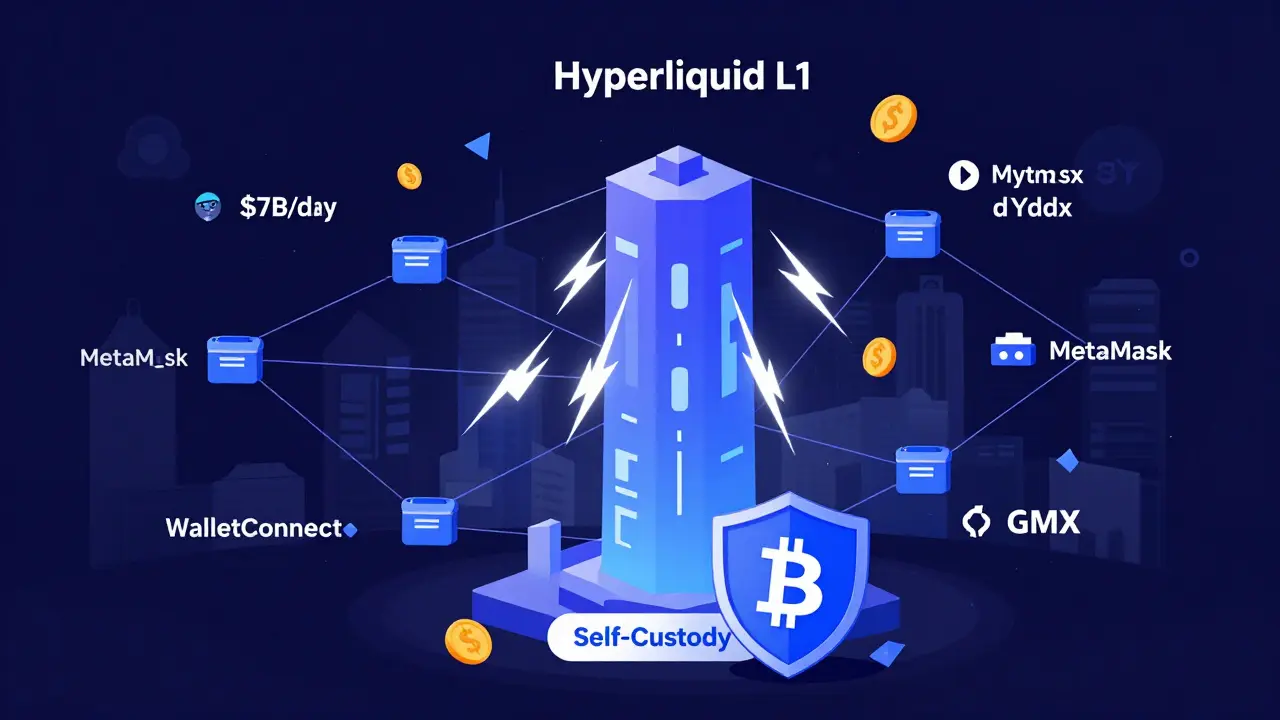
By January 2025, Hyperliquid was processing over $7 billion in daily trading volume and had over 308,000 active users. That’s not a small number. It’s bigger than most altcoin DEXes and rivals dYdX and GMX, two names that dominated the decentralized derivatives space for years. What’s even more telling? The platform had already handled over $1 trillion in total trading volume by Q1 2025. That’s real traction. Real usage. Real demand from traders who care about speed, depth, and control.
How Hyperliquid Works: No AMM, Just a Real Order Book
Most decentralized exchanges use Automated Market Makers (AMMs), like Uniswap. That means prices are set by algorithms, not by real buyers and sellers. Slippage? Common. Fake depth? Frequent. You place a $50,000 order on a small pool, and suddenly you’re getting filled at 5% worse prices than expected.
Hyperliquid doesn’t do that. It runs a fully on-chain order book-just like a centralized exchange. Every bid and ask is visible, recorded on the blockchain, and matched in real time. This means you get:
- True price discovery
- Minimal slippage on large orders
- No artificial liquidity pools that vanish when you trade
- Transparency you can verify on-chain
And it’s fast. The Hyperliquid L1 blockchain processes up to 100,000 transactions per second. Block confirmations take under one second. That’s not just fast for crypto-it’s faster than most traditional trading systems. You can open and close positions with the same responsiveness you’d expect from Bybit or OKX.
Trading Pairs, Leverage, and Collateral
Hyperliquid supports over 170 trading pairs. That includes BTC, ETH, SOL, ADA, XRP, DOGE, and even niche altcoins like NEAR, AVAX, and APT. Most of these pairs offer up to 40x leverage on perpetual contracts. That’s high, but not unusual for crypto derivatives-especially when you’re competing with centralized platforms.
You deposit USDC as collateral, sent via the Arbitrum network. ETH is needed only to pay for Arbitrum gas fees-typically under $0.30 per transaction. But here’s the kicker: Hyperliquid currently charges zero gas fees on its own platform. You don’t pay anything extra to place orders, adjust positions, or close trades. The team says this might change in the future to protect the L1 network, but as of early 2026, it’s still free.
Fee structure is clean:
- Maker fee: 0.015%
- Taker fee: 0.045%
That’s lower than the average 0.05% fee on other DEXes like dYdX or GMX. For active traders, that adds up. If you’re doing 100 trades a month at $10,000 each, you’d save over $150 per month compared to platforms with higher fees.
Why Traders Are Switching from GMX, dYdX, and Bybit
Real traders aren’t just talking-they’re moving. On forums, Reddit threads, and trader Discord groups, the same stories keep popping up:
- From GMX: “Hyperliquid has deeper order books on altcoins. I can move $30K on SHIB without moving the price.”
- From dYdX: “dYdX uses off-chain matching. That’s not truly decentralized. Hyperliquid does everything on-chain.”
- From Bybit: “I hate KYC. I hate waiting 2 days to withdraw. Hyperliquid? I deposit, trade, withdraw-all in minutes, no questions asked.”
One verified trader on Publish0x described switching after trying all three. They said Hyperliquid let them execute $50,000 entries on SOL and ETH without any slippage. That’s rare. Even on centralized exchanges, large orders often get chopped up or filled at worse prices.
The order types are also a big win. You get:
- Take-profit and stop-loss (with no wallet popups)
- Reduce-only (to close positions without opening new ones)
- Post-only (to ensure you’re always a maker)
- Immediate-or-cancel (IOC) for fast, aggressive entries
These aren’t just features-they’re tools used by professional traders. And on Hyperliquid, they work without breaking your flow. No wallet approval every time you adjust a stop-loss. No delays. No interruptions. It just works.
Self-Custody Without Compromise
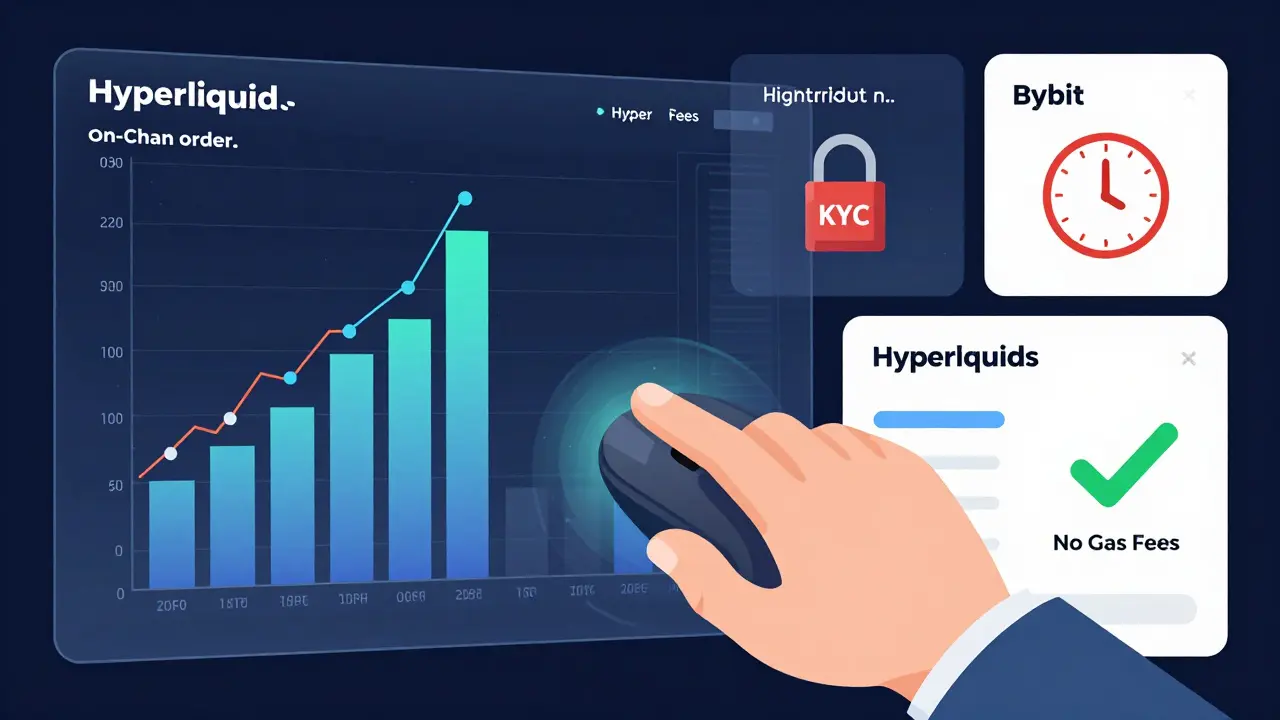
This is the core of Hyperliquid’s appeal. You never give up control of your crypto. Your wallet holds your funds. Your private keys stay yours. You’re not trusting a company to keep your Bitcoin safe. You’re not risking a hack like the ones that hit centralized exchanges in 2022 and 2023.
And yet, the interface feels like a pro trading terminal. Clean charts. Real-time depth. Hotkeys for quick trades. It’s designed by people who’ve used Binance and MEXC. They didn’t try to make crypto trading “simple.” They made it powerful-and kept it decentralized.
No KYC means no ID uploads. No address verification. No delays. You connect your MetaMask or WalletConnect wallet, sign once, and start trading. That’s privacy. That’s freedom. And it’s rare in 2026, when even most DeFi apps now require at least some form of identity.
Who Is Hyperliquid For?
Not everyone should use Hyperliquid. If you’re a beginner who just wants to buy Bitcoin and hold it, this isn’t for you. This is for:
- Active traders who use leverage
- People who hate KYC and want full self-custody
- Traders who’ve been burned by slippage on AMM DEXes
- Those who want institutional-grade tools without centralized control
If you’re trading $1,000 to $100,000 positions, and you care about execution quality, Hyperliquid is one of the few places that doesn’t make you choose between speed and decentralization.
Future Plans and Risks
Hyperliquid isn’t perfect. It’s still young. The L1 blockchain is new. While the team comes from Harvard, MIT, and Caltech-and has built a clean, secure system so far-it hasn’t been tested through a full bear market or a major network attack.
The HYPE token, launched via airdrop in 2024, is the native token of the ecosystem. It’s not required to trade, but it will eventually be used for governance and fee discounts. Experts at 99Bitcoins predict HYPE could hit $30-$60 by the end of 2026, but that’s speculative. Volatility is guaranteed.
Gas fees may return. The team says they’re planning to introduce them eventually to protect the L1 network from spam and abuse. That could change the cost structure. But for now, zero fees are a huge advantage.
ARK Invest confirmed in October 2025 they’re tracking Hyperliquid. That’s not just a nod-it’s institutional validation. When a firm like ARK watches a DeFi project, it means they see real potential.
How to Get Started
Getting started is straightforward:
- Get a wallet: MetaMask, Rainbow, or any EVM-compatible wallet.
- Send USDC to your wallet via Arbitrum (use the Arbitrum bridge if you’re coming from Ethereum).
- Get a little ETH on Arbitrum for gas (under $0.50 is enough).
- Go to hyperliquid.xyz and connect your wallet.
- Deposit USDC as collateral.
- Start trading.
There’s no waiting. No verification. No delays. You’re trading on-chain within minutes.
YouTube has excellent beginner tutorials from creators like CryptoCred and DeFi Mike. The official Hyperliquid docs are clear, well-organized, and updated monthly. The community is active on Discord and Twitter, and the team responds to feedback quickly.
Final Verdict
Hyperliquid isn’t just another crypto exchange. It’s a new kind of trading platform-one that proves you don’t have to sacrifice decentralization to get professional-grade tools. It’s fast, cheap, transparent, and self-custodied. It handles real volume. Real traders use it. Real institutions are watching it.
If you’re tired of centralized exchanges, tired of slippage on AMM DEXes, and tired of waiting for withdrawals, Hyperliquid is one of the best options left in 2026. It’s not without risks-new tech always carries them-but for active traders who value control, speed, and privacy, it’s hard to beat.
Is Hyperliquid safe to use?
Yes, as long as you use a trusted wallet like MetaMask and keep your private keys secure. Hyperliquid doesn’t hold your funds-it’s non-custodial. Your assets stay in your wallet. The platform’s L1 blockchain is designed for high throughput and security, and the team has a strong engineering background from top tech institutions. However, like all DeFi platforms, smart contract risk exists. No system is 100% hack-proof, but Hyperliquid has not had any major exploits as of early 2026.
Do I need KYC to trade on Hyperliquid?
No. Hyperliquid has zero KYC requirements. You only need to connect your crypto wallet. There’s no ID upload, no address verification, and no personal data collected. This makes it one of the few platforms where you can trade perpetuals with full privacy.
Can I trade spot pairs on Hyperliquid?
No. Hyperliquid is a perpetual futures exchange only. You can’t buy or sell spot BTC or ETH directly. All trading is done through leveraged perpetual contracts. If you want spot trading, you’ll need a separate platform like Uniswap or a centralized exchange.
What’s the HYPE token used for?
As of early 2026, the HYPE token is not required to trade. It was distributed via airdrop to early users and liquidity providers. In the future, it’s expected to be used for governance voting and fee discounts. The team has not yet launched a staking or fee-rebate system, but those features are planned as part of the ecosystem’s long-term development.
Will Hyperliquid introduce gas fees?
Yes, eventually. The team has stated that while gas fees are currently zero, they plan to introduce them in the future to protect the L1 network from spam and abuse. This would help fund network security and validator rewards. However, there’s no set timeline, and users will be notified well in advance. For now, trading remains free.


Author
Ronan Caverly
I'm a blockchain analyst and market strategist bridging crypto and equities. I research protocols, decode tokenomics, and track exchange flows to spot risk and opportunity. I invest privately and advise fintech teams on go-to-market and compliance-aware growth. I also publish weekly insights to help retail and funds navigate digital asset cycles.