
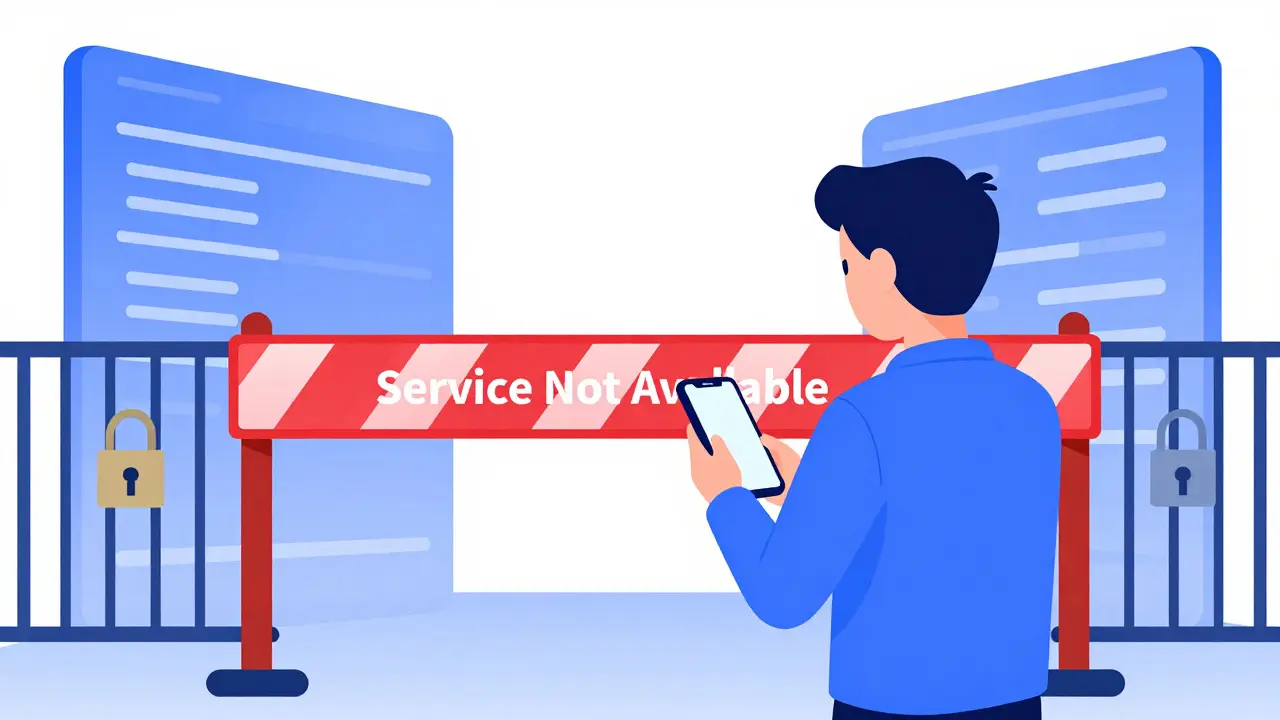
You download the app, enter your details, and then hit a wall. A cold, hard message pops up: "Service not available in your region." It happens more often than you might think, especially with major platforms like OKX, which is a global cryptocurrency exchange founded in 2017 that serves users across multiple jurisdictions while enforcing strict regional bans. If you are trying to trade on OKX from the United States, Canada, or even parts of Europe, you aren't just dealing with a glitch. You are hitting a deliberate legal barrier.
Crypto exchanges don't operate in a vacuum. They sit at the intersection of digital innovation and heavy-handed government regulation. For OKX, this means maintaining a complex web of licenses, bans, and feature restrictions that change depending on where you live. This guide breaks down exactly who can use OKX, who cannot, and why these rules exist-so you don't waste time trying to force an account open where it won't work.
The Three Tiers of OKX Restrictions
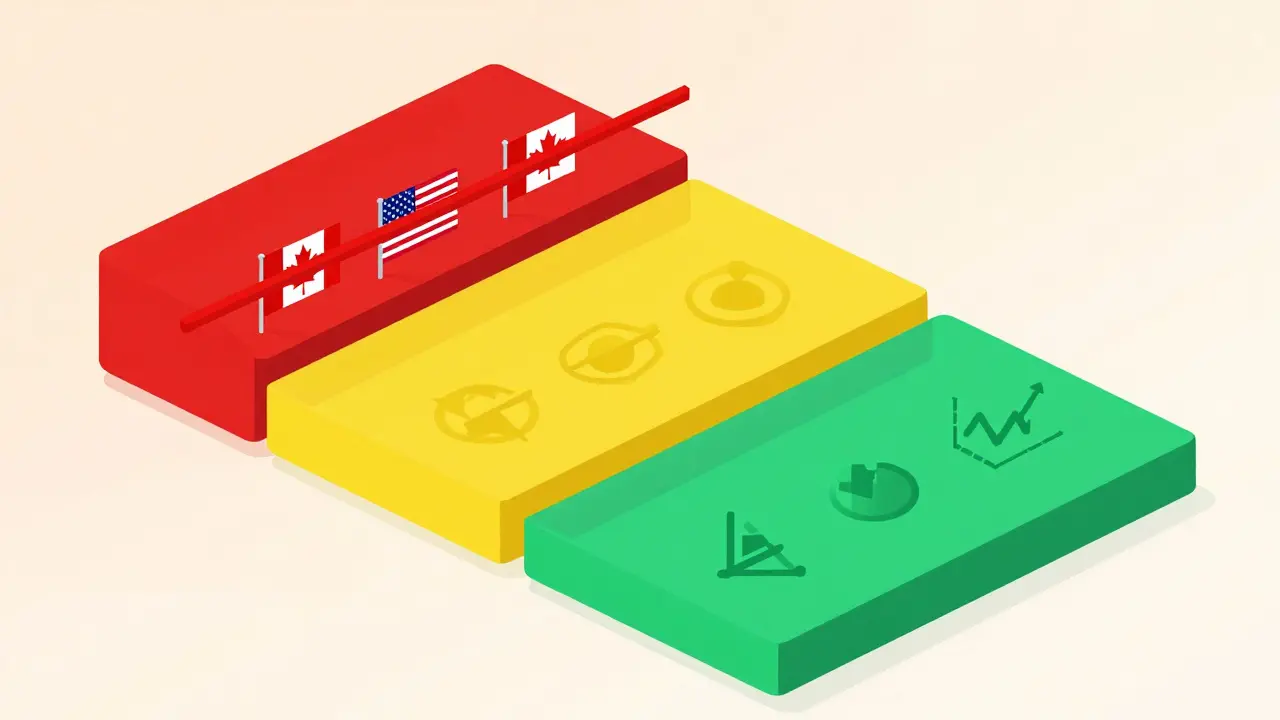
Not all restrictions are created equal. OKX categorizes its geographic limitations into three distinct tiers based on how severe the local laws are. Understanding which tier your country falls into tells you whether you need to find a different exchange entirely or just accept some missing features.
Tier 1: Complete Bans
In these regions, OKX blocks access entirely. You cannot create an account, deposit funds, or view prices. The list includes:
- The United States (including all 50 states)
- Canada
- United Kingdom
- Singapore (for the global platform)
- Malaysia
- The Bahamas
- Sanctioned regions including Cuba, Iran, North Korea, Syria, Crimea, Donetsk, and Luhansk
If you live here, OKX is off-limits. Period. The company has explicitly removed these markets to comply with international sanctions and local financial laws. Trying to bypass this using a Virtual Private Network (VPN) violates their Terms of Service and usually results in immediate account termination once they detect the mismatch between your IP address and your ID documents.
Tier 2: Partial Restrictions and Territories
This group includes U.S. territories like Puerto Rico, Guam, Northern Mariana Islands, and the U.S. Virgin Islands. Other countries like Bangladesh, Bolivia, and Malta also face significant hurdles. In many of these cases, spot trading might be technically possible if you have verified residency elsewhere, but opening a new account from these locations is heavily restricted or blocked outright.
Tier 3: Feature Limitations
Here is where it gets tricky for experienced traders. Countries like Australia, Brazil, South Korea, and the UK (for specific legacy accounts or sub-entities) allow you to trade spot cryptocurrencies. However, they ban high-risk derivatives. This means no futures contracts, no perpetual swaps, and no leveraged trading. You can buy Bitcoin and hold it, but you can't bet on its price moving up or down with borrowed money.
| Region Type | Examples | Spot Trading | Derivatives/Futures | New Account Creation |
|---|---|---|---|---|
| Tier 1 (Banned) | USA, Canada, Singapore | No | No | Blocked |
| Tier 2 (Restricted) | Puerto Rico, Bangladesh | Limited/No | No | Blocked/Hard |
| Tier 3 (Partial) | Australia, South Korea | Yes | No | Allowed |
| Fully Open | Germany, UAE, Thailand | Yes | Yes | Allowed |
Why Does OKX Block So Many Places?
It isn't personal. It's about survival. Cryptocurrency exchanges operate under intense scrutiny from global financial watchdogs. When an exchange ignores local laws, the consequences can be catastrophic. Look at what happened to Binance, which faced billions in fines for regulatory failures. OKX has taken a different path: proactive compliance.
The primary driver is the U.S. Bank Secrecy Act and regulations enforced by the Office of Foreign Assets Control (OFAC). These bodies require strict adherence to anti-money laundering (AML) standards. By banning users from sanctioned countries and those with unclear regulatory frameworks, OKX protects itself from being shut down globally.
Additionally, the European Union’s Markets in Crypto-Assets (MiCA) regulation, fully effective as of late 2024, forced exchanges to standardize their offerings across member states. OKX responded by creating OKX Europe, a separate legal entity licensed to operate within the EU. This entity offers fewer products than the global site but ensures legal stability for European users. Similarly, OKX Singapore operates under the Monetary Authority of Singapore (MAS), allowing residents there to trade despite the global platform listing Singapore as restricted.
This multi-entity approach is sophisticated but confusing. As Dr. David Carlisle, a senior analyst at Chainalysis, noted in August 2025, this strategy allows OKX to navigate complex global regulations while keeping market share. However, critics argue it creates "compliance gaps" that frustrate users who see friends in neighboring countries accessing features they cannot.
The KYC Hurdle: Verification Is Mandatory
Gone are the days when you could trade crypto anonymously on major exchanges. Since January 2023, OKX has required mandatory Know Your Customer (KYC) verification for all core functions. This is non-negotiable.
Without KYC, you cannot deposit fiat currency, withdraw funds, or trade. The process involves uploading a government-issued ID (passport, driver's license, or national ID) and completing a facial recognition scan. Here is how the verification levels break down:
- Level 1: Basic ID verification. Allows daily transaction limits up to $10,000. Good for casual investors.
- Level 2: Enhanced verification, often requiring proof of address. Increases limits significantly.
- Level 3: Institutional-level verification. Required for high-volume traders, with daily limits reaching $1,000,000.
The verification process typically takes 2 to 4 hours, though delays happen during peak times. If you are in a permitted country but get rejected, check your documents carefully. Common issues include blurry photos, expired IDs, or name mismatches between your bank account and your ID. According to OKX’s September 2025 enforcement report, over 14,000 accounts were closed for "geolocation fraud," highlighting how seriously they take identity matching.
Can You Use a VPN to Bypass Restrictions?
Short answer: Don't do it.
Long answer: Technically, you might get the app to load if you connect to a server in Germany or Japan. But OKX uses advanced detection methods beyond just IP geolocation. They employ device fingerprinting, which analyzes your hardware configuration, browser history, and behavioral patterns. More importantly, when you eventually try to verify your identity, you must upload an ID that matches your actual residence.
If OKX detects that your IP address is from a permitted country but your ID shows you live in a banned one (like the USA or Canada), they will freeze your assets and terminate your account. There are thousands of reports on Reddit and Trustpilot from users who lost access to their funds after attempting this workaround. The risk of losing your entire portfolio far outweighs the convenience of trading on a platform that legally shouldn't serve you.
How OKX Compares to Other Exchanges
If you are in a restricted country, you aren't alone. Most major exchanges have similar bans, but the specifics vary. Here is how OKX stacks up against its competitors as of late 2025:
- Binance: Also bans the USA and Canada. However, Binance has faced more aggressive legal action globally, leading to wider service disruptions in some European and Asian markets compared to OKX's stable presence.
- Coinbase: Operates primarily in the USA and 41 other compliant countries. If you are American, Coinbase is your best option, not OKX.
- Kraken: Bans Iran and North Korea but maintains limited operations in Canada. Kraken is often seen as more privacy-friendly, though they still require KYC for fiat transactions.
OKX ranks fourth in regulatory comprehensiveness among top exchanges, according to a CryptoCompare study. Its strength lies in its Web3 integration and deep liquidity in Asian and African markets, where it holds a dominant user base. If you are in Africa or Southeast Asia, OKX is likely your best choice due to lower fees and better local payment options.
What’s Next for OKX Regulations?
The regulatory landscape is shifting fast. As we move through 2026, several trends are emerging that could affect your ability to use OKX:
- U.S. Market Entry Attempts: Reports suggest OKX is exploring launching a U.S.-compliant entity. While no timeline exists, this could mean limited services for Americans in the future. However, given the SEC's ongoing lawsuits against other exchanges, full access remains unlikely before 2027.
- Expansion in Emerging Markets: OKX recently expanded derivatives access to Thailand and Vietnam. Expect similar moves in other regulated Asian and Middle Eastern markets as they establish local partnerships.
- Tighter Global KYC Standards: The Financial Action Task Force (FATF) continues to push for stricter identity checks. Be prepared for more frequent re-verification requests and tighter limits on unverified accounts.
For now, the rules remain strict. If you are in a banned country, look for local alternatives or wait for regulatory changes. If you are in a partially restricted country, enjoy the spot trading but avoid trying to access derivatives through unofficial channels.
Is OKX available in the United States?
No, OKX is completely banned in the United States. Users residing in any of the 50 states cannot create accounts, deposit funds, or trade on the platform. Attempting to bypass this restriction using a VPN violates terms of service and risks asset forfeiture.
Can I use OKX in Canada?
No, OKX restricts access for residents of Canada. This is part of their Tier 1 complete ban list. Canadian users should consider local alternatives like Coinbase, Kraken, or Canadian-specific exchanges that comply with provincial securities laws.
Why is Singapore listed as restricted if there is an OKX Singapore?
The global OKX platform restricts Singaporean residents because it does not hold the necessary licenses to operate there directly. However, OKX established a separate, regulated entity called OKX Singapore, which is approved by the Monetary Authority of Singapore (MAS). Residents must sign up specifically for the Singaporean version to trade legally.
Do I need KYC to trade on OKX?
Yes, mandatory KYC verification is required for all core features including trading, deposits, and withdrawals. Anonymous trading is no longer supported on the main platform. Verification levels determine your daily transaction limits, ranging from $10,000 for basic verification to $1 million for institutional accounts.
Can I trade futures on OKX in Australia?
No, derivatives trading including futures and perpetual contracts is prohibited for Australian residents. You can only engage in spot trading (buying and holding cryptocurrencies) on OKX if you are located in Australia. This restriction aligns with local financial regulations aimed at protecting retail investors from high-risk products.
What happens if I try to use a VPN to access OKX from a banned country?
OKX uses IP geolocation, device fingerprinting, and ID verification to detect false location claims. If you are caught using a VPN to mask your true location, your account will be terminated, and your funds may be frozen. Over 14,000 accounts were closed for this reason in 2025 alone.
Is OKX safe to use in Europe?
Yes, OKX operates a dedicated entity called OKX Europe, which is compliant with the EU's MiCA regulations. European users can trade securely, though certain high-risk derivatives may be restricted depending on the specific country's additional local laws. SEPA deposits and withdrawals are fully supported.


Author
Ronan Caverly
I'm a blockchain analyst and market strategist bridging crypto and equities. I research protocols, decode tokenomics, and track exchange flows to spot risk and opportunity. I invest privately and advise fintech teams on go-to-market and compliance-aware growth. I also publish weekly insights to help retail and funds navigate digital asset cycles.