
Remember the summer of 2021? If you were in crypto, you remember the chaos. ShibaSwap launched on July 6, 2021, and within two days, it hit $1 billion in Total Value Locked (TVL). It was a golden ticket for early adopters who provided liquidity before the masses arrived. Fast forward to August 2026, and the hype has cooled significantly. The meme coin frenzy has matured into something more complex, but also more scrutinized. You might be holding some SHIB is a community-driven cryptocurrency that originated as a meme token but has evolved into a broader ecosystem including DeFi and NFTs from back then, or you’re just curious if this platform still holds any water. Let’s cut through the noise and look at what ShibaSwap actually offers today.
What Is ShibaSwap Really?
At its core, ShibaSwap is a decentralized exchange (DEX) built on the Ethereum network that allows users to trade tokens, stake assets, and provide liquidity without intermediaries. Unlike centralized exchanges like Binance or Coinbase, where a company holds your funds, ShibaSwap lets you trade directly from your wallet. This means no KYC (Know Your Customer) checks, no email sign-ups, and no customer support hotline to call if things go wrong. You are your own bank, which is both a feature and a risk.
The platform operates as the financial hub for the Shiba Inu ecosystem. It isn’t just a place to swap tokens; it’s governed by Doggy DAO is a decentralized autonomous organization that manages the ShibaSwap protocol using the BONE governance token. This means decisions about fee structures, new features, and treasury management are voted on by token holders, specifically those with the BONE token. It’s a democratic system, but one that requires active participation to influence outcomes.
The Three Pillars: SHIB, BONE, and LEASH
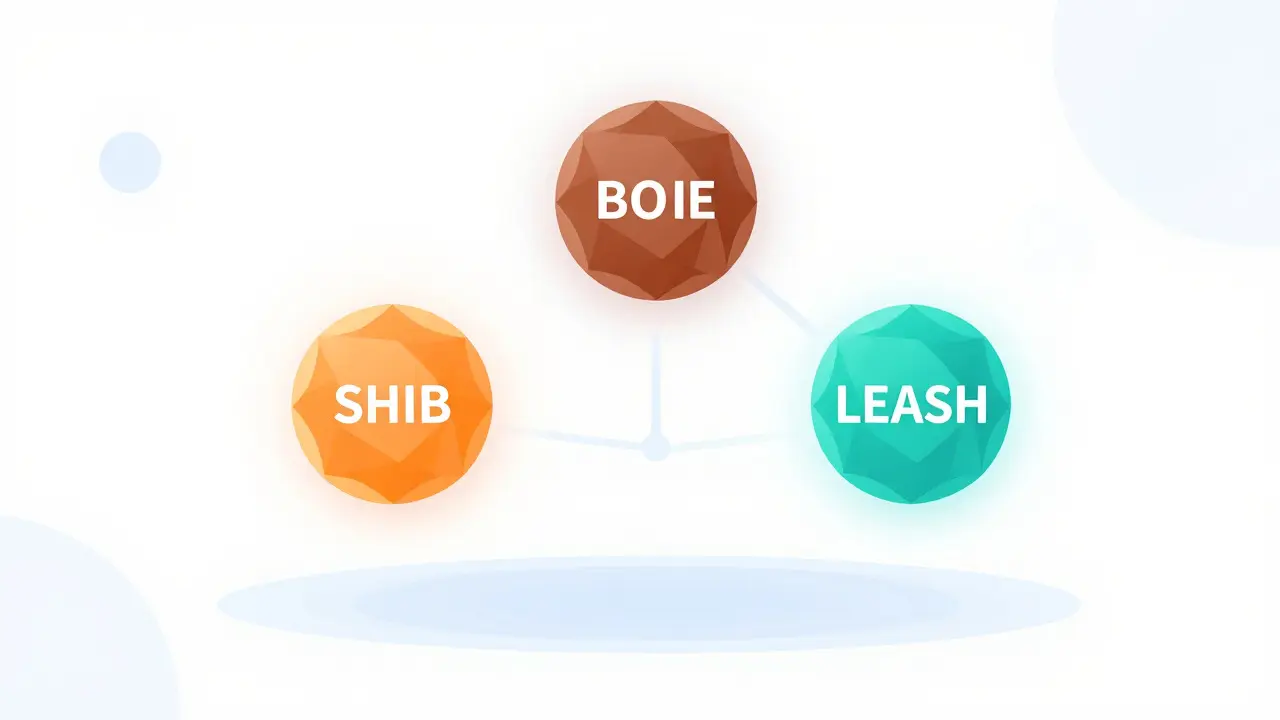
To use ShibaSwap effectively, you need to understand its "tri-factor" token structure. These three tokens serve distinct purposes, and confusing them can lead to costly mistakes.
- SHIB: This is the primary currency. It’s used for trading pairs, paying gas fees on certain integrations, and participating in the broader ecosystem. As of mid-2026, SHIB ranks around 17th by market cap, though it has dropped roughly 94% from its all-time high. It’s volatile, speculative, and heavily influenced by community sentiment.
- BONE: Think of this as the voting share. Holding BONE gives you power in Doggy DAO. You vote on proposals that change how the exchange works. It’s not primarily for speculation; it’s for governance. If you care about the future direction of ShibaSwap, you hold BONE.
- LEASH: Originally marketed as a "Doge Killer," LEASH is now mostly a utility token for risk hedging. There are only 107,800 LEASH tokens in existence, making it incredibly scarce. Historically, it was used to hedge against drops in SHIB price, but its practical utility for the average user remains limited compared to SHIB and BONE.
How to Use ShibaSwap: A Step-by-Step Guide
Getting started is straightforward if you already have a Web3 wallet. Here is the process most users follow in 2026:
- Set Up a Wallet: Download MetaMask or another compatible wallet like Trust Wallet. Ensure you have enough ETH in your wallet to pay for gas fees. Since ShibaSwap runs on Ethereum, transaction costs depend entirely on Ethereum network congestion.
- Connect to ShibaSwap: Go to the official ShibaSwap website. Click "Connect Wallet." Select your wallet provider and approve the connection. No passwords or emails are needed here.
- Choose Your Action: Navigate to the tab you need. "Swap" for trading tokens, "Pools" for providing liquidity, or "Stake" for locking up tokens to earn rewards.
- Execute the Transaction: Enter the amount you want to trade or stake. Review the details carefully. Confirm the transaction in your wallet. Wait for the blockchain to confirm it.
One critical detail: always double-check the URL. Phishing sites targeting ShibaSwap users are common. Bookmark the official site immediately after your first visit.
Fees and Costs: What You’ll Actually Pay
This is where many new users get burned. ShibaSwap charges a standard 0.3% fee on swaps. That sounds low, but compare it to centralized exchanges that often charge less than 0.1%. However, the real cost isn’t the swap fee-it’s the gas fee.
Because ShibaSwap operates on the Ethereum mainnet, every interaction costs ETH. During busy periods, a simple swap can cost $5, $10, or even more in gas. For small trades, this eats up your profits instantly. This is why many users have migrated to Layer-2 solutions or alternative chains.
| Platform | Swap Fee | Gas Fees | Network |
|---|---|---|---|
| ShibaSwap | 0.3% | High (Ethereum Mainnet) | Ethereum |
| Uniswap | 0.05% - 1% | High (Ethereum Mainnet) | Ethereum |
| PancakeSwap | 0.25% | Low (BNB Chain) | BNB Smart Chain |
| Coinbase Pro | 0.4% - 0.6% | $0 (Centralized) | Internal Ledger |
If you’re trading large amounts, the 0.3% fee is manageable. But if you’re moving hundreds of dollars, the Ethereum gas fees will likely make ShibaSwap impractical compared to a centralized exchange or a DEX on a cheaper chain like Arbitrum or Polygon.
Security and Trust: Is Your Money Safe?
ShibaSwap has undergone audits by CertiK is a leading blockchain security firm that conducts smart contract audits to identify vulnerabilities, which adds a layer of credibility. Their code is open-source, meaning anyone can inspect it for bugs. This transparency is a major advantage over opaque centralized platforms.
However, decentralization shifts the burden of security onto you. If you lose your private key, your funds are gone forever. There is no "Forgot Password" button. Additionally, while the platform itself may be secure, the projects you interact with through ShibaSwap might not be. Always verify contract addresses before interacting with new tokens.
The platform also supports IP whitelisting and two-factor authentication (2FA) for certain administrative functions, though these are less relevant for everyday traders since there are no accounts to protect-only wallets.
Liquidity and Staking Opportunities
ShibaSwap isn’t just for swapping. It’s a yield farm. You can provide liquidity to pools (e.g., SHIB/ETH) and earn a share of the trading fees plus additional BONE rewards. This was the primary draw in 2021, and it still exists today, albeit with lower yields due to reduced volatility and TVL.
As of 2026, the total value locked hovers around $1.6 billion. While impressive, this is a fraction of what giants like Uniswap command. The liquidity is deep enough for large trades without significant slippage, but it lacks the breadth of assets found on larger competitors. You won’t find obscure altcoins here unless they’re tied to the Shiba ecosystem.
Staking SHIB or BONE allows you to earn passive income. The annual percentage yield (APY) fluctuates based on demand and reward emissions. Currently, APYs are modest compared to the triple-digit returns seen during the bull run. It’s suitable for long-term believers in the ecosystem, not for quick riches.
The Ecosystem Context: Shibarium and Beyond
ShibaSwap doesn’t exist in a vacuum. It’s part of a larger vision that includes Shibarium is a Layer-2 scaling solution for Ethereum designed to reduce transaction costs and increase speed for Shiba Inu ecosystem applications. Shibarium aims to solve the high gas fee problem by processing transactions off-chain and settling them on Ethereum later. This could drastically improve the user experience for ShibaSwap users in the future.
Other projects include Shiboshis (NFTs), SHIB: The Metaverse, and Shiba Eternity (a trading card game). While ambitious, adoption outside the core SHIB community remains limited. Most of these projects are still finding their footing. For now, ShibaSwap remains the most functional and widely used part of the ecosystem.
Who Should Use ShibaSwap?
ShibaSwap is ideal for:
- SHIB Holders: If you believe in the long-term potential of Shiba Inu, using the native exchange supports the ecosystem and offers exclusive staking rewards.
- DeFi Enthusiasts: Those comfortable with self-custody, gas fees, and smart contract risks will appreciate the transparency and autonomy.
- NFT Traders: The integrated marketplace makes it easy to buy and sell Shiboshis and other ecosystem NFTs.
It is not ideal for:
- Casual Traders: High gas fees and complex interfaces deter beginners.
- Large Institutional Investors: Limited liquidity depth compared to Uniswap or Curve Finance.
- Privacy Seekers: All transactions are public on the blockchain. While anonymous, they are traceable.
Final Verdict: Still Relevant in 2026?
ShibaSwap has survived the bear market and evolved beyond its meme origins. It’s a functional, secure, and community-governed DEX. However, it faces stiff competition from more established platforms with better infrastructure and lower costs. Unless Shibarium gains massive traction to drive down fees, ShibaSwap will likely remain a niche player catering primarily to SHIB loyalists.
If you’re already in the ecosystem, it’s worth using. If you’re new to crypto, consider starting with a simpler, cheaper option until you’re ready to navigate the complexities of Ethereum-based DeFi.
Is ShibaSwap safe to use?
Yes, ShibaSwap is generally considered safe. It has been audited by CertiK, and its code is open-source. However, because it is decentralized, you are responsible for securing your own wallet. If you lose your private keys, your funds are unrecoverable. Always connect via the official website to avoid phishing scams.
What are the fees on ShibaSwap?
ShibaSwap charges a 0.3% fee on all token swaps. Additionally, because it runs on the Ethereum network, you must pay gas fees in ETH. These gas fees vary based on network congestion and can range from a few dollars to over $20 per transaction during peak times.
Can I use ShibaSwap without owning SHIB?
Yes, you can trade other supported tokens on ShibaSwap without holding SHIB. However, to participate in governance via Doggy DAO or access certain staking rewards, you will need the BONE token. SHIB is primarily used for trading pairs and ecosystem utilities.
How does ShibaSwap compare to Uniswap?
Both are decentralized exchanges on Ethereum. Uniswap has significantly higher liquidity, a wider variety of tokens, and more advanced features like limit orders. ShibaSwap is specialized for the Shiba Inu ecosystem, offering unique staking opportunities for SHIB, BONE, and LEASH. Uniswap is better for general trading; ShibaSwap is better for ecosystem engagement.
What is the role of the BONE token?
BONE is the governance token of ShibaSwap. Holders can vote on proposals in the Doggy DAO, which controls the protocol’s development, fee structures, and treasury allocation. It also serves as a reward token for liquidity providers and stakers.
Author
Ronan Caverly
I'm a blockchain analyst and market strategist bridging crypto and equities. I research protocols, decode tokenomics, and track exchange flows to spot risk and opportunity. I invest privately and advise fintech teams on go-to-market and compliance-aware growth. I also publish weekly insights to help retail and funds navigate digital asset cycles.