
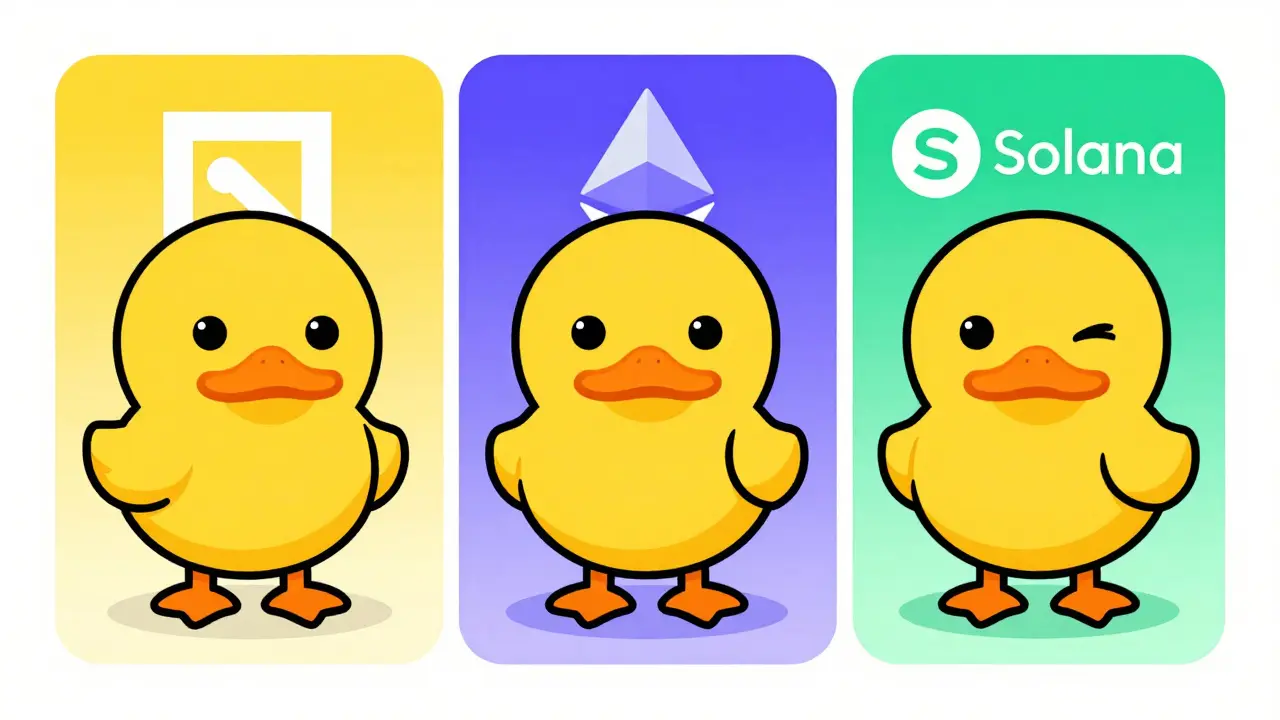
There is no single Ducky (DUCKY) cryptocurrency. If you search for it, you will find at least three different tokens using the same ticker symbol on different blockchains. This confusion is the biggest risk for anyone looking to buy or trade DUCKY in 2026. One version lives on BNB Smart Chain, another on Ethereum, and a third on Solana. They share a name but have completely different contracts, narratives, and levels of liquidity. Understanding which one you are looking at is the first step before risking any money.
The term "meme coin" often implies a lack of utility, but DUCKY takes this further by lacking even a unified identity. Unlike Dogecoin or Shiba Inu, which have established ecosystems and massive market caps, DUCKY variants are micro-cap assets driven entirely by short-term hype. As of early 2024, when these tokens gained attention, their combined market capitalizations hovered between US$0.1 million and US$0.2 million. That is tiny compared to major cryptocurrencies. For context, that amount of money could vanish in minutes if a large holder decides to sell. Before diving into the specifics of each chain, it is crucial to understand why this fragmentation exists and what it means for your wallet.
The Three Faces of DUCKY
To navigate the DUCKY landscape, you need to separate the three distinct entities. Mixing them up can lead to buying the wrong asset or getting stuck with an illiquid token you cannot sell.
1. BNB Smart Chain DUCKY (The Most Listed)
This is the version most people encounter on centralized exchanges like MEXC and LBank. It launched in 2024 as a duck-themed BEP-20 token. Its narrative stems from a viral tweet by Changpeng Zhao (CZ), the founder of Binance. The project claims to have 0% transaction taxes and permanently burned liquidity. Burning liquidity means the developers sent the LP tokens to an unrecoverable address, theoretically preventing them from pulling the funds out in a "rug pull." However, this claim is not backed by a public audit from firms like CertiK or PeckShield.
2. Ethereum ERC-20 DUCKY (The Furie Connection)
This token attempts to ride the coattails of Pepe. It is associated with "Ducky the Duck," a character linked to Jason Furie, the brother of Matt Furie, who created Pepe the Frog. This version trades primarily on decentralized exchanges like Uniswap V2. It has significantly lower trading volume than its BSC counterpart, often recording less than US$1,000 in daily volume on Uniswap. The narrative here is purely speculative, betting on community recognition of the Furie family lore.
3. Solana DUCKY (The Illiquid Wildcard)
A third token exists on Solana, listed by platforms like CoinSwitch. There is no official description, team, or whitepaper for this variant. CoinSwitch explicitly restricts buying due to low liquidity, warning users to "DYOR" (Do Your Own Research). This suggests the token is largely abandoned or used only for minor speculative bets by existing holders trying to exit positions.
Tokenomics and Supply Mechanics
Understanding the supply helps you gauge potential volatility. For the BNB Smart Chain version, data from Coinbase indicates a maximum supply of 420,690,000,000 DUCKY. Approximately 99% of this supply is already circulating. This high circulation percentage means there is little room for future inflation, but it also means the price is heavily dependent on current demand rather than new issuance shocks.
The Ethereum and Solana versions do not have clear, publicly verified supply data in major aggregators. This opacity is a red flag. In crypto, if you cannot verify the total supply and the distribution of tokens among wallets, you are flying blind. Large amounts of tokens held by anonymous wallets can be dumped at any time, crashing the price instantly.
| Feature | BSC DUCKY | Ethereum DUCKY | Solana DUCKY |
|---|---|---|---|
| Blockchain | BNB Smart Chain | Ethereum | Solana |
| Primary Narrative | CZ Tweet / Duck Theme | Jason Furie / Pepe Adjacent | None / Generic Web3 |
| Liquidity Status | Moderate (CEX Listed) | Low (DEX Only) | Very Low (Buy Restricted) |
| Transaction Tax | 0% | Unknown | Unknown |
| Audit Status | No Public Audit | No Public Audit | No Public Audit |
Risk Profile: Why DUCKY Is High-Stakes
You should treat DUCKY not as an investment, but as a speculative gamble. The risks are substantial and multifaceted.
Extreme Volatility: Data from CoinGecko shows that DUCKY has dropped over 99% from its all-time high. While it may have tripled from its lowest point since then, this rollercoaster is typical of micro-cap memecoins. A 50% drop in a day is not uncommon for tokens with market caps under US$1 million.
Lack of Utility: None of the DUCKY variants offer staking, governance rights, or integration into DeFi protocols. They do not power a network or secure a blockchain. Their value is derived solely from people believing other people will pay more for them later. This is a classic "greater fool" theory scenario.
Security Opacity: Without smart contract audits, there is no guarantee that the code does not contain backdoors. Developers could potentially pause trading, blacklist addresses, or mint new tokens to dilute holders. The claim of "burned liquidity" on BSC is reassuring on paper, but without a verifiable transaction hash published by a trusted auditor, it remains an unverified promise.
Regulatory Gray Area: DUCKY is not registered with financial authorities like the SEC or FCA. In many jurisdictions, holding such assets carries tax implications and zero legal recourse if the project fails or turns out to be fraudulent.
How to Buy and Trade DUCKY Safely
If you decide to proceed despite the risks, follow these steps to minimize operational errors.
- Identify the Correct Contract Address: Never rely on the ticker symbol alone. Copy the exact contract address from a reputable source like CoinMarketCap or CoinGecko for the specific chain you want (BSC, ETH, or SOL).
- Choose the Right Platform: For BSC DUCKY, use centralized exchanges like MEXC or LBank. For Ethereum DUCKY, you will need a Web3 wallet like MetaMask and connect to Uniswap V2. Avoid buying Solana DUCKY unless you already hold it, as buying options are restricted due to low liquidity.
- Use Limit Orders: Due to low liquidity, market orders can result in significant slippage. Use limit orders to set the price you are willing to pay.
- Start Small: Only allocate funds you can afford to lose entirely. Given the 99% drawdown history, losing your entire principal is a realistic outcome.
Is DUCKY Worth It in 2026?
The crypto market moves fast. By 2026, the initial hype surrounding the CZ tweet or the Furie connection has likely faded. New meme coins launch daily, siphoning attention and liquidity away from older, smaller projects. DUCKY lacks the community strength or technological innovation to survive long-term bear markets.
Price predictions found on some exchange pages, suggesting values like US$0.000700 by 2027, are marketing tools, not financial analysis. They ignore the fundamental lack of utility and the fragmented nature of the token. If you are looking for exposure to the meme coin sector, established players like Dogecoin, Shiba Inu, or Pepe offer higher liquidity and deeper market understanding, albeit with their own risks.
Ultimately, DUCKY serves as a case study in the dangers of ticker symbol ambiguity and the speculative nature of micro-cap crypto. It offers no intrinsic value, only the thrill of the trade. Proceed with extreme caution, verify every contract address, and never invest more than you are prepared to watch disappear.
Is Ducky (DUCKY) a legitimate investment?
No, DUCKY is not considered a legitimate investment in the traditional sense. It is a speculative meme coin with no underlying utility, no public audit, and extreme volatility. It should be treated as high-risk gambling rather than an investment vehicle.
Which blockchain is DUCKY on?
There are three different DUCKY tokens: one on BNB Smart Chain (most common), one on Ethereum, and one on Solana. You must check the contract address to ensure you are interacting with the correct token, as they are not interchangeable.
Who created the DUCKY token?
The creators of DUCKY are anonymous. No team members, founders, or registered companies are publicly identified for any of the DUCKY variants. This anonymity increases the risk of fraud or abandonment.
Can I buy DUCKY on Coinbase?
Coinbase tracks the price and market data for DUCKY, but it may not always offer direct spot trading pairs. Most users buy DUCKY on centralized exchanges like MEXC and LBank or via decentralized exchanges like Uniswap for the Ethereum version.
What is the maximum supply of DUCKY?
For the BNB Smart Chain version, the maximum supply is 420,690,000,000 DUCKY. Supply data for the Ethereum and Solana versions is not clearly verified or consistently reported across major aggregators.
Is DUCKY audited for security?
No, there is no public evidence of a smart contract audit by reputable firms like CertiK or PeckShield for any of the DUCKY variants. This means the code has not been independently verified for safety or backdoors.
Why is there so much confusion about DUCKY?
Confusion arises because multiple unrelated projects use the same ticker symbol (DUCKY) on different blockchains. Aggregators sometimes mix data from these different contracts, leading to inaccurate price and volume information.
Does DUCKY have any utility or use cases?
No, DUCKY has no functional utility. It is not used for payments, staking, governance, or DeFi applications. Its only purpose is speculative trading based on meme culture and community hype.
Author
Ronan Caverly
I'm a blockchain analyst and market strategist bridging crypto and equities. I research protocols, decode tokenomics, and track exchange flows to spot risk and opportunity. I invest privately and advise fintech teams on go-to-market and compliance-aware growth. I also publish weekly insights to help retail and funds navigate digital asset cycles.