
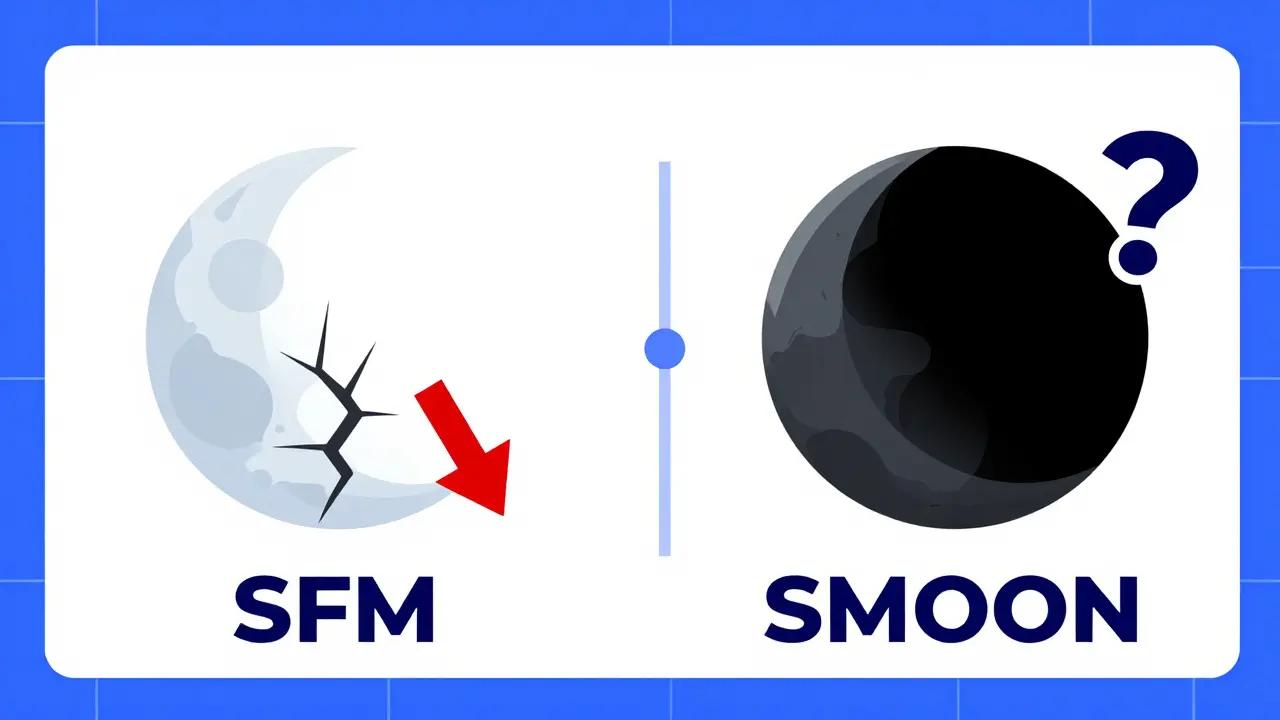
You’ve likely seen the name SafeMoon a controversial cryptocurrency known for its aggressive transaction taxes and extreme price volatility. But if you’re looking at your exchange app right now, you might be staring at a different ticker: SMOON a small-cap BEP-20 token launched in 2025 on the BNB Smart Chain. It’s confusing. Is this the same coin? Is it a new version? Or is it something entirely different that just happens to share a brand name?
The short answer is that they are two completely separate assets with very different risks, histories, and mechanics. One is a legacy token from the 2021 meme coin boom that has crashed by over 99%. The other is a newer, thinly traded token from 2025 with almost no public documentation. If you are thinking about buying either, understanding the difference between the original SafeMoon (SFM) the original 2021 token with a quadrillion supply and 10% tax mechanism and the new SAFEMOON (SMOON) a 2025 launch with a fixed 1 billion supply and unknown tokenomics is critical to protecting your capital.
The Confusion: Two Tokens, One Brand
In the world of Cryptocurrency digital assets secured by cryptography and built on blockchain technology, branding is often loose. You can have multiple projects using similar names, especially when a previous project had a massive cultural impact but a disastrous financial outcome. This is exactly what happened with the SafeMoon ecosystem.
The original SafeMoon, trading under the ticker SFM, launched on March 8, 2021. It became famous-or infamous-for its "reflection" model, where holding the token rewarded you with fractions of other people’s transactions. It pumped hard, hit a market cap of nearly $4 billion, and then crashed spectacularly. By mid-2026, SFM is a micro-cap asset with negligible volume.
Then came SMOON. Launched in 2025, this token operates on the BNB Smart Chain an EVM-compatible blockchain network developed by Binance for smart contracts as a BEP-20 token a standard for creating tokens and smart contracts on the BNB Smart Chain. While it uses the "SafeMoon" name in its listing, it is a distinct smart contract with a fixed supply of 1,000,000,000 tokens-vastly smaller than the original’s quadrillion supply. There is no official whitepaper, no named founding team, and no clear link to the original SafeMoon developers in the public listings provided by major exchanges like Coinbase or Crypto.com.
Comparing the Basics: SFM vs. SMOON
To understand why these two tokens matter differently to an investor, we need to look at their core attributes. They share the same underlying technology but diverge sharply in supply, history, and transparency.
| Attribute | Original SafeMoon (SFM) | SAFEMOON (SMOON) |
|---|---|---|
| Launch Date | March 8, 2021 | 2025 |
| Ticker Symbol | SFM | SMOON |
| Total Supply | 1 Quadrillion (1,000,000,000,000,000) | 1 Billion (1,000,000,000) |
| Blockchain | BNB Smart Chain (BEP-20) | BNB Smart Chain (BEP-20) |
| Price Context (Mid-2026) | ~$0.0000028 (Micro-cap) | ~$0.000008974 (Low liquidity) |
| Documentation | Extensive historical data, known tokenomics | Minimal; no whitepaper or team listed on major exchanges |
| Risk Profile | High (Historical crash, low volume) | Extreme (Unknown utility, potential rug pull risk) |
Note the supply difference. The original SFM had so many tokens that the price per unit was always tiny, even when the market cap was huge. SMOON has a much tighter supply, which means each token represents a larger slice of the pie-but without a product or community, that slice may not be worth anything.
The Original SafeMoon (SFM): A Cautionary Tale
You cannot evaluate SMOON without understanding what happened to SFM. The original SafeMoon was marketed as a "store of value" that resisted volatility through its tokenomics. Here is how it worked:
- 10% Transaction Tax: Every time you bought or sold SFM, 10% of the value was taken as a fee.
- Redistribution: 40% of that tax (4% total) was sent directly to existing holders’ wallets. This encouraged people to hold, hoping to earn passive income.
- Liquidity & Burn: 30% went to the liquidity pool to stabilize trading, and 20% was burned (destroyed) to reduce supply.
- Growth Fund: 10% was allocated to marketing and development.
On paper, this sounded revolutionary. In practice, it created a psychological trap. Selling meant losing 10% instantly. Holding meant getting tiny rewards while the overall price trended downward. During the 2021 bull run, SFM surged 3,300% in 30 days. But once the hype faded, the heavy sell tax made it difficult for large holders to exit without crashing the price further. By late 2022, the token had dropped roughly 90% from its peak. Today, in 2026, it trades with minimal volume, effectively trapped in a liquidity desert.
This history matters because SMOON borrows the brand equity of a project that failed to deliver long-term value. Investors wary of SFM’s collapse will naturally approach SMOON with extreme skepticism.

What We Know About SMOON (And What We Don’t)
If SFM is a ghost of the past, SMOON is a shadow in the present. As of June 2026, information about SMOON is sparse. It is listed on platforms like Coinbase and Crypto.com, which provides some baseline legitimacy-it hasn’t been immediately flagged as a scam by these exchanges. However, the listings are bare-bones.
Here is the reality of SMOON based on available data:
- No Whitepaper: Unlike most serious crypto projects, there is no linked whitepaper explaining the technology, use case, or roadmap.
- No Team Disclosure: The founders are anonymous. In crypto, anonymity isn’t illegal, but it removes accountability. If the project fails or the developers abandon it, you have no one to contact.
- Unknown Tokenomics: Does SMOON have a 10% tax like SFM? Does it burn tokens? Does it reward holders? The exchange listings do not say. Without this information, you are guessing about the costs of buying and selling.
- Low Liquidity: Crypto.com reports 24-hour trading volume as "N/A." This suggests very few people are actually trading it. Low liquidity means you might buy it easily, but struggle to sell it later without slippage (getting a much worse price than expected).
The absence of these details is a significant red flag. In the DeFi Decentralized Finance, a system of financial services built on blockchain technology space, transparency is currency. When a project hides its mechanics, it usually means there is nothing substantial behind the brand name.
Risks of Investing in SMOON
Let’s be direct: investing in SMOON is extremely high-risk. Here are the specific dangers you face:
- Brand Dilution: SMOON relies on the recognition of the SafeMoon name. However, the original SafeMoon is associated with failure and legal controversies. Using a tarnished brand does not add value; it adds baggage.
- Lack of Utility: There is no evidence that SMOON powers any application, game, or service. It appears to be a speculative asset only. Without utility, its value depends entirely on whether someone else is willing to pay more for it tomorrow.
- Smart Contract Risk: Since SMOON is a BEP-20 token, its behavior is defined by code on the BNB Smart Chain. If the code contains hidden functions (like allowing the developer to freeze wallets or mint infinite tokens), users could lose everything. Without an audit report or transparent source code, this risk is unchecked.
- Liquidity Traps: With near-zero volume, SMOON is illiquid. If panic sets in, there may be no buyers. You could hold tokens worth thousands on paper but be unable to sell them for actual cash.

How to Verify SMOON Yourself
If you still want to explore SMOON, do not rely on exchange listings alone. Perform your own due diligence:
- Check the Contract Address: Find the official SMOON contract address on a block explorer like BscScan. Compare it carefully with addresses listed on unofficial social media channels to avoid scams.
- Analyze Holder Distribution: Look at who holds the tokens. If a few wallets hold a large percentage of the supply, the risk of a "dump" (massive sell-off) is high.
- Search for Community Activity: Are there active discussions on Reddit, Twitter, or Telegram? Or is the community silent? A dead community is a bad sign for a new token.
- Look for Audits: Has a reputable firm audited the smart contract? If not, assume the code is unverified.
Conclusion: Proceed with Extreme Caution
SAFEMOON (SMOON) is not the same as the original SafeMoon (SFM). It is a new, separate token launched in 2025 on the BNB Smart Chain. While it shares a name, it lacks the documented history, community size, and-even then-flawed utility of its predecessor. With no whitepaper, no known team, and minimal trading volume, SMOON fits the profile of a highly speculative micro-cap asset.
For most investors, the risks outweigh the potential rewards. The crypto market is full of opportunities with clearer fundamentals and better transparency. If you choose to engage with SMOON, treat it as a gamble, not an investment. Never put in money you cannot afford to lose, and remember that in the absence of information, caution is your best strategy.
Is SMOON the same as SafeMoon (SFM)?
No. SMOON is a different token launched in 2025, while SafeMoon (SFM) was launched in 2021. They have different contract addresses, supplies, and trading histories. SMOON is not an official upgrade or rebrand of the original SafeMoon.
Does SMOON have a transaction tax like the original SafeMoon?
There is no public information confirming that SMOON has a transaction tax. The original SafeMoon had a 10% tax, but SMOON's listings do not disclose any tokenomics. You should check the smart contract on BscScan to verify if fees apply before trading.
Where can I buy SMOON?
SMOON is listed on centralized exchanges like Coinbase and Crypto.com. However, due to low liquidity, you may also find it on decentralized exchanges (DEXs) on the BNB Smart Chain, such as PancakeSwap, though this carries higher risk.
Is SMOON a safe investment?
No. SMOON is considered extremely high-risk due to its lack of documentation, anonymous team, low trading volume, and association with a previously failed brand. It should only be approached by experienced traders who understand the risks of micro-cap speculative assets.
What is the total supply of SMOON?
The total supply of SMOON is fixed at 1,000,000,000 (one billion) tokens. This is significantly lower than the original SafeMoon's supply of one quadrillion tokens.
Author
Ronan Caverly
I'm a blockchain analyst and market strategist bridging crypto and equities. I research protocols, decode tokenomics, and track exchange flows to spot risk and opportunity. I invest privately and advise fintech teams on go-to-market and compliance-aware growth. I also publish weekly insights to help retail and funds navigate digital asset cycles.