
You’ve probably seen the ticker KET flash across your screen or heard friends whispering about "yellow cat" coins. But here is the confusing part: there isn't just one KET. In fact, mixing up the different tokens with this symbol could cost you serious money. One version lives on Solana and acts like a standard meme coin, while another-specifically known as Yellow ket, often referred to as YellowCatDAO-runs on the Avalanche network and claims to use artificial intelligence to trade for its holders.
If you are looking at the Avalanche-based Yellow ket, you are dealing with a highly speculative asset that blends internet culture with automated treasury management. It promises something most meme coins do not: an autonomous agent that supposedly hunts for profits across blockchains and reinvests them into a community wallet. Sounds great in theory, right? In practice, it’s a wild ride marked by extreme volatility, massive price crashes, and plenty of data confusion. Before you buy even a single fraction of a cent worth of KET, you need to understand exactly what you are getting into.
The Core Concept: More Than Just a Cat Picture
Most meme coins rely entirely on hype, community vibes, and viral marketing. Think Dogecoin or Shiba Inu. They have no intrinsic utility other than being a medium of exchange within their fanbase. Yellow ket tries to differentiate itself by wrapping that same cat-themed branding around a functional mechanism. According to project descriptions from platforms like Coins.ph and CoinMarketCap, Yellow ket serves as the governance and utility token for YellowCatDAO.
Here is how they claim it works. The project utilizes an advanced AI agent designed to execute trades across multiple blockchain networks. Instead of sitting idle, this algorithm identifies arbitrage opportunities or momentum shifts in the market. When it makes a profit, those gains are routed back into the DAO’s treasury. This treasury then funds further development and community initiatives. Essentially, the token is supposed to be a self-sustaining engine where holding the coin gives you a stake in a collective trading bot.
This setup places Yellow ket at the intersection of three trending but risky crypto sectors: meme coins, decentralized finance (DeFi), and AI-driven automation. While the narrative is attractive, remember that "AI agent" in the world of low-cap crypto tokens can sometimes mean anything from a sophisticated neural network to a simple script running basic buy/sell orders. Transparency regarding the actual code and audit results of this AI remains limited compared to established DeFi protocols.
Tokenomics and Supply Details
Understanding the supply dynamics is crucial because it dictates potential scarcity and inflation. For the Avalanche-based Yellow ket, the numbers are relatively straightforward but tell a story of a fixed cap rather than an endless print job.
| Attribute | Value |
|---|---|
| Total Supply | 1,000,000,000 KET |
| Circulating Supply | Approximately 997 million - 1 billion KET |
| Blockchain Network | Avalanche (AVAX) |
| Fully Diluted Valuation (FDV) | Varies widely ($1.2M - $3.8M USD) |
With a total supply capped at 1 billion tokens, the project avoids the hyper-inflationary models seen in some other meme coins. However, the circulating supply is nearly equal to the total supply, meaning very few tokens are locked away for future vesting or team rewards. This implies that the current market price reflects almost the entire available inventory. If demand spikes, there is little hidden supply to dampen the price increase; conversely, if holders sell, there is no large reserve to absorb the shock.
Data discrepancies between trackers like CoinGecko and CoinMarketCap highlight the thin liquidity. One might show a market cap of $1.2 million while another shows $3.8 million for the same time period. This variance usually stems from differences in which exchanges' prices are averaged and how circulating supply is verified on-chain. For a retail investor, this means your entry price on one exchange could be significantly different from another.
Price History: The Boom and Bust Cycle
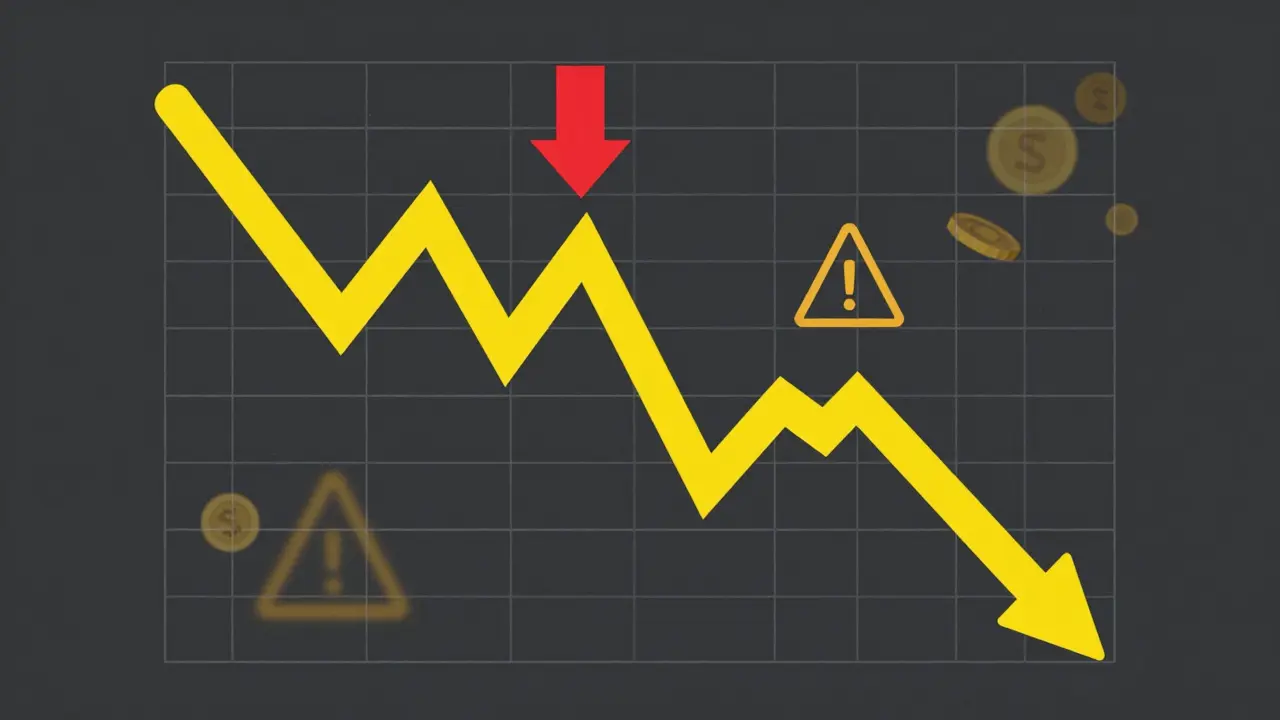
If you think crypto is volatile, look closely at Yellow ket’s price chart. It is a textbook example of speculative mania followed by a severe correction. Back in May 2025, during a peak in meme coin enthusiasm, KET reached an all-time high (ATH) of approximately $0.62 per token. At that moment, the market capitalization hovered near $300 million, placing it among the mid-tier performers on the Avalanche chain.
Then came the crash. By March 2026, the price had plummeted to an all-time low (ATL) of roughly $0.00176. That represents a drawdown of over 99%. To put that in perspective, if you had invested $1,000 at the peak, you would have been left with less than $3 by the trough. As of July 2026, the price has stabilized somewhat in the range of $0.0012 to $0.0046, depending on the day and the exchange. While this looks like a recovery from the bottom, it is still down more than 99% from its highest point.
This pattern is common for meme assets. They surge on narrative hype-in this case, the combination of cats, AI, and cross-chain trading-and then bleed value as early investors cash out and attention shifts to the next shiny object. The recent stability around the $0.003 mark suggests a floor has been found, but floors in crypto are often temporary until the next major market cycle begins.
Confusion Alert: Don’t Mix Up Your KETs
This is perhaps the most critical warning for anyone researching this coin. The ticker symbol "KET" is shared by multiple distinct projects. You must verify which blockchain you are interacting with.
- Yellow ket (Avalanche): Associated with YellowCatDAO, features AI trading narratives, and has a much lower market cap (millions of USD).
- Ket (Solana): A separate cat-themed/alien-hybrid token operating on the Solana blockchain. This version has historically shown higher valuations, with market caps reaching hundreds of millions of dollars at times, and does not share the same AI treasury structure as the Avalanche version.
Exchanges like Binance, Kraken, and Crypto.com may list both or confuse the two in their aggregators. Always check the contract address before buying. If you intend to buy the AI-driven Yellow ket on Avalanche, ensure your transaction is directed to the AVAX network contract. Sending funds to the wrong chain can result in permanent loss of assets.

How to Buy and Store Yellow ket
If you decide to take the risk, the process is similar to buying any altcoin, but with extra steps due to the specific network requirements.
- Choose an Exchange: Centralized exchanges like Binance, Bitget, and Kraken have listed KET pairs. You will likely need to deposit fiat currency or convert Bitcoin/Ethereum into USDT or AVAX first.
- Execute the Trade: Search for the KET/USDT or KET/AVAX pair. Be mindful of the spread-the difference between the buy and sell price-as liquidity is thin. Large orders can slip the price significantly against you.
- Withdraw to a Wallet: For long-term holding, keep your tokens off the exchange. Since Yellow ket lives on Avalanche, you need a wallet compatible with that network. MetaMask is a popular choice; simply add the Avalanche C-Chain network settings to it. Alternatively, dedicated wallets like Core Wallet support Avalanche natively.
- Verify the Contract: Double-check the contract address on a reliable tracker like CoinMarketCap or CoinGecko before pasting it into your wallet. Scammers often create fake tokens with similar names.
Once stored, you can participate in the YellowCatDAO governance if such features are active. This typically involves voting on proposals related to the AI agent’s strategy or treasury allocations. However, always read the terms carefully, as governance rights in early-stage DAOs can be experimental.
Risks and Realistic Expectations
Let’s be direct: Yellow ket is a high-risk, speculative play. It is not a stable store of value, nor is it a blue-chip cryptocurrency like Bitcoin or Ethereum. Its value is driven primarily by sentiment and the perceived novelty of its AI integration.
The primary risks include:
- Extreme Volatility: Daily swings of 10-20% are normal. Losing 50% of your investment in a week is possible.
- Liquidity Issues: With low trading volumes on some platforms, exiting a large position quickly without crashing the price is difficult.
- Smart Contract Risk: The AI agent and treasury functions rely on smart contracts. Bugs or exploits could lead to fund losses, though audits are rarely publicized in detail for micro-cap projects.
- Regulatory Uncertainty: As regulations around AI and crypto tighten globally, projects blending these technologies may face scrutiny.
Expert analysts, such as those covering quantitative crypto strategies, have noted that while KET had significant upside during its initial hype cycle, its current valuation leaves limited room for exponential growth compared to larger meme coins. Unless the broader market enters a massive bull run or the AI agent demonstrates verifiable, substantial profit generation that is transparently audited, expect gradual movements rather than overnight ten-bagger returns.
Is Yellow ket the same as the KET token on Solana?
No, they are completely different assets. Yellow ket operates on the Avalanche blockchain and is associated with YellowCatDAO's AI trading narrative. The KET token on Solana is a separate meme coin with different branding, contract addresses, and market dynamics. Always check the network before trading.
What does the AI agent in Yellow ket actually do?
According to project documentation, the AI agent executes automated trades across various blockchains to find arbitrage or momentum opportunities. Profits from these trades are reinvested into the YellowCatDAO treasury. However, the exact algorithms and performance metrics are not fully transparent to the public.
Why is the price of KET so different on CoinMarketCap versus CoinGecko?
These discrepancies arise due to thin liquidity and varying data sources. Different aggregators pull prices from different exchanges, some of which may have outdated feeds or low volume. Additionally, differences in how circulating supply is calculated can skew market cap figures. Always check multiple sources.
Can I mine Yellow ket?
No, Yellow ket cannot be mined. It is an ERC-20 style token deployed on the Avalanche network with a fixed total supply of 1 billion tokens. All tokens were pre-minted and distributed through sales, liquidity pools, and airdrops.
Is Yellow ket a good investment for beginners?
Generally, no. Due to its extreme volatility, history of 99% drawdowns, and complex nature involving AI and DAO governance, it is considered a high-risk speculative asset. Beginners should stick to established cryptocurrencies with clearer fundamentals and deeper liquidity until they gain more experience.
Author
Ronan Caverly
I'm a blockchain analyst and market strategist bridging crypto and equities. I research protocols, decode tokenomics, and track exchange flows to spot risk and opportunity. I invest privately and advise fintech teams on go-to-market and compliance-aware growth. I also publish weekly insights to help retail and funds navigate digital asset cycles.