

Imagine a group of strangers trying to agree on the score of a game without a referee. In the physical world, this is chaotic. In the digital world, it’s impossible-unless you have a consensus mechanism, which is a protocol that allows distributed nodes to agree on a single transaction history without a central authority. This technology is the backbone of every cryptocurrency. It ensures that when you send Bitcoin or Ethereum, everyone sees the same result, preventing double-spending and fraud.
You might assume all blockchains work the same way. They don’t. The method a network uses to reach agreement determines its speed, cost, security, and energy footprint. Some are slow but incredibly secure. Others are fast but rely on fewer participants. Understanding these differences isn't just for developers; it’s crucial for anyone holding or using crypto assets.
The Core Problem: Trust Without a Middleman
In traditional banking, a central server keeps the ledger. If the bank says you have $100, you have $100. But in a decentralized network, thousands of computers (nodes) hold copies of the ledger. How do they ensure no one cheats? How do they decide which version of the ledger is the correct one?
This is where consensus comes in. A good consensus algorithm must provide three things:
- Agreement: All honest nodes eventually agree on the same order of transactions.
- Validity: Only valid transactions are confirmed.
- Termination: The process finishes in finite time, even if some nodes fail or act maliciously.
The trade-off usually lies in the "Blockchain Trilemma": Security, Decentralization, and Scalability. You can generally pick two, but getting all three is hard. Let's look at how different mechanisms try to solve this.
Proof of Work (PoW): The Energy-Intensive Pioneer
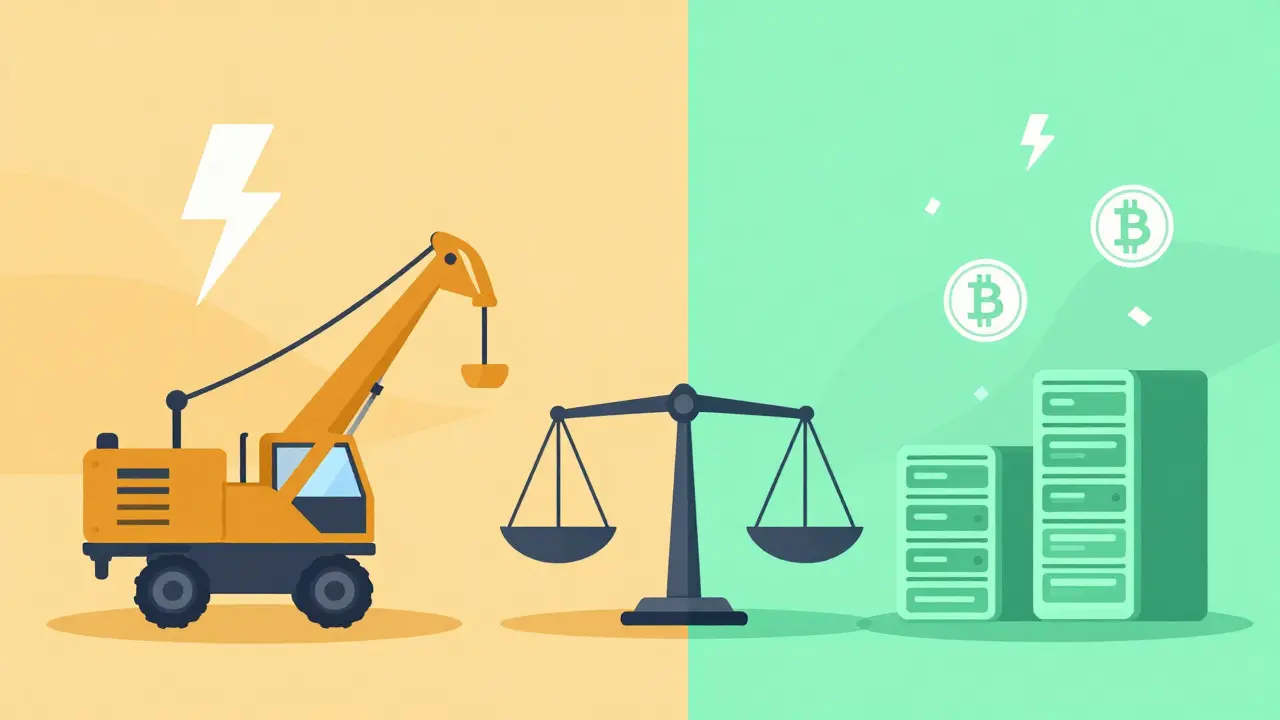
Proof of Work is the original consensus mechanism introduced by Bitcoin in 2009, relying on computational power to secure the network. It was designed to be permissionless-anyone with electricity and hardware could join.
Here is how it works. Miners compete to solve a complex cryptographic puzzle. This requires guessing a random number (nonce) until the hash of the block header falls below a specific target. It’s like a lottery where buying more tickets means having more computing power. The first miner to solve it broadcasts the block. Other nodes verify it instantly and add it to their chain.
Key Characteristics:
- Security: Extremely high. To attack the network, an attacker needs more than 51% of the total global computing power (hash rate). For Bitcoin, this costs billions in hardware and electricity.
- Finality: Probabilistic. Transactions aren't final immediately. You wait for several blocks (e.g., 6 blocks in Bitcoin, ~60 minutes) to be sure the transaction won't be reversed.
- Energy Use: Very high. The competition consumes massive amounts of electricity, comparable to small countries.
- Throughput: Low. Bitcoin handles about 7 transactions per second (TPS).
PoW is battle-tested. It has secured Bitcoin for over 14 years without a major breach. However, its environmental impact and low speed led to the rise of alternatives.
Proof of Stake (PoS): The Capital-Based Alternative
Proof of Stake is a consensus mechanism where validators are chosen based on the amount of cryptocurrency they lock up as collateral. Instead of burning electricity to solve puzzles, validators "stake" their tokens. The more you stake, the higher your chance of being selected to propose the next block.
Ethereum switched from PoW to PoS in 2022 (The Merge), reducing its energy consumption by over 99%. Cardano, Polkadot, and Solana also use variations of PoS.
Key Characteristics:
- Security: Based on economic penalty. If a validator tries to cheat, they lose part of their staked tokens (slashing). Attacking requires acquiring a huge portion of the token supply.
- Finality: Faster than PoW, often achieving finality in seconds to minutes depending on the protocol design.
- Energy Use: Negligible. Validators run standard servers, not mining rigs.
- Decentralization Risk: Wealth concentration. Those with more tokens have more influence, potentially leading to oligarchy.
PoS is efficient and scalable, making it ideal for smart contract platforms. However, critics argue it favors the wealthy and introduces new risks like "long-range attacks," where an attacker buys old private keys to rewrite history.
Delegated Proof of Stake (DPoS): Voting for Speed
Delegated Proof of Stake is a variant of PoS where token holders vote for a small number of delegates who produce blocks. Think of it as a representative democracy rather than direct democracy. Token holders cast votes, and the top candidates (often 21-100) become block producers.
Networks like EOS and TRON use DPoS. Because only a few nodes handle consensus, they can communicate quickly and finalize blocks almost instantly.
Key Characteristics:
- Speed: Very high. Block times can be under one second.
- Throughput: High. Can handle hundreds or thousands of TPS.
- Centralization: High. Control rests with a small group of elected validators. If they collude, the network is compromised.
- Accountability: Validators can be voted out if they misbehave or go offline.
DPoS sacrifices decentralization for performance. It’s great for applications needing fast transactions, but it raises concerns about censorship resistance. If a government pressures the 21 validators, they might comply.
Byzantine Fault Tolerant (BFT): Deterministic Finality
Byzantine Fault Tolerance is a class of protocols that achieve immediate, irreversible finality through multi-round voting among validators. Unlike PoW’s probabilistic approach, BFT guarantees that once a block is finalized, it cannot be changed. Protocols like Practical Byzantine Fault Tolerance (PBFT) are used in many enterprise chains and hybrid public chains.
In BFT, validators exchange messages in phases (pre-prepare, prepare, commit). If two-thirds of validators agree, the block is final. This tolerates up to one-third of malicious nodes.
Key Characteristics:
- Finality: Immediate. No waiting for confirmations.
- Scalability Limit: Communication complexity grows quadratically ($O(n^2)$). As you add more validators, the network slows down due to message overload.
- Use Case: Ideal for cross-chain bridges, decentralized exchanges, and enterprise systems where certainty is critical.
Many modern PoS chains combine PoS with BFT committees to get the best of both worlds: broad participation for selection, and BFT for fast finality.
Proof of Authority (PoA): Identity-Based Trust
Proof of Authority is a permissioned consensus mechanism where known, verified identities validate transactions. Validators are approved entities, often companies or institutions. Their reputation is their stake. If they cheat, they lose their license and face legal action.
PoA is rarely used in public cryptocurrencies. It dominates enterprise blockchains (like Hyperledger Fabric) and testnets. It offers high throughput and low latency because there are few, trusted validators.
| Mechanism | Primary Resource | Finality Type | Throughput (TPS) | Energy Efficiency | Best For |
|---|---|---|---|---|---|
| Proof of Work (PoW) | Computing Power | Probabilistic | Low (7-30) | Very Low | Digital Gold, Store of Value |
| Proof of Stake (PoS) | Cryptocurrency Stake | Probabilistic/Deterministic | Medium-High (100-10,000+) | High | Smart Contracts, DeFi |
| Delegated PoS (DPoS) | Votes/Stake | Near-Instant | High (1,000+) | High | High-Speed Apps, Gaming |
| BFT Variants | Validator Votes | Deterministic | Medium (Limited by N) | High | Bridges, Enterprise Ledgers |
| Proof of Authority (PoA) | Identity/Reputation | Deterministic | Very High | High | Private/Consortium Chains |
Which One Should You Care About?
Your choice depends on what you value most. If you prioritize maximum security and decentralization above all else, Proof of Work remains the gold standard, despite its inefficiency. Bitcoin’s resilience proves its worth.
If you want to build dApps, trade DeFi, or need faster settlements, Proof of Stake is the current industry leader. It balances security with usability and sustainability. Most new projects launch on PoS chains.
For high-frequency applications like gaming or social media, DPoS offers the speed needed, though you accept higher centralization risk.
Enterprise users looking for auditability and compliance prefer PoA or BFT systems, where identities are known and legal recourse exists.
The Future: Hybrid Models
The line between these mechanisms is blurring. Many networks now use hybrids. For example, a chain might use PoS to select validators and BFT to finalize blocks. Layer 2 solutions (like rollups) sit on top of base layers to boost throughput while inheriting the base layer’s security.
As regulations tighten, expect more scrutiny on PoW’s energy use and PoS’s validator concentration. The trend is moving toward efficiency and interoperability, with consensus mechanisms evolving to meet both technical and regulatory demands.
What is the main difference between Proof of Work and Proof of Stake?
Proof of Work relies on miners solving computational puzzles using electricity and hardware, while Proof of Stake selects validators based on the amount of cryptocurrency they lock up as collateral. PoS is significantly more energy-efficient.
Is Proof of Stake more secure than Proof of Work?
Both are highly secure but in different ways. PoW security is tied to the cost of hardware and electricity. PoS security is tied to the economic value of the staked tokens. PoW has a longer track record, but PoS is mathematically robust and increasingly adopted by major networks like Ethereum.
Why does Bitcoin still use Proof of Work?
Bitcoin prioritizes maximum decentralization and security over speed and energy efficiency. Its PoW model has proven resilient for over 14 years. Changing it would require significant coordination and could introduce unknown risks to the network's stability.
What is finality in blockchain?
Finality refers to the point at which a transaction is considered irreversible. In PoW, finality is probabilistic (you wait for confirmations). In BFT and some PoS variants, finality is deterministic (immediate upon consensus).
Can I mine Bitcoin with my home computer?
No. Bitcoin mining requires specialized ASIC hardware and large-scale operations to be profitable. Home computers lack the necessary hash rate and would consume too much electricity relative to rewards.
Author
Ronan Caverly
I'm a blockchain analyst and market strategist bridging crypto and equities. I research protocols, decode tokenomics, and track exchange flows to spot risk and opportunity. I invest privately and advise fintech teams on go-to-market and compliance-aware growth. I also publish weekly insights to help retail and funds navigate digital asset cycles.