

Ever stared at a screen asking for your passport and a selfie, wondering why opening a simple account feels like an interrogation? You're not alone. KYC verification is the gatekeeper between you and financial services, from traditional banks to decentralized finance (DeFi) platforms. While it can feel intrusive, understanding exactly what happens behind the scenes helps you move through the process faster and avoid common pitfalls that lead to rejections.
This guide breaks down the Know Your Customer (KYC) process into plain English. We’ll look at what documents you actually need, how the technology verifies your identity, and why some checks take seconds while others drag on for days. Whether you’re signing up for a cryptocurrency exchange or a new bank account, here’s how to get it done right the first time.
What Is KYC Verification and Why Does It Exist?
Know Your Customer (KYC) is a regulatory compliance process that requires financial institutions to verify the identity of their customers to prevent fraud, money laundering, and terrorist financing. It didn't start with crypto; it’s been around since the early 2000s, largely driven by regulations like the USA PATRIOT Act and international standards set by the Financial Action Task Force (FATF). Today, over 180 jurisdictions enforce these rules.
The goal isn't just to collect your data for fun. It’s about risk management. Institutions need to know who they are dealing with to ensure funds aren’t moving illegally. For you, the customer, this means proving you are who you say you are. The process typically involves three core pillars: verifying your identity, assessing your risk level, and keeping an eye on your transactions over time.
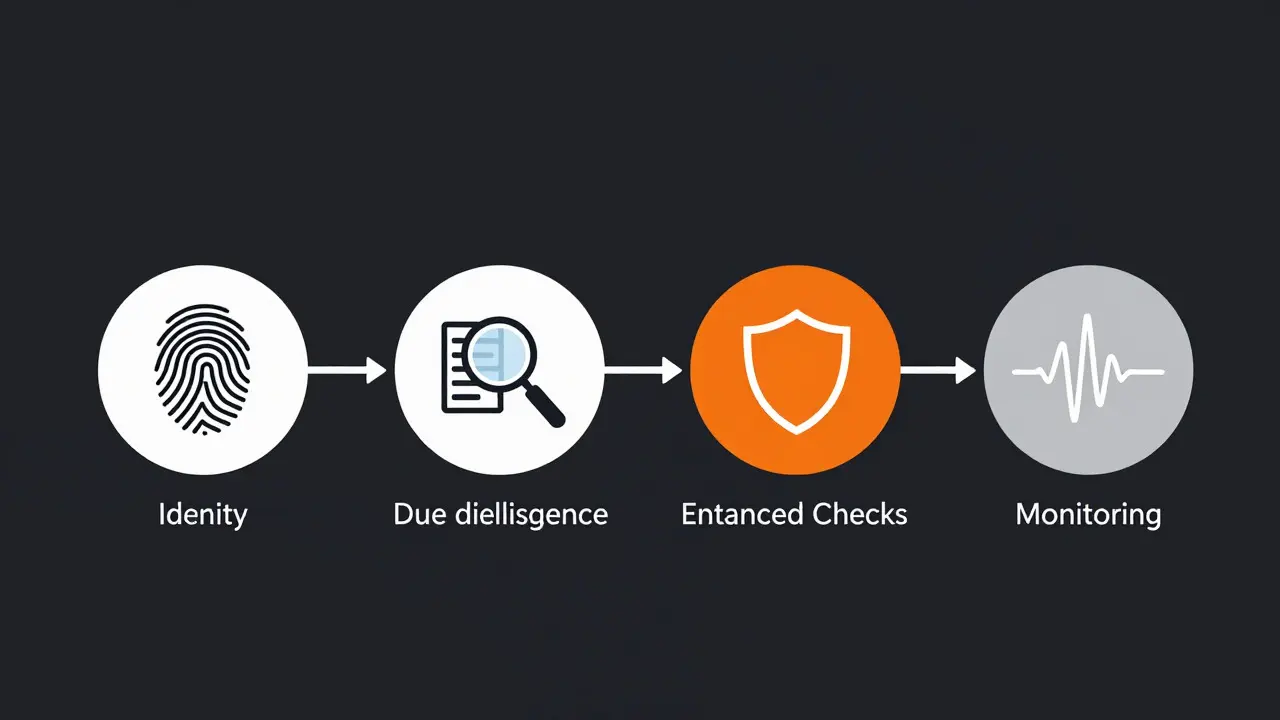
The Four Core Steps of the Process
While different providers use different terminology, the underlying workflow remains consistent. Here is the standard flow you will encounter:
- Identity Verification: This is the initial check. You provide basic details and upload a government-issued ID. Systems scan this document for security features to ensure it hasn't been forged.
- Customer Due Diligence (CDD): Once your ID is verified, the system cross-references your information against various databases. This includes checking if you appear on any sanctions lists or watchlists. It’s a background check in digital form.
- Enhanced Due Diligence (EDD): Not everyone gets this step. If you are flagged as high-risk-perhaps due to living in a specific region, being a public figure, or handling large sums-you undergo deeper scrutiny. This might involve verifying your source of wealth or income.
- Ongoing Monitoring: Verification doesn't end when you open the account. Your transaction patterns are monitored continuously. If you suddenly send a massive amount of cash to a high-risk country, the system flags it for review.
Documents You Need: Be Prepared
The biggest frustration for users is often having to go back and forth for missing documents. To speed things up, gather these four items before you start:
- Government-Issued Photo ID: A passport, driver's license, or national ID card. Passports are generally the most universally accepted and least likely to cause technical issues with scanning software.
- Proof of Address: A utility bill (electricity, water, gas), bank statement, or official government correspondence. Crucially, this must be dated within the last three months. Older documents are frequently rejected automatically.
- Selfie Video or Live Photo: Most modern systems require a liveness check. This prevents someone else from using your ID. You’ll usually be asked to blink, turn your head, or hold your ID next to your face.
- Corporate Documents (if applicable): If you are verifying a business entity, you’ll need certified articles of incorporation, business licenses, and proof of beneficial ownership (identifying anyone owning 25% or more).
| Method | Average Time | Accuracy Rate | Best For |
|---|---|---|---|
| Digital Document Scan | 3-5 minutes | 99.4% | Standard individual accounts |
| Biometric Liveness Check | < 1 minute | High | Preventing identity theft |
| Manual Review (EDD) | 72-96 hours | Variable | High-risk profiles or complex entities |
Why Do Some Verifications Take So Long?
If your standard check takes under five minutes, why does yours take three days? The answer usually lies in risk scoring. Algorithms assign a risk score to every applicant. Low-risk individuals (scores 1-30) breeze through automated checks. Medium-risk users (31-70) might trigger additional database searches. High-risk users (71-100) are almost always routed to manual review.
Common triggers for manual review include:
- Poor image quality (blurry text, glare on the ID).
- Mismatched names (e.g., "John Smith" on ID vs. "Johnny Smith" in profile).
- Living in a jurisdiction with stricter regulations.
- Previous failed attempts or suspicious activity flags.
Another major factor is cross-border complexity. If you are using a platform based in one country but living in another, the system may struggle with local ID formats. Gartner reports that nearly 70% of institutions face challenges with cross-border verification, leading to higher false rejection rates. Using a passport instead of a local driver's license can significantly reduce this friction.
Common Mistakes That Cause Rejection
Even with the right documents, technical errors can stall your progress. Here are the top mistakes to avoid:
- Cropping Errors: Make sure all four corners of your ID are visible. Cropped images force manual review.
- Expired Documents: Always double-check the expiration date. An expired passport is an instant fail.
- Lighting Issues: Avoid backlighting or shadows on your face during the selfie. Natural light works best.
- Name Discrepancies: Ensure the name on your application matches your ID *exactly*, including middle initials if required.
- Old Proof of Address: A bill from four months ago looks suspicious to algorithms. Use something recent.

The Future: Blockchain and Digital Identity
As we move further into 2026, the landscape is shifting. Traditional KYC is centralized; you submit your data to Company A, then again to Company B. The future points toward decentralized identity solutions. Banks and exchanges are piloting blockchain-based KYC utilities where your verified identity exists on a secure ledger. Once verified, you can share that status with other institutions without re-uploading documents. This could cut verification times from days to seconds and reduce duplicate data storage risks.
Regulators are watching closely. With the European Banking Authority pushing for real-time monitoring and the FATF updating guidelines for virtual assets, the bar for compliance is rising. But for the user, the trend is toward smoother, faster experiences powered by AI and biometrics. The days of mailing physical copies of your passport are officially over.
Frequently Asked Questions
How long does KYC verification usually take?
For low-risk customers using digital methods, it typically takes less than 5 minutes. However, if you are flagged for Enhanced Due Diligence (high-risk profile) or if there are document mismatches, it can take anywhere from 48 to 96 hours for manual review.
Can I use a mobile phone photo for my ID?
Yes, most modern platforms accept high-quality photos taken with a smartphone camera. Ensure the lighting is good, the text is sharp, and the entire card is visible. Scans are also acceptable but photos are often easier to manage digitally.
What happens if my KYC fails?
You will usually receive an email explaining the reason for failure (e.g., blurry image, name mismatch). You can then resubmit corrected documents. If you fail multiple times, the account may be suspended pending manual review by a compliance officer.
Is KYC mandatory for all crypto exchanges?
Most centralized exchanges (CEXs) like Coinbase or Binance require full KYC to comply with global AML laws. Decentralized exchanges (DEXs) often do not require KYC, but many newer hybrid platforms are adopting lighter forms of verification to access certain features.
Do I need to redo KYC every year?
Generally, no. Once verified, your status remains active unless your risk profile changes significantly or your ID expires. However, institutions perform periodic reviews. If you change your address or name, you should update your profile proactively to avoid frozen accounts.
Author
Ronan Caverly
I'm a blockchain analyst and market strategist bridging crypto and equities. I research protocols, decode tokenomics, and track exchange flows to spot risk and opportunity. I invest privately and advise fintech teams on go-to-market and compliance-aware growth. I also publish weekly insights to help retail and funds navigate digital asset cycles.