
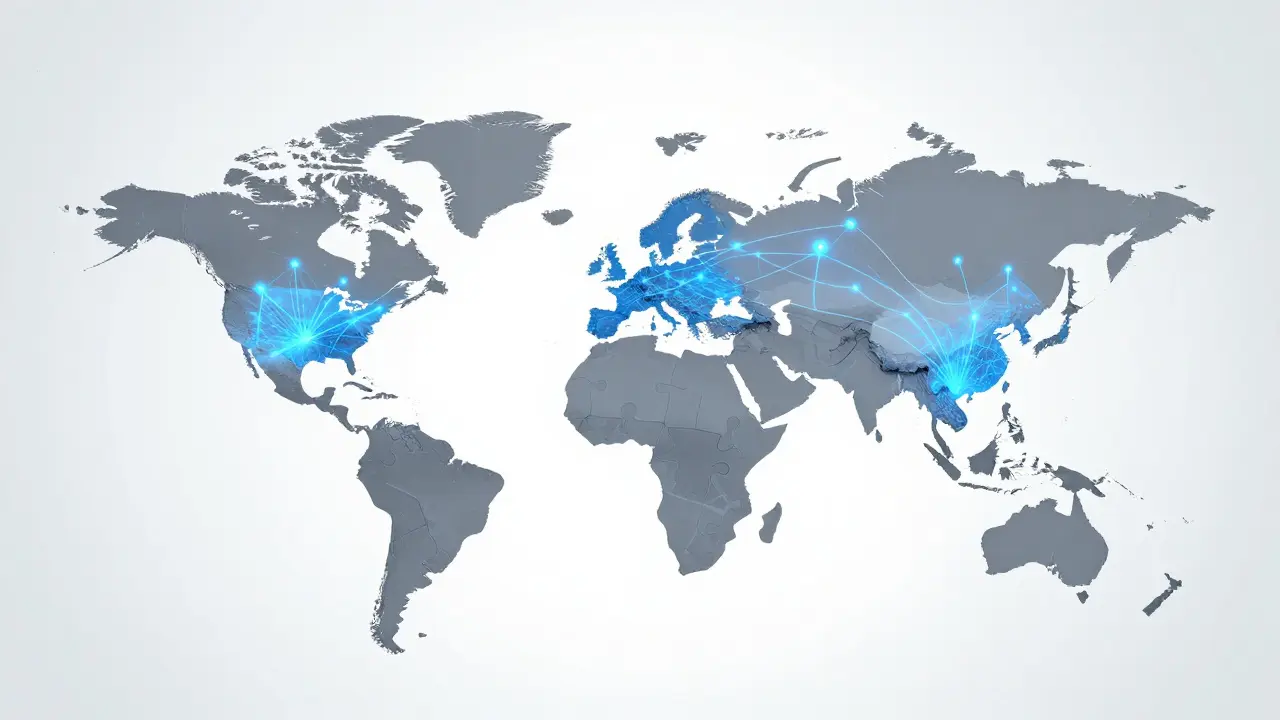
The days of regulatory guesswork in the cryptocurrency world are officially over. If you are navigating international markets in 2026, you are no longer operating in a gray zone defined by enforcement actions and vague warnings. Instead, you are entering an era of structured legislative frameworks that dictate exactly how digital assets must be issued, traded, and held. The landscape has shifted from fragmented local rules to coordinated international standards, driven by major policy reversals in the United States and comprehensive adoption in Europe and Asia.
Understanding these laws is not just about avoiding fines; it is about unlocking institutional capital and banking access. For years, uncertainty kept traditional finance on the sidelines. Now, with clear definitions for what constitutes a security versus a commodity, businesses can plan long-term strategies without fear of retroactive penalties. This guide breaks down the critical regulations shaping the industry today, focusing on the practical steps you need to take to remain compliant across borders.
The US Framework: From Enforcement to Legislation
The United States underwent a dramatic transformation in 2025, moving away from its previous strategy of regulating through litigation. This shift was anchored by two key pieces of federal legislation: the GENIUS Act and the pending CLARITY Act. These laws provide the first clear federal roadmap for digital assets, resolving decades of ambiguity between regulatory bodies.
The GENIUS Act specifically targets stablecoins, defining them as digital assets pegged to the dollar and intended for payments. It mandates that only issuers approved by U.S. regulators or foreign entities registered in the United States can create such tokens. Crucially, it requires full reserve backing-meaning every stablecoin in circulation must be backed by equivalent cash or highly liquid assets. Issuers must undergo monthly audits and adhere to strict anti-money laundering (AML) and consumer protection standards. This framework is designed to promote trust, allowing stablecoins to function reliably within the broader payment ecosystem.
Meanwhile, the CLARITY Act addresses the long-standing jurisdictional dispute between the Securities and Exchange Commission (SEC) and the Commodity Futures Trading Commission (CFTC). Under this framework, the CFTC assumes primary jurisdiction over "digital commodities"-blockchain-based assets that are decentralized and do not qualify as securities. The SEC retains authority over digital assets that meet the definition of a security, such as those offered through initial coin offerings (ICOs) or by centralized entities. This division clarifies which regulator oversees which asset, reducing the legal risk for projects building decentralized protocols.
A pivotal moment came on July 31, 2025, when SEC Chair Paul Atkins launched "Project Crypto." This initiative explicitly stated that most crypto assets are not securities and should not be governed under securities laws. The SEC staff was ordered to develop clear guidelines to help market participants determine whether their digital asset constitutes a security or falls under an investment contract. For assets that do qualify as securities, the SEC is proposing purpose-fit disclosures and safe harbors, making compliance more manageable for legitimate projects.
Banking integration also saw significant progress. On March 7, 2025, the Office of the Comptroller of the Currency (OCC) issued Interpretive Letter 1183, reaffirming that national banks and federal savings associations may participate in cryptocurrency activities, including custody and stablecoin issuance. This letter rescinded previous restrictive guidance, removing barriers that had prevented traditional banks from engaging with the crypto sector. However, businesses must still navigate state-level money transmitter laws, which vary significantly across jurisdictions.
European Union: Navigating MiCAR Implementation
In Europe, the Markets in Crypto-Assets Regulation (MiCAR) sets the standard for licensing and operation. Introduced in May 2023, MiCAR creates a comprehensive framework requiring any company issuing or trading cryptocurrency to obtain proper authorization. As we move into 2026, the transitional periods are ending, and full compliance is mandatory.
Starting January 2026, all service providers under MiCAR must obtain the names of senders and beneficiaries for transactions, regardless of the amount. This eliminates previous thresholds that allowed smaller transactions to bypass identity verification. Additionally, self-hosted wallets holding over 1,000 euros require wallet ownership verification for transactions involving regulated services. These measures aim to enhance transparency and combat illicit finance while maintaining user privacy where possible.
MiCAR’s unified approach allows firms to operate across the EU single market with one license, reducing fragmentation. However, the complexity of implementation has caused some fintech companies to relocate to jurisdictions with clearer or more flexible guidelines during the transition phase. Businesses operating in Europe must ensure their KYC (Know Your Customer) and AML procedures align strictly with MiCAR requirements to avoid severe penalties.
| Jurisdiction | Key Legislation/Regulation | Primary Focus | Stablecoin Rules | Banking Access |
|---|---|---|---|---|
| United States | GENIUS Act, CLARITY Act | Securities vs. Commodities clarity | Full reserve backing, monthly audits | OCC permits crypto activities |
| European Union | MiCAR | Single market licensing | Strict issuer reserves, travel rule | Varies by member state |
| Singapore | PAYMENTS Services Act | Licensing regime for exchanges | Finalized stablecoin framework | Open to licensed entities |
| Hong Kong | New Licensing Regimes | Exchange and custody licensing | Drafting strict requirements | Gradual integration |
Asian Hubs: Singapore and Hong Kong Lead Innovation
Asia has emerged as a leader in balancing innovation with investor protection. Singapore has finalized a robust stablecoin framework and maintains a rigorous licensing regime for crypto firms. Its approach emphasizes clear rules for virtual asset service providers (VASPs), making it a preferred destination for fintech investment in the Asia-Pacific region. The Monetary Authority of Singapore (MAS) continues to update its guidelines to address emerging risks while fostering growth.
Hong Kong SAR has introduced comprehensive new licensing regimes for exchanges, including over-the-counter trading and custody services. Regulators are also reviewing rules for crypto derivatives and lending, aiming to become a regional digital asset hub. Strict stablecoin requirements are being drafted as part of this strategy. These initiatives reflect a coordinated effort to attract global players while managing systemic risks through graduated regulatory approaches.
The success of these Asian models has influenced policy discussions elsewhere. Their ability to attract capital while maintaining financial stability demonstrates that regulation does not have to stifle innovation. For businesses looking to expand globally, establishing a presence in Singapore or Hong Kong can provide a strategic foothold with relatively predictable regulatory environments.

Global Extremes: Brazil’s Integration vs. China’s Ban
Not all countries follow the same path. Brazil established comprehensive cryptocurrency regulation in June 2023 with the Cryptoassets Act, designating the central bank as the supervisor for crypto assets. This legislation focuses on scam prevention, setting rules for companies providing virtual asset services and defining criminal practices in crypto use. Penalties for fraud or money laundering are clearly outlined, creating a safer environment for users.
In stark contrast, China maintains a complete ban on cryptocurrency exchanges, trading, and mining. This polarized approach illustrates the spectrum of regulatory responses, from total prohibition to comprehensive integration. Businesses must carefully assess their target markets, as operating in restricted jurisdictions can lead to severe legal consequences and reputational damage.
Other regions, such as South Africa and Bahrain, have implemented licensing rules for crypto exchanges and token issuers, reflecting a global trend toward regulatory adoption. This widespread movement suggests that the era of unregulated crypto is ending, replaced by a network of interconnected but distinct regulatory regimes.
Tax Implications and Property Classification
Beyond securities laws, tax treatment remains a critical consideration. In the United States, the Internal Revenue Service (IRS) continues to treat cryptocurrencies as property for tax purposes, a position maintained since 2014. This means that using, selling, or exchanging digital assets may trigger capital gains or losses. Every transaction is a taxable event, requiring meticulous record-keeping.
Businesses must invest in robust accounting systems to track cost basis and fair market value at the time of each transaction. Failure to report crypto income accurately can result in significant penalties. As regulations evolve, tax authorities are increasing their scrutiny of crypto-related activities, making compliance essential for both individuals and corporations.

Practical Steps for Cross-Border Compliance
Navigating this complex landscape requires a proactive approach. Here are key steps to ensure your business remains compliant:
- Conduct Jurisdictional Analysis: Identify all jurisdictions where you operate or intend to operate. Map out specific requirements for each, including licensing, reporting, and consumer protection standards.
- Classify Your Assets: Determine whether your digital assets are classified as securities, commodities, or other categories under local laws. Seek legal counsel to avoid misclassification.
- Implement Robust KYC/AML Procedures: Ensure your identity verification and anti-money laundering processes meet the highest standards, particularly for MiCAR and US requirements.
- Monitor Regulatory Updates: Regulations are evolving rapidly. Subscribe to official government updates and engage with legal experts who specialize in crypto law.
- Prepare for Audits: Maintain transparent records of reserves, transactions, and customer data. Regular internal audits can help identify gaps before external regulators do.
The cost of non-compliance far outweighs the investment in proper legal and operational infrastructure. By aligning with current frameworks, you position your business for sustainable growth in a maturing market.
Future Outlook: Coordination and Standardization
Looking ahead, international coordination will likely increase. The Financial Action Task Force (FATF) continues to push for global standards on travel rules and AML compliance. Success in jurisdictions like Singapore and Hong Kong may encourage other regions to adopt similar balanced approaches. However, the fundamental challenge of balancing innovation with investor protection remains.
As the CLARITY Act moves toward final passage in the US and MiCAR fully takes effect in Europe, the regulatory floor will rise globally. Businesses that adapt early will gain a competitive advantage, attracting institutional investors who demand certainty and safety. The future of crypto is not wild west speculation; it is integrated, regulated, and accountable.
What is the difference between a crypto security and a commodity?
Under the proposed US CLARITY Act, a digital commodity is a decentralized blockchain asset not classified as a security, overseen by the CFTC. A digital security is an asset offered by centralized entities or through ICOs that meets the Howey test criteria, falling under SEC jurisdiction. Classification depends on decentralization and investor expectations.
How does MiCAR affect small crypto businesses in Europe?
MiCAR requires all crypto service providers in the EU to obtain licenses, regardless of size. Small businesses must implement strict KYC/AML procedures, including verifying sender/beneficiary names for all transactions. Compliance costs may be higher, but operating without a license is illegal.
Can US banks now offer crypto custody services?
Yes. Following OCC Interpretive Letter 1183 in March 2025, national banks and federal savings associations are permitted to engage in crypto activities, including custody and stablecoin issuance, provided they maintain safety and soundness standards.
What are the stablecoin requirements under the GENIUS Act?
The GENIUS Act requires stablecoin issuers to hold full reserves in cash or highly liquid assets, undergo monthly audits, and comply with AML and consumer protection rules. Only approved US or registered foreign issuers can create payment stablecoins.
Is crypto legal in China?
No. China maintains a complete ban on cryptocurrency exchanges, trading, and mining. Engaging in these activities within China is illegal and carries severe penalties.
How are cryptocurrencies taxed in the US?
The IRS treats cryptocurrencies as property. Every sale, exchange, or use triggers a taxable event, resulting in capital gains or losses. Accurate record-keeping of transaction dates and values is essential for tax compliance.
Author
Ronan Caverly
I'm a blockchain analyst and market strategist bridging crypto and equities. I research protocols, decode tokenomics, and track exchange flows to spot risk and opportunity. I invest privately and advise fintech teams on go-to-market and compliance-aware growth. I also publish weekly insights to help retail and funds navigate digital asset cycles.