
You’ve probably seen the headlines: "NFTs are dead," or "The NFT bubble burst." But here’s a fact that contradicts the noise: in Q1 2025, the NFT market hit $12.3 billion in transaction volume, growing 15% year-over-year despite the chaotic crash of 2022. So, what exactly is an NFT a unique digital asset recorded on a blockchain that proves ownership of a specific item, and why should you care if you’re not a tech wizard?
Think of it this way: if Bitcoin is like a dollar bill-where one bill is identical to any other-Non-Fungible Tokens digital assets that are unique and non-interchangeable are like a signed concert ticket. You can’t swap your signed ticket for someone else’s unsigned one and expect the same value. That uniqueness is the entire point. In this guide, we’ll strip away the jargon and look at how these tokens actually work, what they cost, and whether they’re worth your time in 2026.
The Core Concept: Why Uniqueness Matters
To understand NFTs, you first have to unlearn how digital files usually work. Right now, if I send you a JPEG of a painting, we both own the exact same file. It’s a copy. There’s no scarcity. If I make a million copies, the value doesn't drop because there was never real "ownership" to begin with, just possession of data.
Blockchain technology a decentralized ledger that records transactions securely and transparently changes this. When an artist creates an NFT, they aren't selling the image file itself. They are selling a cryptographic certificate of authenticity tied to that file. This record lives on a public ledger, meaning anyone in the world can verify who owns the original token. It solves the problem of digital scarcity. You don't own the pixels; you own the right to claim that specific piece of content as yours, verified by code rather than a paper deed.
This distinction is crucial. An NFT isn't magic. It’s a database entry with legal and social weight attached to it. The value comes from the community agreeing that this specific entry represents something rare or valuable, much like how a handwritten letter from a famous person has value not because of the ink, but because of its provenance.
How Minting Works Under the Hood
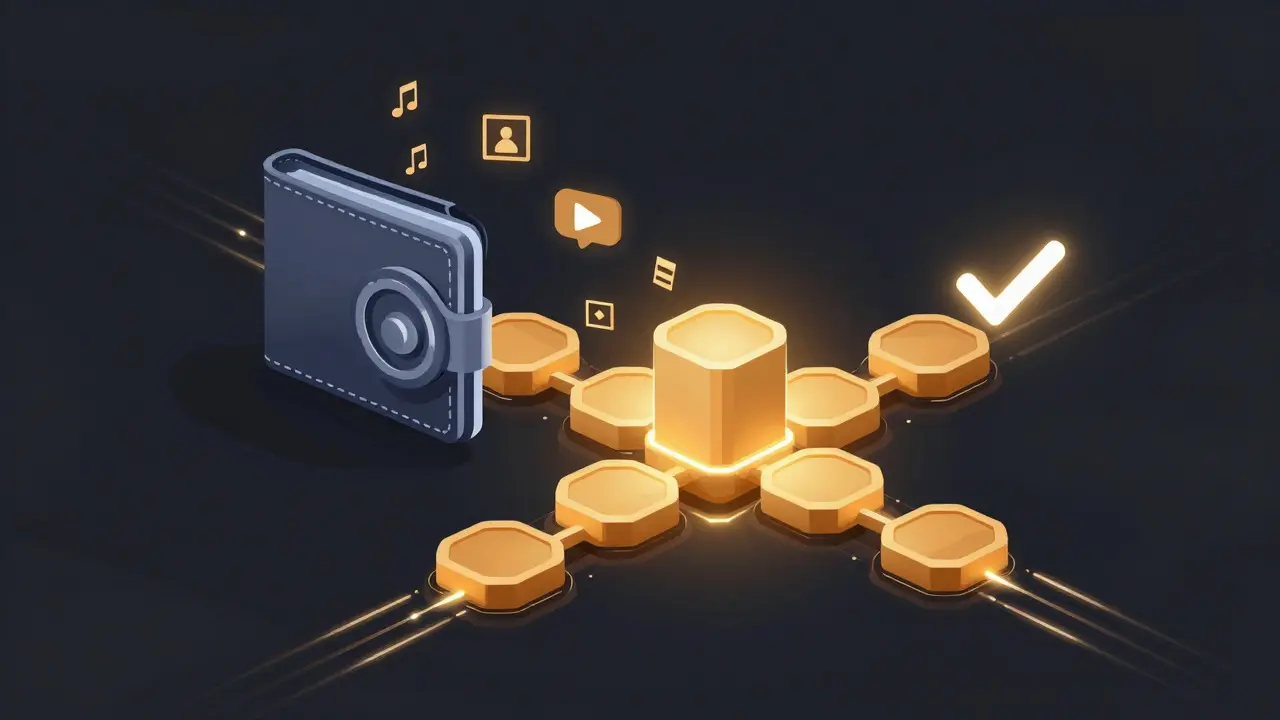
Creating an NFT is called "minting." It sounds industrial, but technically, it’s just writing data to a blockchain. Most NFTs run on Ethereum the leading smart contract platform supporting most high-value NFTs, which uses a standard called ERC-721. Think of ERC-721 as the universal format for these unique tokens. It ensures that every wallet, marketplace, and app knows how to read the token’s metadata (like the image link and name).
Here is the step-by-step reality of what happens when you mint:
- Prepare the Asset: You have a digital file (image, video, audio).
- Connect Wallet: You link a crypto wallet to a marketplace.
- Upload & Configure: You upload the file and set details like the number of copies (edition size) and royalty fees.
- Pay Gas Fees: You pay a transaction fee to the network miners/validators to write this new record permanently.
The "gas fee" is the part that confuses beginners. It’s the price of computing power on the network. On Ethereum, these fees fluctuate wildly based on demand. In early 2025, average fees were around $1.20 per transaction, but during peak times, they can spike over $50. This is why many creators now use alternative chains like Solana a high-speed blockchain with lower transaction costs than Ethereum or Polygon, where fees are fractions of a cent. However, Ethereum still holds the prestige for high-value art, simply because that’s where the major collectors are.
Getting Started: The Practical Setup
If you want to buy or create an NFT, you need two things: a wallet and some cryptocurrency. You don’t need to be a programmer, but you do need to be careful with security.
1. Set Up a Wallet The most common tool is MetaMask a popular browser extension wallet used to store crypto and interact with NFTs. It acts like a key to your digital house. During setup, you’ll get a 12-word seed phrase. Write this down on paper. Do not screenshot it. Do not save it in your cloud notes. If you lose these words, you lose access to everything forever. No customer support line will help you.
2. Buy Crypto You need ETH (or SOL, depending on the chain) to pay for gas fees and purchases. You can buy this on regulated exchanges like Coinbase or Kraken. Minimums are low, often starting at $10-$25.
3. Navigate the Marketplace OpenSea the largest NFT marketplace holding over 60% of market share is the go-to platform. It looks like eBay, but with more technical terms. Here’s a quick cheat sheet for the lingo you’ll see:
| Term | What It Actually Means |
|---|---|
| Floor Price | The lowest price currently listed for any item in a collection. This is the baseline cost to enter the club. |
| Bid | An offer to buy an item for less than its current listing price. Sellers can accept or reject it. |
| Royalty | A percentage (usually 2.5%-10%) paid back to the creator every time the NFT is resold. It keeps artists earning long-term. |
| Mint | The act of creating a new NFT on the blockchain. Sometimes "Minting Soon" means the project hasn't launched yet. |
The Real Value: Beyond Speculation
In 2021, NFTs were mostly about speculation-buying a monkey picture hoping it would go up. By 2026, the landscape has shifted toward utility. According to Token Metrics, 68% of new projects in 2025 incorporated real-world benefits. What does that look like? It looks like Nike .SWOOSH Nike's digital collectibles platform that generated $185 million in sales in 2024, where owning an NFT gives you access to exclusive sneaker drops. It looks like ticketing systems where the NFT *is* the ticket, eliminating scalping and fraud. It looks like copyright management, where 37% of entertainment companies are testing NFT-based rights tracking (PwC, 2025).
For creators, the math is changing too. An Adobe survey of 1,200 digital creators found that while 20% lost money after fees, 43% earned over $1,000 monthly. The difference? Community. Successful NFT projects aren't just selling images; they're selling membership. The Bored Ape Yacht Club didn't just sell monkeys; they sold a private club with events and perks. If you’re entering this space, ask yourself: "Is there a reason for people to hold this beyond price appreciation?" If the answer is no, you’re gambling, not investing.
Risks and Pitfalls to Avoid
Let’s be honest: the learning curve is steeper than most guides admit. One Reddit user reported losing $300 in failed transactions just trying to buy their first NFT because they didn't understand gas fees. Here are the biggest traps:
- Gas Fee Shock: Always check current gas prices before transacting. Use tools like Etherscan to see live costs. If fees are spiking, wait. Prices rarely move fast enough to punish you for waiting an hour.
- Scams and Rug Pulls: Many projects are fake. Check the contract address. Verify the official Twitter/X account. If a project promises guaranteed profits, it’s likely a scam. The SEC has noted that certain NFTs may even be considered securities if they promise future returns.
- Liquidity Illusion: Just because an NFT is listed for $10,000 doesn't mean you can sell it for $10,000. Floor prices can drop 90% in a week. Never buy an NFT you wouldn't keep if the price went to zero tomorrow.
Also, consider the environmental angle. While Ethereum moved to proof-of-stake (reducing energy use by 99%), the network still consumes electricity. For casual users, the impact is negligible, but it’s a factor for those with strong sustainability values.
Where Is This Going?
The hype cycle has settled into a practical phase. J.P. Morgan predicts NFTs will become standard for digital ownership verification within 5-7 years. We’re already seeing enterprise adoption, with 42% of Fortune 500 companies experimenting with NFTs for loyalty programs (Gartner, 2025). The technology is maturing. Ethereum’s recent upgrades have cut transaction costs by 65%, making it accessible for smaller projects. Platforms are introducing "gasless minting," where creators don't pay upfront, removing a huge barrier to entry.
For you, the beginner, the advice is simple. Don't chase the next viral meme coin. Look at the infrastructure. Understand how the wallet works. Try buying a small, low-risk item to learn the mechanics. The goal isn't to get rich quick; it's to understand the new layer of digital identity and ownership that is quietly becoming part of our daily lives, from gaming to music to physical product authentication.
Do I need to know how to code to buy an NFT?
No. Buying an NFT is similar to buying stock online. You just need a compatible wallet (like MetaMask) and some cryptocurrency. The complex coding happens behind the scenes via smart contracts. Your main job is managing your security keys and understanding the marketplace interface.
What is the difference between an NFT and a regular digital file?
A regular digital file (like a JPG) can be copied infinitely without loss of quality or value change. An NFT is a unique record on a blockchain that proves ownership of a specific version of that file. You don't own the file itself, but you own the verifiable right to claim that specific token, which creates scarcity and potential resale value.
Are NFTs only for art?
No. While art started the trend, NFTs are now used for gaming assets, virtual land, ticketing, domain names, and intellectual property rights. By 2025, 30% of NFT volume was related to gaming, and 15% to virtual land. The technology is a tool for proving unique ownership, applicable to any digital or even physical item.
How much does it cost to start with NFTs?
The minimum barrier is low. You can buy $10-$25 worth of cryptocurrency on major exchanges. However, you need extra funds for gas fees (transaction costs). On Ethereum, budget $5-$50 per transaction depending on network congestion. On cheaper chains like Solana, fees are under $1. Total initial investment for a beginner test drive could be as low as $50-$100.
Is it safe to keep my NFTs in a marketplace wallet?
It depends. Marketplaces like OpenSea often use connected wallets. For safety, many experts recommend using a dedicated hardware wallet (like Ledger or Trezor) for large collections, or at least keeping a separate software wallet just for NFTs so you don't mix them with your main savings. Always double-check contract addresses to avoid scams.
Author
Ronan Caverly
I'm a blockchain analyst and market strategist bridging crypto and equities. I research protocols, decode tokenomics, and track exchange flows to spot risk and opportunity. I invest privately and advise fintech teams on go-to-market and compliance-aware growth. I also publish weekly insights to help retail and funds navigate digital asset cycles.