

A Sybil attack isn’t some futuristic sci-fi threat-it’s happening right now on smaller blockchains. Imagine one person pretending to be 1,000 different users, all voting, validating transactions, and shaping the network’s decisions. That’s a Sybil attack. Named after the 1973 book Sybil about a woman with multiple personalities, this attack exploits a core weakness in peer-to-peer networks: the assumption that every node is independent and honest. In blockchain systems, where trust is supposed to be distributed, a single attacker controlling hundreds of fake identities can tilt the balance of power. And when they gain enough influence, they don’t just mess with votes-they can rewrite history.
How a Sybil Attack Works
In a normal peer-to-peer network, every node has equal say. New nodes join, check the ledger, and help validate transactions. But if you can create as many fake nodes as you want-using automated scripts, botnets, or cheap cloud servers-you can drown out real participants. The goal? To control more than half the network. That’s called a 51% attack. Once you have that, you can reverse transactions, stop others from mining, or double-spend cryptocurrency. It’s not theoretical. Ethereum Classic was hit in 2019. Attackers rerouted $6 million worth of ETC by controlling enough hash power to rewrite blocks.
What makes this scary is how easy it is on small networks. If a blockchain only has 500 active miners, you don’t need a fortune to buy up 250 of them. But on Bitcoin? It’s a different story. To control 51% of Bitcoin’s network today, you’d need over $20 billion in ASIC miners and consume electricity equivalent to a small country. Bitcoin’s network uses about 150 terawatt-hours per year-more than Argentina. The cost to mine a single block? Around $50,000 per miner in 2025 estimates. That’s not just expensive-it’s economically impossible for most attackers.
Why Some Blockchains Are Vulnerable
Not all blockchains are built the same. Networks that rely on node count for consensus-like some privacy coins or early DeFi chains-are sitting ducks. If your security model says, “The majority of nodes decide,” then an attacker who spawns 10,000 fake nodes wins. That’s why smaller, low-hash-rate chains get targeted. They lack the economic barriers that protect Bitcoin and Ethereum.
Take Ethereum Classic again. After its 2019 attack, the network never fully recovered trust. Why? Because there was no real cost to joining. Anyone could spin up a node with a $50 VPS. No staking. No mining hardware. No proof of effort. That’s the flaw: zero economic disincentive. In contrast, Bitcoin requires massive investment in hardware and power. Ethereum 2.0 requires you to lock up 32 ETH-roughly $102,400 at $3,200 per ETH-to become a validator. That’s not just a barrier-it’s a wall.
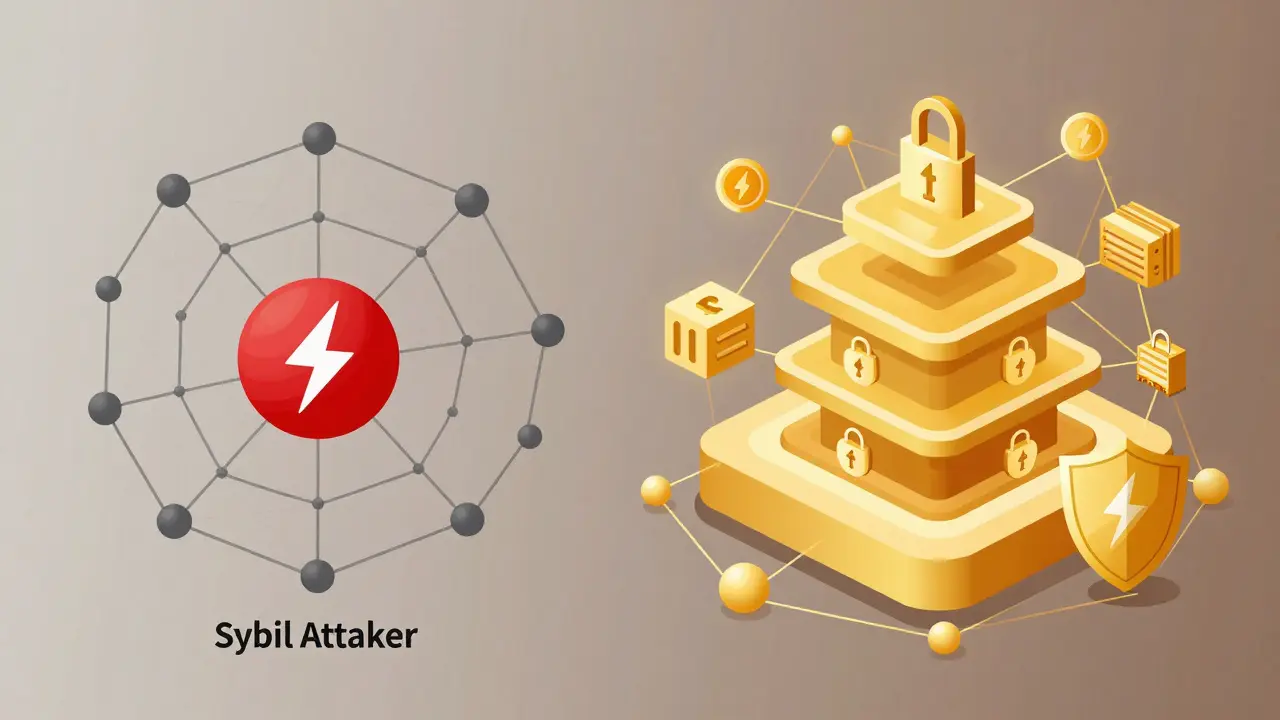
How Networks Defend Against Sybil Attacks
There are four main ways networks fight back, and the best ones use all of them together.
- Proof of Work (PoW): This is Bitcoin’s shield. To join the network as a valid node, you must solve hard cryptographic puzzles. Each fake node requires real computing power. The more nodes you fake, the more electricity and hardware you burn. It’s like trying to flood a dam with paper boats-it just doesn’t scale.
- Proof of Stake (PoS): Ethereum switched to this in 2022. Instead of buying hardware, you stake real cryptocurrency. If you try to cheat, you lose your stake. It’s not just about money-it’s about reputation. Why risk $100,000 to attack a network worth $300 billion? The math doesn’t work.
- Reputation Systems: Some networks track how long a node has been active. Older nodes get more trust. New ones? They’re watched. This helps, but it’s not perfect. Attackers can wait months to build reputation, then strike. And it raises privacy concerns: who’s tracking your node history?
- Social Trust Graphs: Tools like SybilGuard and SybilLimit analyze how nodes connect. Real users tend to have limited, organic connections. Fake nodes? They cluster together, talk only to each other, or link to known bad actors. By mapping these patterns, systems can flag suspicious behavior before it causes damage.
Some networks try identity verification-like asking for government ID or linking to social media. But that defeats the point of decentralization. If you need a passport to join a blockchain, are you really decentralized? That’s the trade-off: security vs. freedom.
The Real Cost of Failure
When a Sybil attack succeeds, it doesn’t just steal coins-it kills trust. Users leave. Developers abandon the project. Exchanges delist the token. That’s what happened to Ethereum Classic. Even after the attack was fixed, the damage lasted years. Investors lost confidence. Liquidity dried up.
And it’s getting worse. According to CipherTrace’s 2024 threat forecast, 37% of new blockchain projects will face a Sybil attack within their first year. Why? Because many founders focus on speed and features, not security. They think, “We’ll fix it later.” Later never comes.
DeFi is especially at risk. With billions locked in smart contracts, attackers don’t need to break into wallets-they just need to manipulate the consensus layer. A single Sybil-controlled node can lie about transaction order, trigger liquidations, or drain liquidity pools. The 2023 DeFi exploit report from Rejolut showed that 62% of vulnerabilities in new protocols came from weak consensus design, not code bugs.

What’s Being Done Now
Big players are adapting. Ethereum’s shift to PoS was the biggest move in blockchain security since Bitcoin’s launch. Microsoft Research released a new version of SybilLimit in 2023, improving how social graphs detect fake clusters. Lightspark’s 2023 security framework now recommends a layered approach: combine PoS, reputation tracking, and limited identity checks. No single solution works alone.
Even consumer tools are helping. Using authenticator apps like Google Authenticator or KeePass to secure wallet access reduces the chance of account compromise-something that could feed a Sybil network. If your private key gets stolen, an attacker can create a new node with your identity. That’s why password hygiene matters, even in decentralized systems.
The Future of Sybil Defense
Quantum computing gets all the hype, but it’s not the biggest threat. Quantum attacks on cryptography are still 10-15 years away, according to IBM’s 2023 roadmap. The real danger is complacency. Networks that ignore Sybil resistance will die. Gartner predicts that only blockchains using layered defenses-economic, social, and identity-based-will survive past 2027.
The winning formula? Make it expensive, traceable, and socially monitored. If an attacker has to spend millions in hardware, lock up six figures in crypto, and pass a trust network check-then they’ll give up and move on. That’s the goal: not to stop every attack, but to make it easier to walk away than to attack.
Bitcoin has never been successfully Sybil-attacked. Not once. Not in 15 years. Why? Because the cost is too high. Ethereum’s PoS system makes it just as hard. The lesson is simple: if you want security, build economic barriers. Don’t just count nodes. Make them matter.
What is a Sybil attack in blockchain?
A Sybil attack happens when a single attacker creates multiple fake identities (nodes) in a peer-to-peer network to gain control over consensus. In blockchain, this allows them to manipulate transaction validation, block ordering, or voting systems. The goal is often to achieve 51% control of the network to enable double-spending or censorship.
Can Bitcoin be Sybil-attacked?
No, Bitcoin has never been successfully Sybil-attacked. Its Proof of Work consensus requires massive computational power and electricity to create each valid node. Controlling 51% of Bitcoin’s network would cost over $20 billion in hardware and energy-far beyond what any attacker can realistically afford.
How does Proof of Stake prevent Sybil attacks?
Proof of Stake (PoS) prevents Sybil attacks by requiring validators to lock up real cryptocurrency-like 32 ETH-to participate. Creating fake nodes is useless unless you own the underlying asset. If you try to cheat, you lose your stake. This makes attacks economically irrational: why risk $100,000 to steal $10,000?
Why are small blockchains more vulnerable to Sybil attacks?
Small blockchains have lower hash rates or fewer validators, meaning attackers need less computing power or capital to gain majority control. Ethereum Classic’s 2019 attack succeeded because it had minimal economic barriers-attackers could spin up nodes cheaply and overwhelm the network with fake identities.
Do reputation systems fully protect against Sybil attacks?
No. Reputation systems help by giving more trust to long-standing nodes, but attackers can wait months to build fake reputations before striking. They also risk centralization, since tracking node history requires monitoring who’s been online-something that contradicts blockchain’s privacy ideals.
What’s the best way to defend against Sybil attacks?
The best defense combines economic barriers (like PoW or PoS), social trust analysis (tools like SybilLimit), and limited identity checks. No single method works alone. Layering them makes attacks too expensive, too detectable, and too risky to attempt.


Author
Ronan Caverly
I'm a blockchain analyst and market strategist bridging crypto and equities. I research protocols, decode tokenomics, and track exchange flows to spot risk and opportunity. I invest privately and advise fintech teams on go-to-market and compliance-aware growth. I also publish weekly insights to help retail and funds navigate digital asset cycles.