
Imagine you send an email to your bank saying, "Please transfer $1,000 to Alice." Anyone who intercepts that email could change the amount to $10,000 or swap Alice for Bob. In the physical world, you’d sign a check with ink and paper. But in crypto, there is no ink. So, how does Bitcoin know it’s really you sending money, and not a hacker pretending to be you? The answer lies in digital signatures. These aren't just fancy stamps; they are mathematical proofs that verify two things: you own the funds, and nobody messed with the transaction details after you signed them.
If you’ve ever wondered why you can’t just copy someone else’s wallet address and spend their coins, this guide breaks down exactly what’s happening under the hood. We’ll skip the heavy academic jargon and look at how asymmetric cryptography keeps billions of dollars safe every day.
The Core Concept: Two Keys, One Truth
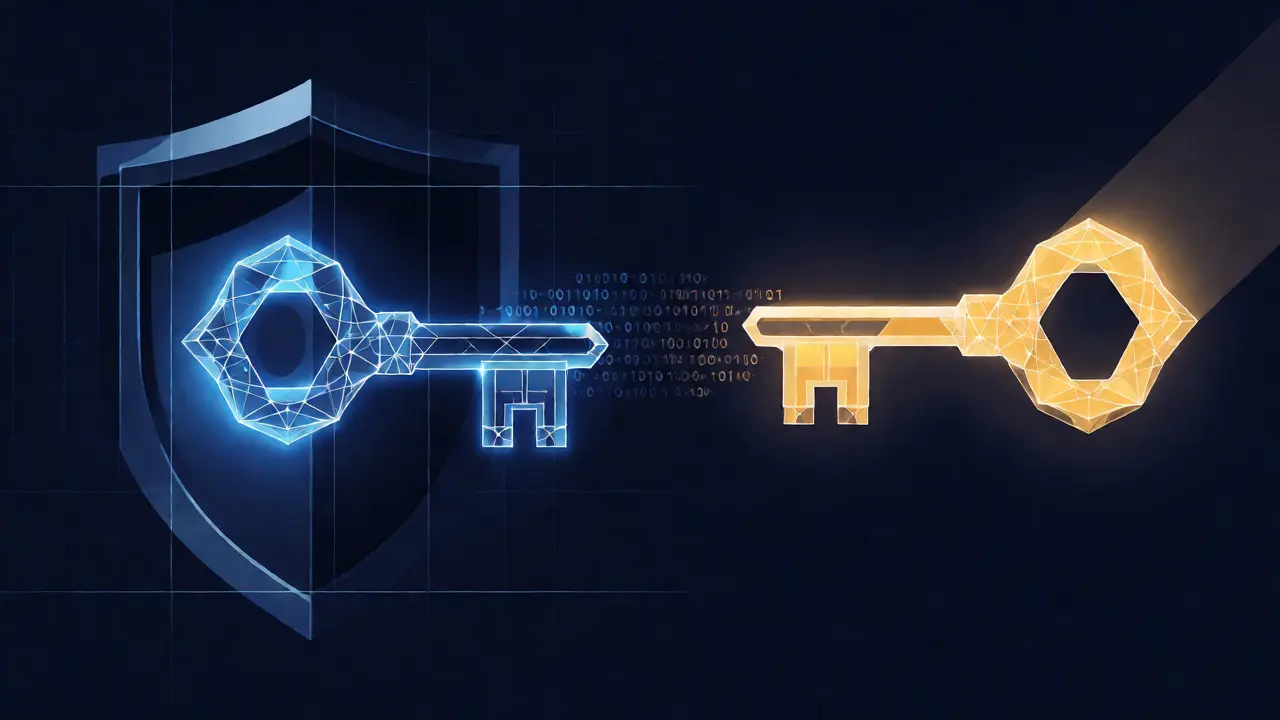
To understand digital signatures, you first need to grasp the idea of asymmetric cryptography, also known as public-key cryptography. Unlike traditional locks where one key opens one lock, here we have a pair of mathematically linked keys: a private key and a public key.
Think of your public key like your email address. You can share it with anyone, anywhere. It’s open to the world. Your private key, however, is like your password. It must stay secret. If you lose it, you’re locked out forever. If someone steals it, they can act as you.
Here is the magic trick: When you create a digital signature, you use your private key to encrypt a specific piece of data (the transaction). This creates a unique code. Because of the mathematical link between the keys, only your corresponding public key can decrypt or verify that code. Crucially, verifying the signature doesn’t reveal your private key. It just proves that the person who made the signature had access to the private key.
| Feature | Private Key | Public Key |
|---|---|---|
| Visibility | Secret (Never shared) | Open (Shared with network) |
| Primary Function | Creates digital signatures | Verifies digital signatures |
| Derivation | Generated randomly | Derived from Private Key |
| Risk if Lost/Stolen | Total loss of funds | No direct risk (can be regenerated) |
How a Transaction Actually Gets Signed
You might think signing a transaction means writing your name on it. In crypto, it’s much more precise. Let’s walk through what happens when you send 0.5 BTC to a friend.
- The Data Hash: First, your wallet takes all the transaction details-sender, receiver, amount-and runs them through a hash function (like SHA-256). This turns the data into a fixed-length string of characters, called a hash. Think of this as a fingerprint of the transaction. If even one decimal point changes, the fingerprint changes completely.
- The Signing Process: Your wallet combines this hash with your private key using a cryptographic algorithm (usually ECDSA, or Elliptic Curve Digital Signature Algorithm, in Bitcoin). This produces the digital signature.
- Broadcasting: Your wallet sends the original transaction data, the digital signature, and your public key to the Bitcoin network.
- Verification: Miners and nodes on the network take the transaction data, hash it again to get the fingerprint, and then use your public key and the digital signature to check if they match. If they do, the transaction is valid. If not, it’s rejected.
This process ensures integrity. Because the signature is tied to the specific hash of the data, any attempt to alter the amount or recipient after signing will break the verification link.
Why You Can’t Fake It: Security Properties
Digital signatures provide three critical guarantees that make trustless systems possible. Without these, crypto would just be a messy database anyone could edit.
- Authentication: The signature proves identity. Since only you have the private key, only you could have generated that specific signature. It’s like a wax seal that only your stamp could make.
- Integrity: The signature proves the data hasn’t changed. As mentioned earlier, the signature is bound to the hash. If a hacker tries to change "Send 1 BTC" to "Send 100 BTC," the hash changes, and the signature no longer matches. The network instantly rejects it.
- Non-Repudiation: You can’t deny it later. Once a transaction is confirmed on the blockchain, the mathematical proof stands forever. You can’t claim, "I didn’t send that," because the math shows your private key authorized it.
This last point is vital for legal and audit purposes. While crypto offers privacy, it doesn’t offer anonymity in terms of accountability. Every action is permanently recorded and attributable to a specific public key.

The Math Behind the Magic (Simplified)
You don’t need a PhD to get this, but understanding the basics helps. Most cryptocurrencies use elliptic curve cryptography. Imagine a complex geometric shape defined by an equation. Points on this curve have special properties.
Your private key is essentially a random number. Your public key is a point on that curve, derived by multiplying the private key by a base point. The beauty of elliptic curves is that while it’s easy to calculate the public key from the private key, it’s computationally impossible to reverse the process. You can’t look at the public key and figure out the private key. This asymmetry is what secures billions in value.
In Bitcoin, the standard used is secp256k1. This specific curve was chosen because it offers high security with relatively small key sizes, keeping the blockchain efficient. Ethereum uses a similar approach with its own curve parameters. Other chains like Solana or Cardano may use different algorithms (like EdDSA), but the core principle remains: sign with private, verify with public.
Common Pitfalls and Real-World Risks
The math is solid, but humans are often the weak link. Here is where things go wrong in practice.
Key Management: The system assumes your private key stays secret. If you store your keys on a website that gets hacked, or write them on a sticky note that falls behind the couch, you’re vulnerable. Unlike a bank password, you can’t call support to reset your private key. If it’s gone, your funds are gone.
Replay Attacks: Sometimes, a forked blockchain (like Bitcoin Cash splitting from Bitcoin) might accept old signatures. If you sent a transaction on Bitcoin, it might accidentally work on Bitcoin Cash too, unless protections are in place. Modern wallets usually handle this by adding chain IDs to the signature data.
Quantum Computing Threats: Right now, breaking a 256-bit private key would take supercomputers millions of years. However, future quantum computers could theoretically solve the discrete logarithm problem faster. This isn’t an immediate crisis, but developers are already researching post-quantum cryptography to update signature schemes in the coming decades.
Digital Signatures vs. Traditional Signatures
It’s worth comparing crypto signatures to handwritten ones to see why the former is superior for global finance.
| Aspect | Handwritten Signature | Crypto Digital Signature |
|---|---|---|
| Uniqueness | Same for every document | Unique for every transaction |
| Forgery Risk | High (easy to copy visually) | Negligible (mathematically secure) |
| Portability | Physical presence required | Works globally via internet |
| Verification | Manual comparison by expert | Instant automated check by nodes |
Notice that uniqueness is a huge advantage. If I forge your handwritten signature on a contract, it looks the same as your real signature. But in crypto, if I try to reuse your signature on a different transaction, it fails immediately. The signature is baked into the specific data of that transaction.
Frequently Asked Questions
Can my public key reveal my private key?
No. Due to the nature of asymmetric cryptography, specifically the difficulty of the discrete logarithm problem, deriving the private key from the public key is computationally infeasible with current technology. You can share your public key freely without compromising security.
What happens if I lose my private key?
You lose access to your funds. Since the private key is the only way to generate valid digital signatures for that address, no one else can authorize transactions from it. There is no central authority to recover it for you.
Are digital signatures legally binding?
In many jurisdictions, including the US and EU, electronic signatures (which include cryptographic digital signatures) are recognized as legally binding equivalents to handwritten signatures, provided certain criteria regarding intent and record retention are met. However, specific laws vary by country.
Do all cryptocurrencies use the same digital signature algorithm?
No. Bitcoin primarily uses ECDSA (Elliptic Curve Digital Signature Algorithm) over the secp256k1 curve. Ethereum also uses ECDSA but has moved toward Schnorr signatures for better efficiency. Other blockchains like Solana use EdDSA (Edwards-curve Digital Signature Algorithm). The underlying concept remains the same, but the math differs.
Can a hacker change the amount in my transaction after I sign it?
They can try, but the network will reject it. The digital signature is calculated based on the exact data of the transaction. If a hacker changes the amount, the hash of the data changes, and the existing signature no longer validates against the new data. The transaction becomes invalid.
Author
Ronan Caverly
I'm a blockchain analyst and market strategist bridging crypto and equities. I research protocols, decode tokenomics, and track exchange flows to spot risk and opportunity. I invest privately and advise fintech teams on go-to-market and compliance-aware growth. I also publish weekly insights to help retail and funds navigate digital asset cycles.