

You hold a digital coin. You send it to me. But what stops you from sending that same exact coin to someone else at the same time? In the physical world, this is impossible-you can't hand over the same $20 bill twice. In the digital realm, however, copying data is trivial. This is the double-spending, defined as the act of spending the same digital currency units more than once. It is the fundamental flaw that almost killed digital cash before blockchain existed.
For decades, we solved this problem by trusting banks. They kept a central ledger. If I had $100, they subtracted it when I paid you, so I couldn't pay you again. But blockchain promised something radical: trust without a middleman. Now, in 2026, we are past the early hype cycles. We know that simple solutions like Bitcoin's original design have limits. The question isn't just "how do we stop double-spending?" It's "how do we stop it faster, cheaper, and more securely than ever before?"
The Evolution of Trust: From Work to Stake
To understand where we are going, you have to look at how we got here. The first major solution was Proof-of-Work (PoW), pioneered by Bitcoin. Imagine a massive global lottery. Miners use powerful computers to solve complex math puzzles. The first one to solve it gets to add a block of transactions to the ledger. Why does this prevent double-spending? Because changing a past transaction means redoing all the work for that block and every block after it. To cheat, an attacker would need more computing power than the rest of the network combined-a scenario known as a 51% attack. It’s expensive, energy-intensive, but incredibly secure.
Then came Proof-of-Stake (PoS), popularized by Ethereum after its transition in 2022. Instead of burning electricity to solve puzzles, validators lock up their own cryptocurrency as collateral. If they try to validate a fraudulent transaction or attempt a double-spend, the protocol slashes their stake-they lose their money. It’s an economic disincentive rather than a computational barrier. It’s faster and greener, but it introduces new risks, like the "nothing at stake" problem, where validators might support multiple chains if it benefits them financially.
The Hybrid Consensus Revolution
So, which is better? PoW or PoS? The future answer, according to recent academic analyses from 2024 and ongoing development in 2026, is: both. The leading edge of double-spending prevention is moving toward Hybrid Consensus Mechanisms.
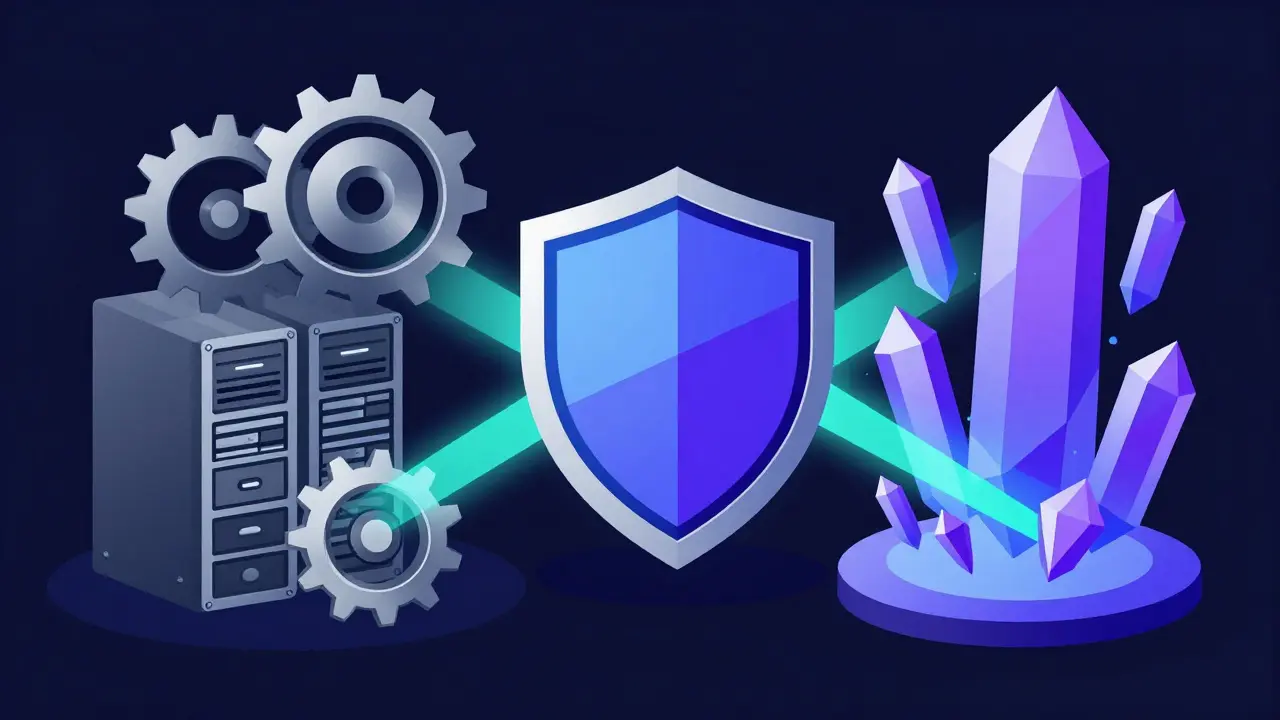
These systems don't pick a side. They combine the immutability of PoW with the efficiency of PoS. Here is how it typically works in next-generation architectures:
- Initial Security Layer: The network uses decentralized PoW computing power to establish the initial chain. This ensures that no single entity controls the genesis blocks and provides a high bar for early-stage attacks.
- Transition to Efficiency: Once the chain is established and secure, the system transitions to a PoS model for day-to-day transaction validation. Validators lock tokens to propose blocks, drastically reducing energy consumption.
- Continuous Auditing: Some hybrid models keep a lightweight PoW layer running in the background. This acts as an immutable audit trail. If a PoS validator tries to manipulate history, the PoW layer serves as the ultimate truth anchor, making double-spending economically unviable because the attacker would need to break both systems simultaneously.
This approach addresses the biggest weakness of pure PoS: centralization. In PoS, those with the most coins have the most power. By retaining elements of PoW or using delegated structures, hybrid models distribute power more evenly, making it harder for a wealthy few to collude and double-spend.
Instant Finality and Zero-Knowledge Proofs
Another frontier in preventing double-spending is speed. In traditional blockchains, you wait for confirmations. One confirmation is risky. Six is safer. Twelve is nearly certain. This delay creates a window where double-spending is theoretically possible. Future solutions aim for Instant Transaction Finality.
How? Through advanced cryptographic techniques like Zero-Knowledge Proofs (ZKPs). ZKPs allow a user to prove they have the funds to spend without revealing their entire transaction history or requiring the whole network to verify every step in real-time. When combined with optimistic rollups or validity proofs, the network can accept a transaction as final the moment it is submitted, provided the mathematical proof holds. If a double-spend is attempted later, the invalid proof is rejected instantly, and the fraudster is penalized. This removes the "waiting period" anxiety entirely.
Delegated Proof-of-Stake and Dynamic Penalties
We also see the rise of refined Delegated Proof-of-Stake (DPoS). In DPoS, token holders vote for a small number of "supernodes" or witnesses to validate transactions. This sounds centralized, but the key innovation lies in governance and monitoring.
Future DPoS implementations feature real-time node behavior monitoring. If a supernode attempts to include a double-spent transaction, other nodes detect the discrepancy immediately. The system then triggers dynamic penalty mechanisms. Unlike static slashing in basic PoS, these penalties are proportional and immediate. The malicious node is ejected from the network, and its collateral is redistributed to honest validators. This creates a highly responsive immune system against double-spending attacks.
| Mechanism | Security Basis | Speed/Finality | Energy Use | Primary Risk |
|---|---|---|---|---|
| Proof-of-Work (PoW) | Computational Power | Slow (Minutes to Hours) | Very High | 51% Attack via Hardware |
| Proof-of-Stake (PoS) | Economic Collateral | Fast (Seconds) | Low | Wealth Centralization |
| Hybrid Consensus | Combined PoW + PoS | Medium-Fast | Moderate | Complex Implementation |
| ZK-Rollups | Cryptographic Proofs | Instant | Very Low | Proof Generation Cost |

Practical Implications for Users in 2026
What does this mean for you? If you are using a modern blockchain platform today, you likely benefit from some of these hybrid or advanced features without realizing it. However, understanding the underlying mechanism helps you make better decisions about risk.
When sending high-value transactions, always check the finality guarantees of the network. A network claiming "instant finality" via ZK-proofs is fundamentally different from one relying on six PoW confirmations. The former offers certainty through mathematics; the latter offers probability through economics. Both are secure, but they operate on different principles.
Also, be wary of newer, lesser-known chains that promise extreme speed without clear consensus explanations. If a network doesn't clearly state how it prevents double-spending-whether through staking, voting, or computational work-it may be vulnerable to subtle forms of manipulation. Look for transparency in their whitepapers regarding consensus algorithms and penalty structures.
The Role of Governance in Security
Technology alone isn't enough. The future of double-spending prevention is deeply tied to On-Chain Governance. As networks evolve, the rules for what constitutes a valid transaction must be updated. In decentralized systems, this happens through community voting. Robust governance ensures that changes to the consensus mechanism are agreed upon by the majority, preventing malicious actors from altering the rules to facilitate double-spending.
Projects with active, transparent governance forums are generally safer bets. They have built-in checks and balances. If a vulnerability is discovered, the community can coordinate a response quickly. In contrast, closed or poorly governed projects may struggle to patch holes in their double-spending defenses, leaving users exposed.
Can double-spending still happen on Bitcoin?
Technically, yes, but it is extremely difficult and expensive. An attacker would need to control more than 51% of the network's hashing power to rewrite the blockchain and reverse transactions. For Bitcoin, this would require billions of dollars in hardware and electricity costs, making it economically irrational for any rational actor. For most users, waiting for six confirmations makes the risk negligible.
Why are hybrid consensus models considered the future?
Hybrid models combine the best aspects of Proof-of-Work and Proof-of-Stake. They offer the high security and decentralization of PoW during the initial stages or as a backup layer, while utilizing the speed and energy efficiency of PoS for daily operations. This balance reduces the risk of centralization seen in pure PoS and the environmental concerns of pure PoW.
What is instant finality in blockchain?
Instant finality means a transaction is confirmed and irreversible the moment it is processed, without needing to wait for multiple block confirmations. This is often achieved through advanced cryptographic methods like Zero-Knowledge Proofs or specific consensus designs that guarantee agreement among validators immediately, eliminating the window of opportunity for double-spending attacks.
How does Proof-of-Stake prevent double-spending?
In Proof-of-Stake, validators must lock up a significant amount of cryptocurrency as collateral. If they attempt to validate a fraudulent transaction or engage in double-spending, the protocol automatically detects the irregularity and "slashes" or confiscates their staked assets. This economic penalty makes attacking the network far more costly than any potential gain.
Is Delegated Proof-of-Stake (DPoS) less secure?
Not necessarily, but it relies heavily on good governance. DPoS elects a smaller number of validators (supernodes), which can lead to centralization if not managed well. However, modern DPoS systems include robust monitoring and dynamic penalty mechanisms. If a supernode behaves maliciously, it can be voted out and penalized quickly, maintaining security through accountability rather than raw computational power.
Author
Ronan Caverly
I'm a blockchain analyst and market strategist bridging crypto and equities. I research protocols, decode tokenomics, and track exchange flows to spot risk and opportunity. I invest privately and advise fintech teams on go-to-market and compliance-aware growth. I also publish weekly insights to help retail and funds navigate digital asset cycles.