
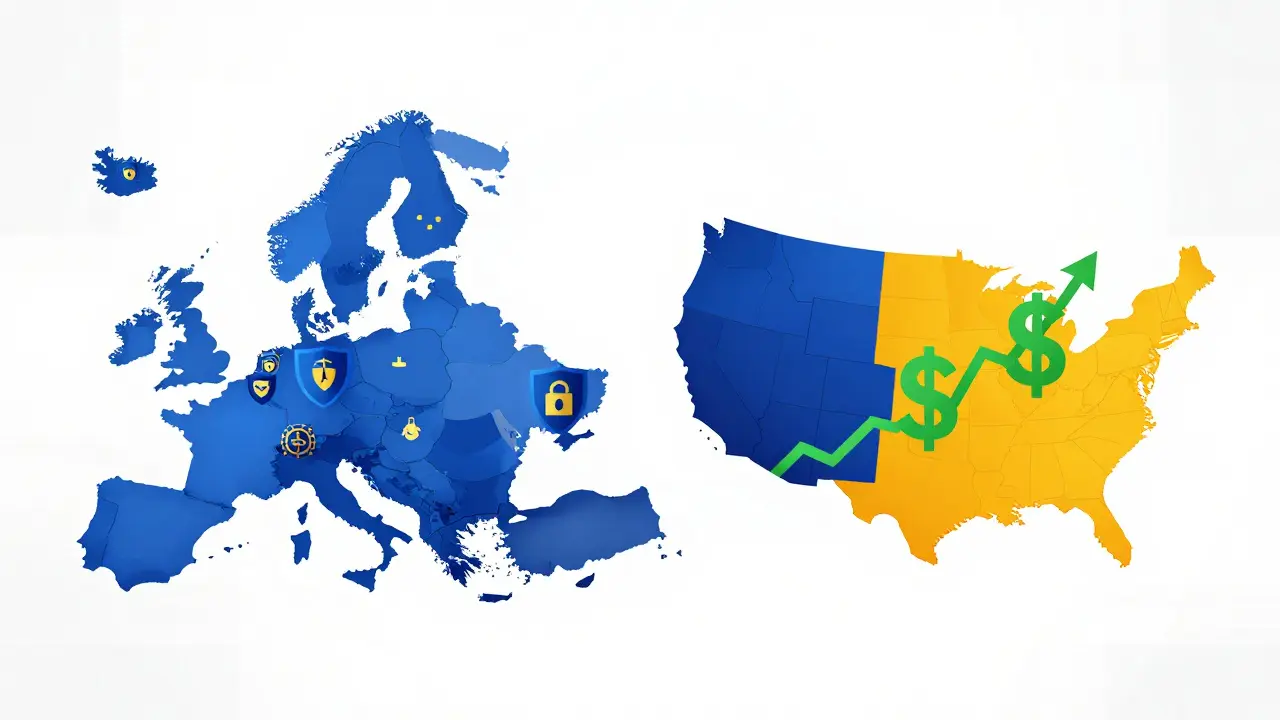
The rules for stablecoins are no longer vague suggestions. They are hard laws that dictate who can issue tokens, what backs them, and where they can be traded. If you hold or use stablecoins, two massive regulatory frameworks are currently defining your reality: the European Union’s Markets in Crypto-Assets Regulation (MiCA), which is fully active, and the emerging US Federal Stablecoin Framework (often misidentified as the 'GENIUS Act' in early drafts), which is rapidly moving toward enactment.
As of late 2025 and heading into 2026, these two systems represent a fork in the road for global finance. One prioritizes consumer protection and strict reserve transparency at the cost of innovation speed. The other leans heavily on strengthening the US dollar’s dominance by tying stablecoin reserves directly to government debt. Understanding the difference isn't just academic-it determines which tokens you can buy, how safe your money is, and whether your favorite exchange will still support your preferred asset next year.
MiCA: The EU's Strict "Safe Harbor" Approach
MiCA is a comprehensive regulatory framework for crypto-assets in the European Union. It entered into force in June 2023, with specific stablecoin rules kicking in on June 30, 2024. By December 2024, all remaining requirements for service providers were enforced. This wasn't a soft launch; it was a mandate.
The core philosophy behind MiCA is simple: if it looks like a bank deposit, it must act like one. The regulation splits stablecoins into two distinct buckets:
- E-money Tokens (EMTs): These peg to a single official currency, like the Euro. Issuers must be authorized credit institutions or electronic money institutions. They need minimum capital of EUR 350,000 and must allow redemption at par value at any moment.
- Asset-Referenced Tokens (ARTs): These track a basket of currencies or assets. Issuers must be EU-based legal entities. They face stricter governance rules and must maintain liquid reserves at a 1:1 ratio.
Here is the kicker that changed the market overnight: MiCA explicitly bans algorithmic stablecoins. Because protocols like TerraUSD (UST) relied on code rather than tangible assets to maintain their peg, they were deemed too risky. As confirmed by LegalNodes in January 2025, any stablecoin lacking "explicit reserves tied to any traditional type of asset" is illegal under MiCA. This effectively wiped out an entire category of products from the European market.
For users, this means higher safety but less choice. According to Circle’s April 2025 analysis, only USDC and EURC among the top ten stablecoins were fully MiCA-compliant in Q2 2025. Non-compliant tokens faced delisting. Binance, for example, had to notify 1.2 million users about restrictions on non-compliant stablecoins within a 10-day window in January 2025.
The US Framework: Dollar Dominance via Treasuries
While Europe built a wall around its financial system, the United States took a different path. The emerging federal framework-culminating from efforts starting with President Biden’s 2022 Executive Order and various legislative proposals like the 'Clarity for Payment Stablecoins Act'-focuses on one primary goal: expanding the utility of the US dollar.
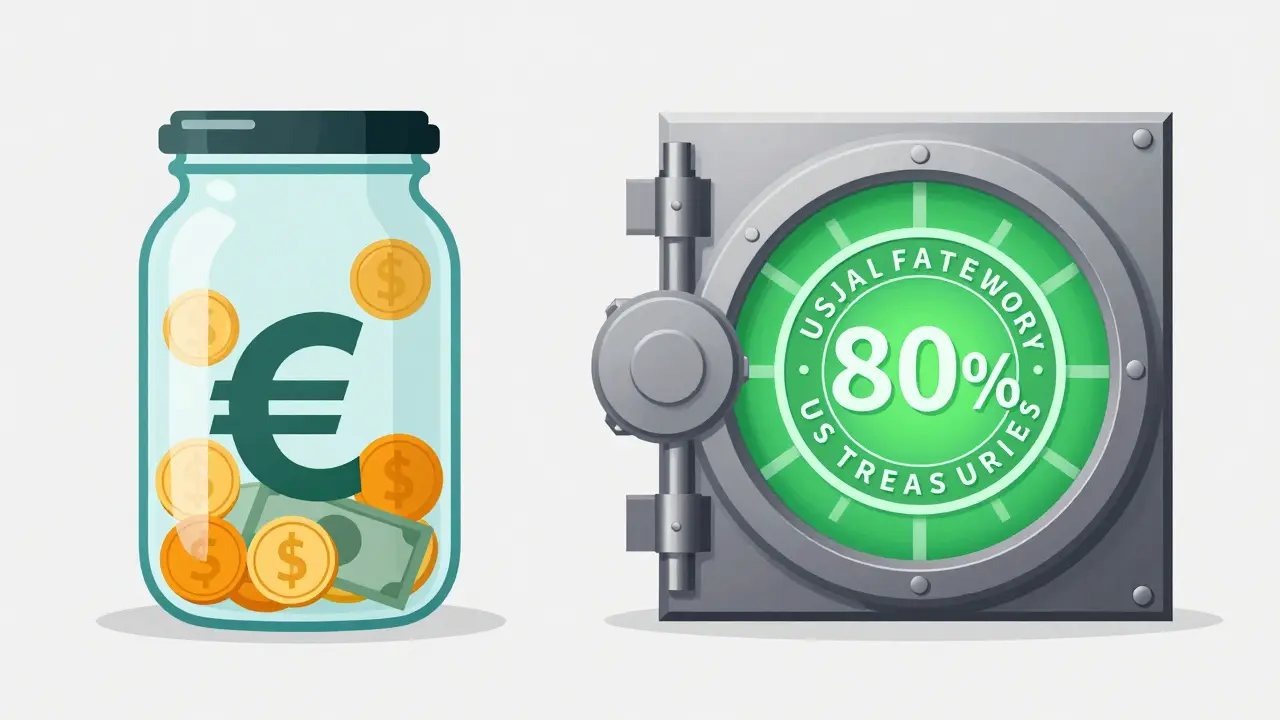
Unlike MiCA’s broad ban on certain mechanisms, the US framework focuses heavily on reserve composition. The prevailing requirement, as noted by Circle CEO Jeremy Allaire in March 2023 testimony and reinforced in mid-2025 developments, mandates that at least 80% of stablecoin reserves be held in US Treasuries or central bank reserves.
This creates a unique economic loop. Stablecoin issuers buy US debt to back their tokens. This increases demand for Treasuries, which helps keep borrowing costs lower for the US government. In return, the US dollar gets a digital boost globally. As of May 2025, the six largest US-issued stablecoins held $187.4 billion in US Treasuries, up from just $28.6 billion in early 2023.
Crucially, the US approach does not ban algorithmic models outright. If an algorithmic stablecoin can meet the strict reserve requirements (holding enough high-quality liquid assets), it can operate. However, the practical barrier to entry is high. The Office of the Comptroller of the Currency noted in January 2025 that achieving the necessary infrastructure to access Fed Treasury repo facilities cost issuers an average of $1.9 million.
Key Differences: Safety vs. Scale
To understand how these regulations affect you, we need to look at the mechanics side-by-side. The differences aren't subtle; they represent two opposing views on risk and growth.
| Feature | EU MiCA | US Federal Framework |
|---|---|---|
| Status (Mid-2025) | Fully Enforced | Pending Final Enactment / Operationalizing |
| Algorithmic Stablecoins | Banned | Permitted (if reserve-backed) |
| Reserve Requirements | 100% Liquid Assets (Cash, short-term debt AA-+) | Min. 80% US Treasuries/Central Bank Reserves |
| Issuer Location | Must be EU-based for ARTs | Federal Charter required (OCC) |
| Primary Goal | Consumer Protection & Financial Stability | Dollar Dominance & Market Growth |
| Systemic Risk Thresholds | Yes (>1M daily txns triggers enhanced oversight) | No equivalent explicit thresholds yet |
The most striking difference is the treatment of risk. MiCA sets clear "significant token" criteria. If a stablecoin exceeds 1 million daily transactions or serves 1% of the EU population, it faces enhanced liquidity requirements (up to 120% backing). The US framework lacks these explicit systemic risk triggers, relying instead on the sheer quality of the underlying assets (Treasuries) to mitigate danger.
Market Impact: Who Won and Who Lost?
Regulations don't exist in a vacuum; they reshape markets. Since MiCA’s implementation, the European stablecoin landscape has contracted but stabilized. The ECB reported a 37% drop in the EU stablecoin market size between June 2024 and June 2025, falling from $58.3 billion to $36.7 billion. Why? Because non-compliant tokens were phased out.
However, the remaining market is incredibly robust. MiCA-compliant stablecoins saw a 99.98% redemption reliability rate during stress tests, according to the European Banking Authority. Users felt safer. A Reddit survey of r/EUcrypto users showed 68% appreciated the increased confidence in redemptions, even though 72% complained about having fewer options.
In contrast, the US market exploded. Despite regulatory uncertainty until mid-2025, the US stablecoin market grew by 32.7% during the same period, reaching $192.7 billion. USDT maintained a 58.4% market share. The promise of a clear federal framework attracted capital, with JPMorgan projecting the US market could hit $315.4 billion by 2027.
But there is a catch. The US model concentrates risk. By forcing 80% of reserves into Treasuries, the entire stablecoin sector becomes highly sensitive to interest rate shocks. The US Treasury’s Office of Financial Research warned in June 2025 that this concentration creates new vulnerabilities. Meanwhile, MiCA’s diversity of allowed assets (cash, high-grade debt) spreads risk more evenly but limits yield potential for issuers.

What This Means for You
If you are a retail user in Europe, your choices are narrower but safer. You will likely trade exclusively in EMTs like EURC or major ARTs like USDC. Expect exchanges to delist anything that doesn’t fit the mold. The days of high-yield algorithmic staking rewards are over in the EU.
If you are in the US or trading on US-centric platforms, you have more variety, but you need to watch the news closely. The shift toward Treasury-backed reserves means that stablecoin performance is now tightly linked to US bond yields. If rates spike, the cost for issuers goes up, which could squeeze margins or change fee structures.
For businesses, cross-border payments are changing. EU companies are increasingly using MiCA-compliant tokens for B2B transactions, accounting for 47% of compliant volume. The European Payments Initiative processed €4.2 billion in Q1 2025 using MiCA-compliant EURC with zero failures. This suggests that regulated stablecoins are becoming viable alternatives to traditional SWIFT transfers for European firms.
Future Outlook: Convergence or Conflict?
By 2026, the question is no longer "will regulations happen" but "how will they interact." The International Organization of Securities Commissions proposed global standards in June 2025 that blend elements of both frameworks. There is pressure for harmonization, particularly regarding reserve requirements.
However, tensions remain. The European Commission stated in April 2025 that no equivalence determination exists for US stablecoins, meaning US tokens might face hurdles entering the EU unless they adapt to MiCA rules. Conversely, the US Treasury asserted that US-issued stablecoins meeting federal requirements should be recognized internationally.
Expect to see more "regulatory arbitrage" in the short term, where issuers set up subsidiaries in Dublin (like Paxos did in September 2024) to serve Europe while maintaining US operations. For the average user, this complexity will be hidden behind exchange interfaces, but the underlying stability of your assets depends entirely on which jurisdiction’s rules apply to the issuer holding your funds.
Is the GENIUS Act real?
The term "GENIUS Act" appears to be a confusion or early draft name. Authoritative sources, including the European Central Bank and US Treasury documents from 2025, refer to the emerging legislation as the "US Federal Stablecoin Framework" or reference specific bills like the "Clarity for Payment Stablecoins Act." There is no officially enacted law named the GENIUS Act as of mid-2025.
Can I still use algorithmic stablecoins in Europe?
No. MiCA explicitly bans algorithmic stablecoins that do not have explicit reserves tied to traditional assets. Any such token offered to EU consumers is non-compliant and subject to delisting by exchanges operating within the EU.
Which stablecoins are MiCA compliant?
As of Q2 2025, the primary MiCA-compliant stablecoins include USDC (issued by Circle) and EURC. Other tokens must undergo rigorous authorization processes to become EMTs or ARTs. Always check the issuer's whitepaper and regulatory status before buying.
How does the US framework affect US Treasuries?
The US framework requires stablecoin issuers to hold at least 80% of reserves in US Treasuries. This creates significant demand for US government debt, helping to stabilize borrowing costs for the US government while tying the stability of digital dollars directly to the health of the Treasury market.
Will MiCA reduce my stablecoin options?
Yes. User surveys indicate that 72% of EU users noticed reduced stablecoin options after MiCA implementation. However, this came with a trade-off: higher confidence in redemption reliability and protection against rug pulls associated with unbacked algorithmic tokens.
Author
Ronan Caverly
I'm a blockchain analyst and market strategist bridging crypto and equities. I research protocols, decode tokenomics, and track exchange flows to spot risk and opportunity. I invest privately and advise fintech teams on go-to-market and compliance-aware growth. I also publish weekly insights to help retail and funds navigate digital asset cycles.